

One Of The Internet's Most Important Websites Works Out Of A Former Church
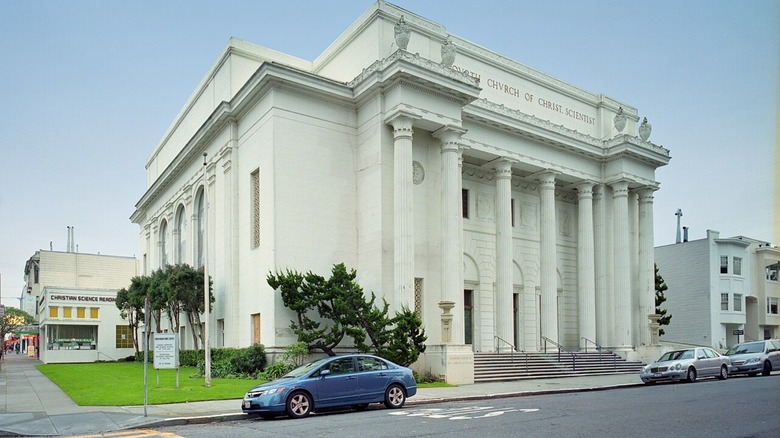
Though we sometimes imagine websites as floating around in the ether, we typically picture their physical forms as banks of servers. Meanwhile, the Internet Archive, one of the most regularly visited websites in the world, actually resides in a stunning building in San Francisco that used to be a church.
"I think the role here is to be a record of what happened," Internet Archive found Brewster Khale told The San Francisco Standard, "so that people can't rewrite history [...] and [...] to build on the best that other people have ever done." CNN shares Kahle's retelling of the story of the library of Alexandria, a vast collection of much of the sum of human knowledge at its time. It was not a single library but two separate sites, both of which are believed to have been ultimately destroyed at different (frequently disputed) points in history. It was a tragic loss of what essentially amounted to much of the sum of written human knowledge at the time, and this is exactly what Kahle and his team are trying to prevent happening again at that former Christian Science church in the City By The Bay.
Let's take a closer look at the site itself and the means through which it is slowly and steadily preserving the Internet's content for the browsers of the future. Archiving content is a valuable function in Gmail and far beyond, and this is perhaps the largest-scale utilization of that concept.
The continued battle for preservation of the Internet
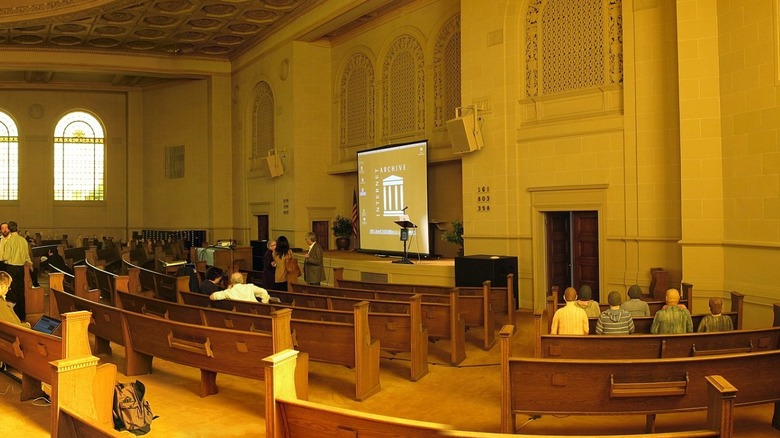
The building is found at 300 Funston Street, San Francisco. It's a former Christian Science Church that had been in service for around 86 years when it was bought by the Internet Archive in 2009. It may no longer be a church, but this doesn't mean its pews are empty. The founder also explains to The San Francisco Standard that when a staff member has worked with them for three years, they're awarded with a small sculpture of themselves sitting in the pews. "It's a way of [...] recognizing the people that are spending their lives doing a public service," Khale told the outlet. As the founder goes on to boast, it's difficult to get any closer to the famed library of Alexandria than this in the modern world. The medium might have changed a great deal, but the idea of gathering the sum of human knowledge is very much the same. The process of doing it, though, would have been unimaginable to the builders of Alexandria's library.
Relatively few of the websites in existence are actively visited or maintained, and this complicates the process of preserving important ones. Everything from academic research papers to old newspaper clippings can be rediscovered via the Wayback Machine, and it's here that this happens.
Kahle explains that the Internet Archive kept the church largely as it was, with the magnificent pews still intact and in place. Still, it has carefully placed a wealth of servers, and "every time a light blinks, it's somebody either uploading or downloading from the Internet Archive, so it's an active way you can 'see' the Internet."
The sheer scale of the mission
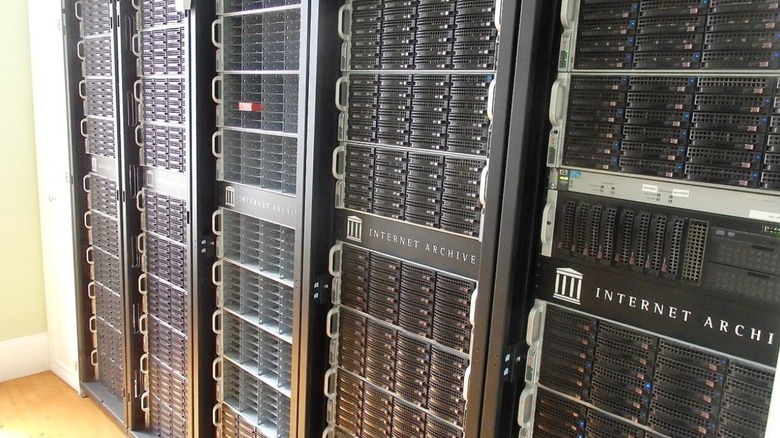
If you've used the Internet Archive and/or Wayback Machine frequently, you've surely started to get a sense of the sheer scale of this resource and the love and care that undoubtedly goes into maintaining it and continuing to grow it. To give an idea of the scale of the Internet's growth, the World Economic Forum reports that there were a grand total of ten websites in 1992. In 1994, there were almost 3,000. Fast forward to August of 2021, around three decades after the creation of the first, and the total was almost 1.9 billion.
The number of web pages preserved by the Internet Archive is truly remarkable. In late October 2025, Internet Archive Blogs proudly boasted of "1 trillion web pages preserved and available for access via the Wayback Machine." Celebrations ensued, including speeches from Brewster Kahle, Annie Rauwerda of Depths of Wikipedia, and Internet pioneer Vint Cerf, along with special tours of the archives.
The Wayback Machine is the result of capturing a web page as it was at the time, and this is done using crawls. The Internet Archive explains, "much of our archived web data comes from our own crawls or from Alexa Internet's crawls," and that there are ways to make the content more accessible and so more likely to be added, with thorough linking practices and directory use being important to this. Beyond websites themselves, CNN adds, the Internet Archive also has the technology (from the microfiche format to record players) required to record other media formats for prosperity too. There have been lawsuits against the Internet Archive regarding access to content, but its overall function is important.