

Valve Confirms What Everyone Feared About The Steam Machine's Pricing

Valve made waves last month upon the announcement of a slew of new Steam hardware. The company launched a sequel to the Steam Controller and course-corrected the metaverse with the Steam Frame. But perhaps the most interesting launch is the Steam Machine, a tiny PC with massive implications for the future of desktop gaming. It runs SteamOS, the company's bespoke Linux distribution already found on the Steam Deck, which is why it has many PC gamers hoping SteamOS can free them from Windows, sounding like Carrie Fisher in "Star Wars." Save us, Gaben-Wan. You're our only hope.
But one question has lingered over this launch: pricing, which Valve avoided announcing during its big announcement. The glaring issue with the Steam Machine is that it's simply not a very impressive PC in terms of specs. In fact, it's barely competitive with the current generation of consoles. Granted, SteamOS has helped to prove that Windows isn't ideal for gaming, and Nintendo is here to remind us all that underpowered hardware can still fly off the shelves at premium prices. But the Steam Machine doesn't fill a gap in the market like the Steam Deck originally did, and unlike the Switch 2, the most casual gamers are unlikely to gravitate toward it.
Now, we finally have confirmed what's been suspected since day one. Valve does not see the Steam Machine as a console, and won't price it like one. That's not surprising, given that Valve employees avoided answering pricing questions from the press during their launch-day blitz. Here's what employees are now officially saying on the record, and why pricing could prove a fatal flaw for the Steam Machine.
The Steam Machine will be priced like a PC, not a console

Appearing on the November 22 episode of the "Friends Per Second" podcast, Valve developer Pierre-Loup Griffais confirmed what gamers had feared about the Steam Machine's pricing structure. "I think that if you build a PC from parts and get to basically the same level of performance, that's the general price window that we aim to be at," he said. "Ideally, we'd be pretty competitive with that." However, no specific price was given.
What that means is a bit murky. Consoles are traditionally priced under the cost of hardware because their game storefronts are the real moneymaker, but Valve doesn't seem to envision a similar role for Steam's game store in this equation. Assuming the company wants to recoup the cost of parts and labor, we could be looking at a price tag of at least $600 or $800 based on parts estimates for an equivalent PC. That would put the Machine firmly outside console territory, potentially priced above even the relatively expensive PlayStation 5 Pro, but with performance more in line with the base-model PS5.
High pricing could leave the Steam Machine as a bit of an ugly duckling, too pricey for console gamers but too underpowered for PC enthusiasts. SteamOS alone can't sell this game cube, since the operating system is available for free to whoever wants it. Steam itself is obviously not a siren call, either, since it runs on any Windows or Linux PC.
Valve is walking a tightrope with Steam Machine pricing
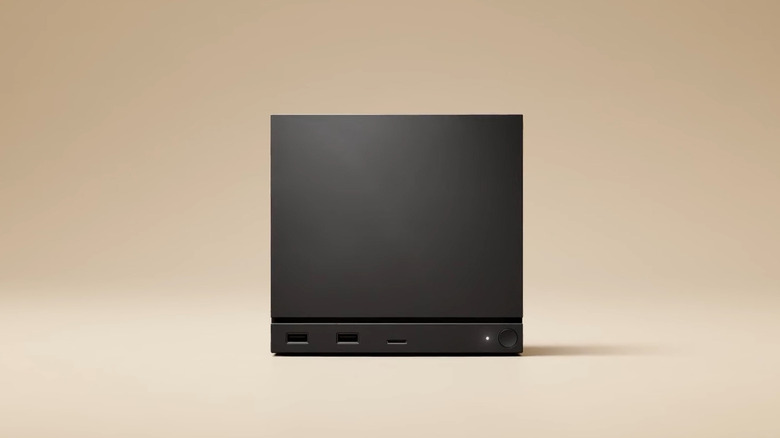
It's a tough time to be building new PC hardware, even if you're an established player like ASUS or MSI. For a company like Valve, which only dabbles in physical products occasionally, it's easy to sympathize. Common PC parts are getting painfully expensive as the AI industry cannibalizes demand for different types of memory, storage, and graphics cards. Even consumers who don't use desktop PCs may feel the burn next time they need to buy a new laptop. Launching a product like the Steam Machine in that environment puts Valve in a tough spot, since they'll be squabbling over scraps to source parts.
But although the Steam Machine is technically more of a PC than a console, that's not how most owners will use it in practice. Think of it this way: anyone who was going to buy a beefy gaming PC already has one, and the Steam Machine's relatively lackluster hardware does not appeal to that crowd in the first place. Its specs only feel competitive when compared to current-generation consoles, so the demographic most likely to buy one is made up of people who would otherwise buy a PlayStation, Xbox, or Nintendo Switch. A good chunk of console-only gamers would certainly like to own a gaming PC but find themselves priced out of the market (even before the latest price spikes).
Hardcore PC enthusiasts might want a Machine as a secondary PC for the living room, or to tinker with, but the general consumer who just wants to kick back and game is getting left in the cold. In other words, if Valve prices the Steam Machine above what current console gamers can tolerate, it may be shutting out its largest potential customer demographic.