

Why Car Tires Went From Inner Tubes To A Tubeless Design
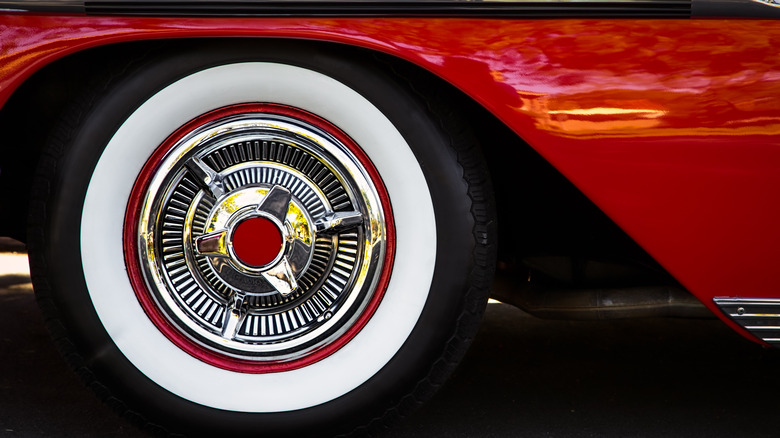
When we hear the word inner tube, most of us think of hot childhood days spent by the community pool or a lazy day meandering down a river on the Fourth of July. It doesn't bring to mind the tires on our car, which did indeed have inner tubes at some point, but likely not during your lifetime — though your grandparents may remember the change!
If you've never studied their history, here's a bit of tire 101. Early wheels were made of solid, curved pieces of wood that were eventually covered in leather for a smoother ride. Solid rubber tires debuted in the 1880s. In 1888, the first pneumatic tire inflated with air was invented, and in 1898, the Goodyear Tire and Rubber Company debuted. For half a century, cars used a technology called bias-ply tires, which consisted of an inner tube filled with compressed air surrounded by an outer casing. That outer shell helped to protect the tube inside. The casing was reinforced with layers called plies, hence the name, which were rubberized fabric cords.
This type of tire is actually still in use today, though mostly on classic cars and tractors! Despite how long they were used on cars, however, they provided a rather stiff, bumpy ride and wore out much more quickly than modern tires. In 1952, everything changed when B.F. Goodrich patented the tubeless tire. This type of tire is not only more cost-effective, it's also safer, more comfortable, and lasts longer.
The benefits of tubeless tires

Unsurprisingly, tubeless tires don't have those inner tubes that are a hallmark of bias-ply tires. They have an airtight seal between the tire bead and the rim that prevents air from leaking out, eliminating the need for the air-filled tube. Unlike tubed tires, which deflate quickly if they're punctured, potentially leading to a dangerous blowout at high speeds, tubeless tires don't lose air quickly when perforated. While you'll know pretty quickly if you have a flat, modern tires give drivers time to safely pull off the road for a tire change or to call a tow truck. And, unlike tubed tires, tubeless ones can sometimes be fixed with liquid sealant if the puncture is minor, saving drivers from having to completely replace the tire.
Tubeless tires also don't overheat like tubed tires do, which is important due to the high speeds of modern cars. And, while buying new tires can certainly put a dent in your wallet, tubeless tires are actually more cost-effective than tubed tires. They are more lightweight, giving you better fuel efficiency and a better overall performance and feel on the road.
Tubeless tires are fairly easy to inflate and care for. Your vehicle has a recommended tire pressure for each tire that you can find in the manual or inside the driver's door jamb. Many gas stations offer air pumps that you can preset to the recommended pressure for easy inflation. If your car doesn't automatically monitor the tire pressure, you'll want to check it every few months to be sure your tires are still properly inflated.