

5 Of The Fastest Cars From The 80s, According To Car And Driver
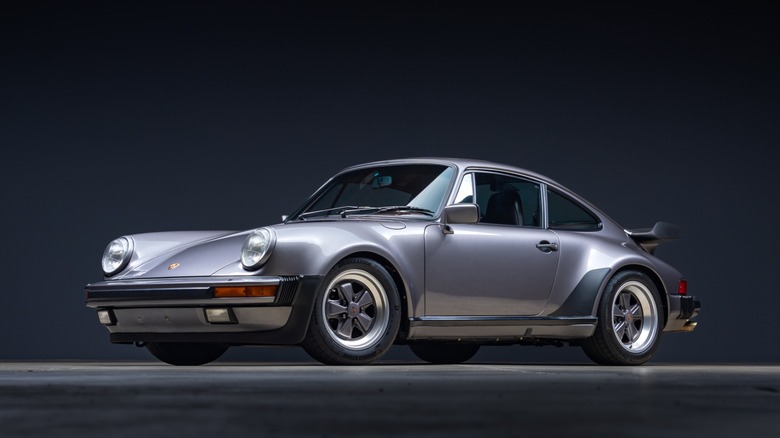
Thanks to the long list of cars that the outlet has reviewed over the years, Car and Driver provides one of the best ways to look into the past and see what manufacturers have been able to produce. While each decade is filled with these reviews, Car and Driver got its hands on countless performance cars from the 1980s that were on bedroom wall posters, and pushed them to see what they were truly capable of.
The '80s were an incredibly competitive time for the performance segment, particularly with European brands continuing to establish themselves as some of the go-to manufacturers for pure speed. This meant that the American manufacturers were doing everything they could to stand toe-to-toe with them, giving us numbers that still hold up against the top tiers of today's industry. Out of the fastest cars Car and Driver tested in the 1980s, here's a closer look at the five cars that topped the timing sheets.
1987 Buick GNX
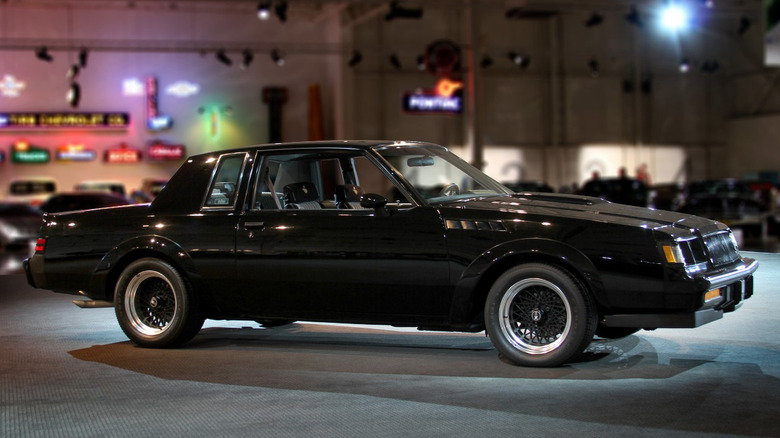
The Grand National was already a pretty impressive step up over the base Regal in 1982. Running from 1982 to 1987, before the third generation of the Regal, the Grand National wasn't around for long, but its send-off model managed to define an era of the muscle car. The Buick GNX bumped up the power output of the 1987 Grand National by some margin, with the latter sitting at 245 horsepower thanks to its turbocharged 3.8L V6. The GNX kept the V6, but was bolstered through things like an improved turbo and intercooler. The result was a 276-horsepower output, allowing the muscle car to set worldwide benchmarks.
When Car and Driver tested the GNX, it was the fastest-accelerating American car that the outlet had put through the trials at the time. In combination with the tightened chassis, the GNX was able to reach 60 MPH in just 4.7 seconds, which still isn't too bad today, let alone almost 40 years ago. With only 547 examples produced in 1987, the GNX isn't exactly the easiest car to find. If you do manage to locate one, expect to pay around $185,000 on average, judging by recent sales numbers.
1989 Pontiac Firebird 20th Anniversary Trans Am
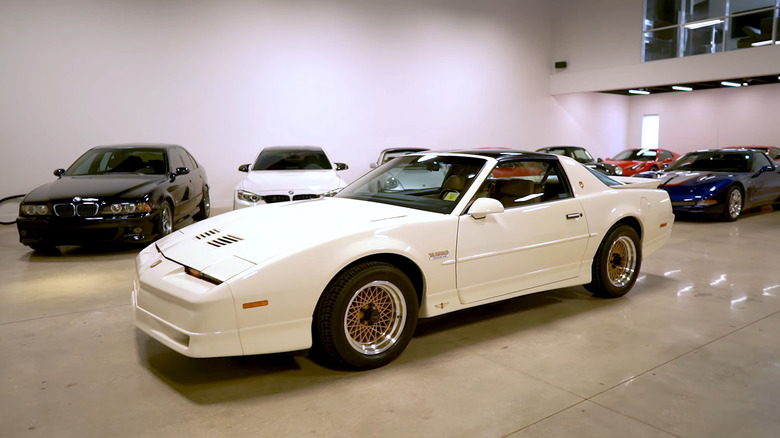
The Pontiac Firebird was one of the key pony cars to hit American roads in the late '60s, in a bid to capture some of the attention that the Mustang was getting at the time. Being one of the nameplates to survive the 1973 emissions act, the Firebird also stayed on trend moving into the 1980s, with its unmistakable wedge-shaped design. The Trans Am package was already well-established for the Firebird, which always took it to muscle territory by enhancing just about everything that could extract more performance from the pony car. In the '80s, the best version came out for the 20th anniversary of the model, leaving the decade with a few more accolades along the way.
The base 1989 Trans Am had a couple of different engine options available. You could get a 5.0L V8 or a more potent 5.7L engine on the GTA trim. The latter's 235-horsepower output was plenty to enjoy with the GTA, but was no match for the 20th Anniversary's turbocharged 3.8L V6 that Car and Driver pushed to the limit. Producing 250 horsepower and 340 pound-feet of torque, this version of the Firebird, dubbed the Turbo Trans Am, went from 0 to 60 MPH in 4.6 seconds, narrowly beating the GNX's time to become the fastest American car on its release. Besides the performance garnering attention, it was also chosen as the pace car for the Indy 500 that year.
1986 Porsche 911 Turbo
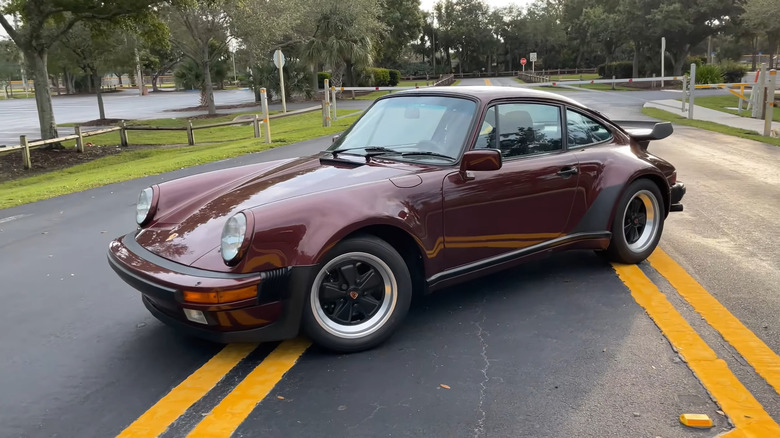
Car and Driver's round-up does feature brands such as Ferrari, but for the 1980s, it was Porsche that had the jump off the line compared to its European rivals. The 911 has been setting the standard for rear-engine machines since its release in September 1964. While the core philosophy has predominantly remained the same over the decades, there are a handful of model years that stand out for their importance. Specifically for the U.S. market, the 1986 911 Turbo was the returning model after it was pulled in 1979 due to emission regulations that prevented Porsche from selling the car here. Upon its return, Car and Driver was quickly on the case to see how it held up against the competition.
In order to allow the 911 Turbo to comply with U.S. regulations, the power output of the 3.3L turbocharged flat-six was dropped slightly to 282 horsepower from its 300-horsepower rating in Europe, along with the fitment of a new catalytic converter, an oxygen sensor, and updates to the existing fuel-injection system. Despite the dip in performance, the 1986 911 Turbo still managed to go from 0 to 60 MPH in 4.6 seconds, level with the '89 Trans Am for early-stage acceleration.
1989 Chevrolet Corvette ZR-1
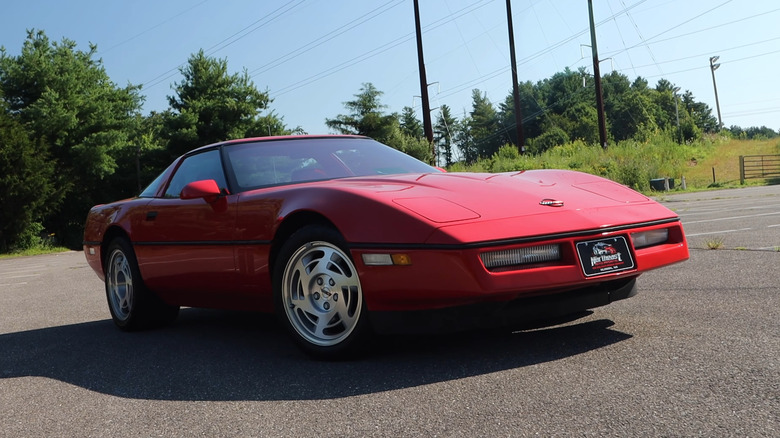
The Trans Am wasn't the only American car in the '80s to reach its peak by the end of the decade. Introduced well before any other car on this list back in 1953, the Chevrolet Corvette was made solely to compete with the best coming out of Europe. Some muscle cars like the Trans Am leaned more toward the wedge design philosophy, but as a sports car through and through, the 1989 Corvette was able to embody it fully to maximize its performance potential.
Even with today's lineup, the ZR-1 tag is the pinnacle of the Corvette, even if the car looks a lot different from what it did four decades ago. While officially a 1990 model-year car, some pre-production models were built for testing. This Corvette was the first to get the ZR-1 treatment since the package was offered on the 1970 model, but in a much different way this time around. For starters, the engine was developed by Lotus (which was owned by GM at the time), giving the Corvette ZR-1 a 5.7L V8 LT5 producing a solid 375 horsepower.
Earning its nickname "King of the hill," Car and Driver put one of the early models to the test in a bid to see if Chevrolet's latest challenger was worth all the turmoil behind the scenes. After it shot to 60 MPH in 4.5 seconds, it was quite clear that the Corvette would be able to keep up with its European rivals.
1987 Porsche 959
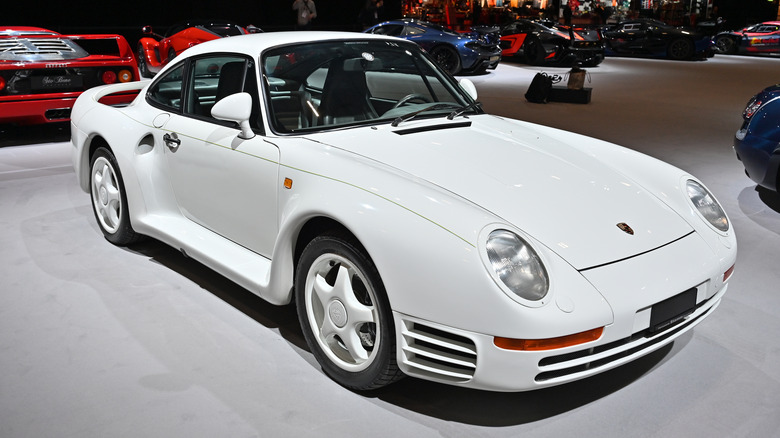
Each decade has a list of cars that can be pointed at for pushing the industry forward. There are a few that stand out from the 1980s, but the Porsche 959 may very well take the crown from them all. Originally built to compete in the iconic Group B rally class, it never actually got to compete due to the series being canceled. It still had some time off-road, most notably the Dakar Rally, but what Porsche managed to do with the road-going version took it to a new level.
The supercar's shape made it naturally adept at aerodynamics, with the addition of automatic ride-height adjustment only bolstering that. Built on the 911 platform of the time, the endurance racing-inspired 2.8L twin-turbocharged flat-six sat in the rear of the car. The turbochargers were also sequential to help reduce lag. Producing 444 horsepower, Car and Driver managed to go from 0 to 60 MPH in just 3.6 seconds, which would still be competitive if it were to roll off the production line today. The top speed was unsurprisingly another talking point for the 959, reaching up to 198 MPH when pushed to the limit. As impressive as the performance is, so is the money you'll need to pay for one of the 292 production models. In 2025, the 959 sells for a staggering yet understandable average price tag of $1.8 million. Unfortunately, the year after its release, it still couldn't be legally driven in the U.S. because Porsche never certified the 959 to meet federal regulations.