

Why Fighter Jets Fly Upside Down – And How They Pull It Off
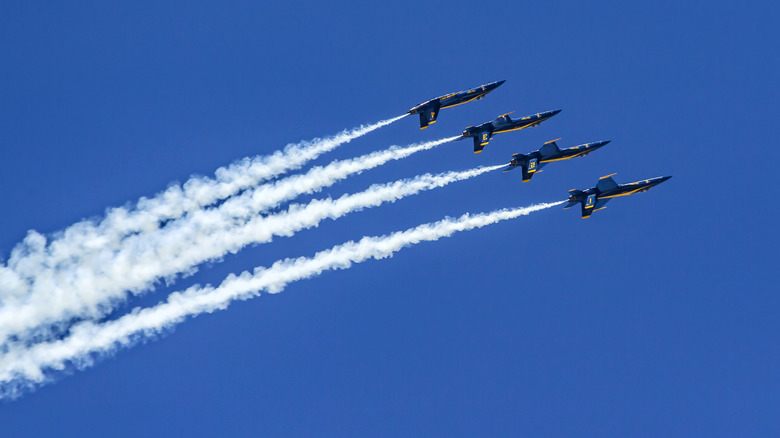
You don't need to have seen either "Top Gun" movie to know that fighter jets can flip upside down, unlike commercial aircraft. But the sight of an inverted jet doesn't mean physics has flipped on its head, too. The principles of flight (we're talking lift, weight, thrust, drag) are still the principles of flight regardless of a fighter jet's orientation.
What does change, however, is how pilots and aircraft generate lift while upside down. Unlike commercial airplanes, which use cambered wings shaped to create stronger lift during flight, many fighter jets rely on symmetrical wings instead. They're rounded equally on top and bottom, which lets them produce lift even when turned upside down. This design helps avoid the loss of altitude that a conventional airliner would experience if it tried the same trick.
For those fighter jets that don't have perfectly symmetrical wings, pilots have to overcome the challenge of lift by increasing the angle of attack: They point the leading edge of the wing upward relative to the oncoming airflow, and that forces enough air beneath the wing to maintain lift (even while inverted).
Beyond aerodynamics and structure, fighter jets also rely on specialized fuel and oil systems to prevent mechanical failure during inverted flight. Conventional commercial jets depend on gravity-fed systems, but those can fail if the aircraft goes upside down. Powerful fighter jet engines use dry-sump oil systems and pressurized fuel pumps instead. That way, lubrication and fuel get delivered regardless of the jet's orientation.
Just because fighter jets can fly upside down doesn't mean they should do it for long
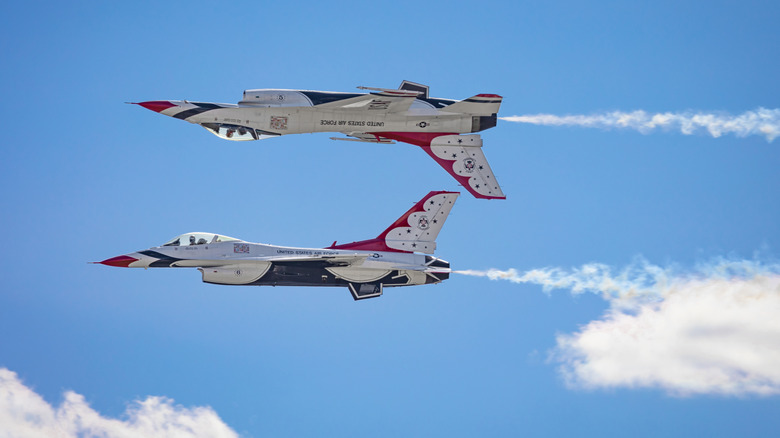
Even though fighter jets can fly upside down, it's not usually something pilots sustain for long periods of time. It's normally only performed very briefly as part of a larger maneuver (like a barrel roll), only leaving them upside down for seconds, not minutes. Even the most agile fighter jets need to maintain positive G-forces as much as possible.
While upside down, pilots have to fight negative G-force by pulling back on the stick throughout the flip. (G-forces reach up to 9 Gs in a normal flight, and it makes pilots feel like something super heavy is pressing down on their entire body.) If they don't fight the negative Gs, it'll send blood toward the eyes and brain, dramatically increasing the risk of eye or brain damage. The human body can't handle that long-term... not to mention the jet itself.
Positive Gs aren't without their symptoms, either: They can cause blood to drain from the head and lead to blackouts. It helps to wear G-suits, which help maintain circulation during positive Gs by squeezing the legs to push blood upward (though they provide no protection against negative Gs). And without a practical way to compress the head and neck to counteract the force, negative-G flight has to remain brief. Don't expect to see one flying cross-country like that!