

3 Common Problems With Ford's 6.2L Boss Engine
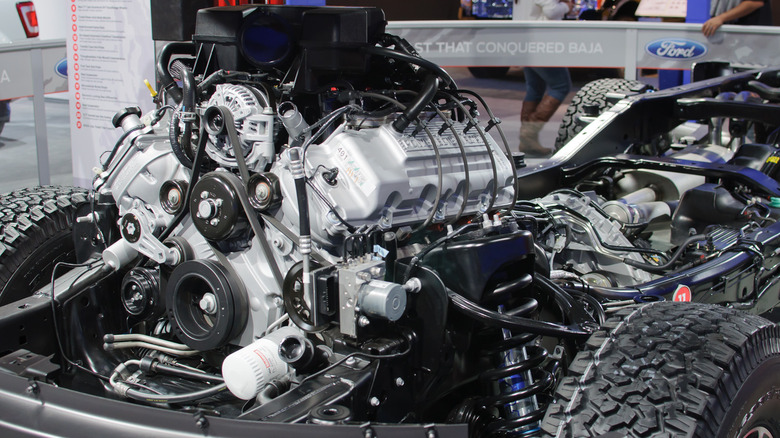
Ford's reputation as an engine manufacturer has been boosted by successes like the 427 cubic inch V8 that made history at the 24 Hours of Le Mans and the 5.0-liter Coyote V8 that is one of the best 8-cylinder engines ever made. Not every one of Ford's engines has been an unqualified success, though. The first Mustang came standard with a wimpy inline-six powerplant, and the second generation arrived in 1974 just as the oil crisis and new emissions regulations were driving American buyers away from large engines. Automakers have since developed ways to make bigger engines more efficient, and Ford planned to use the 6.2-liter Boss V8 in the Mustang when it was still codenamed "Hurricane."
The engine inherited just a few elements from its modular predecessors, and Ford used it primarily in Raptor and Super Duty trucks beginning in 2010. During its decade or so in production, the 6.2-liter Boss V8 developed a reputation among owners for problems with spark plugs, valve springs, oil consumption, and leaks. The former two issues could cause rough operation (especially at idle) and lead to bigger problems, but Ford's Boss V8 is still regarded as a dependable engine with a long service life.
The Boss 6.2 used 16 sometimes troublesome spark plugs

Gasoline engines typically employ one spark plug per cylinder, but some larger ones, like the Boss V8, are designed with two to maximize power and fuel efficiency. These gains are only available to owners who change their plugs regularly, but the extra plugs and coil packs needed make this job twice as expensive and time-consuming as it is on some other V8s. Double the plugs also means double the potential failure points, and the plugs on the sides of the engine and near the firewall are particularly hard to swap. In a thread on F150forum.com, a user named Augster mentioned a need to remove the front wheels and fender liners to access the lower plugs and estimated that the job should take "3 to 4 hours for the average shade tree mechanic."
That's if everything goes as planned; some owners report that their plugs broke during removal or the threads seized in the cylinder heads. That could turn an otherwise routine task into a major repair involving head removal and maybe extra work to clean porcelain bits out of the cylinders.
Broken valve springs are common on 6.2-liter Boss V8s

The 6.2-liter Ford Boss V8 produced in the neighborhood of 400 horsepower, which puts a lot of stress on internal components. Many owners report their valve springs weren't up to the task and broke, leading to rough-running engines. They're easy to replace and might only make your engine run a little strangely if broken, but if the valve stem falls into the cylinder, it could wreak havoc on pistons and cylinder walls. There are several threads on the Ford truck enthusiasts forum page regarding broken valve springs on Boss engines, although most owners dismissed it as an easily fixable problem that had no lasting consequences for them.
Ron94150 commented on one thread with," While broken valve springs and clogged cats are the most common issues with the 6.2, ... it's still not real common. Usually the valve either wadded up against the piston or causes no damage at all. I wouldn't be [too] worried about it." River Wild agreed, writing, "I wouldn't worry about it. Mine is fine and I've beat on it pretty hard in the last 2000 miles since I had it fixed. I lost a spring at just over 11K. I figure I'm good for the life of the truck now."
The Boss 6.2-liter V8 is prone to various oil leaks

Another common subject of Ford 6.2-liter Boss V8 owners' complaints is internal and external oil leaks that lead to excessive oil consumption and potential emissions test failures. The fact that many owners report this issue is partly due to the durability of the engine. All engines will develop leaks over time as seals dry out and heat warps metal components, and this engine's typical long operating life means it's more likely to reach an age where oil seeps out through the rear main seal or valve covers or slips past piston rings.
One owner discovered that his internal oil leak came from a leaking baffle in his passenger side valve cover, and Ford acknowledged this problem with technical service bulletin 15-0161 in October 2015. The advisory noted that "Some 2015-2016 F-Super Duty 250/350 vehicles equipped with a 6.2L engine and built on 3/1/2014 and through 9/8/2015 may exhibit excessive oil consumption due to an internally leaking baffle in the right side valve cover" and recommended its replacement. Some owners reported problems with the Positive Crankcase Ventilation (PCV) valves that help burn off excess oil, and mentions of rear main seal leaks are common on Ford truck forums. Rear main seal leaks can be hard to distinguish from leaks in the oil pan gasket or higher on the engine, as well as labor-intensive to repair.
Our methodology
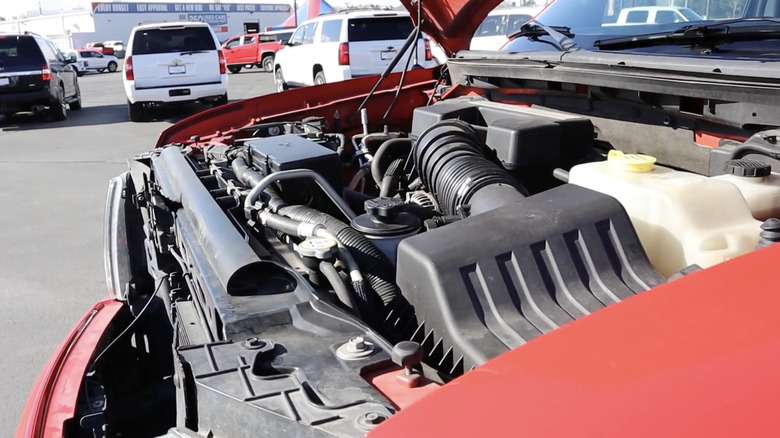
To identify the most common problems with the Ford 6.2-liter Boss V8, we first scoured our own archives for previous reporting on the engine. After supplementing that with a few articles from trusted sources, we looked to forum sites for owner testimony that supported our initial findings. While these three issues are common to many owners, we also found plenty of testimonials from owners who had put 200,000 miles or more on their trucks without any significant trouble.