

Why US WW2 Fighter Planes Used An Insignia That That Looked Like Japan's Rising Sun
The Imperial Japanese Navy launched hundreds of fighters and bombers at Pearl Harbor in an effort to paralyze the main U.S. naval base for the Pacific Fleet near Honolulu, Hawaii, on December 7, 1941. Ironically, not a single U.S. aircraft carrier was sunk during the bombing. The very next day, President Franklin D. Roosevelt went to Congress asking for a declaration of war against the Empire of Japan.
Anyone familiar with this global conflagration will recognize Japan's military flag — a white background with a sometimes offset red disc emitting 16 red rays (hence the comparison to the rising sun). It was used by the Imperial Japanese Army and adopted by the Imperial Navy in 1870. It's different from Japan's national flag — a white background with the red disc, sans rays. Known as the Hinomaru (meaning the "circle of the sun"), versions of it date back to 701 AD, but it wasn't officially designated as the national flag until 1999.
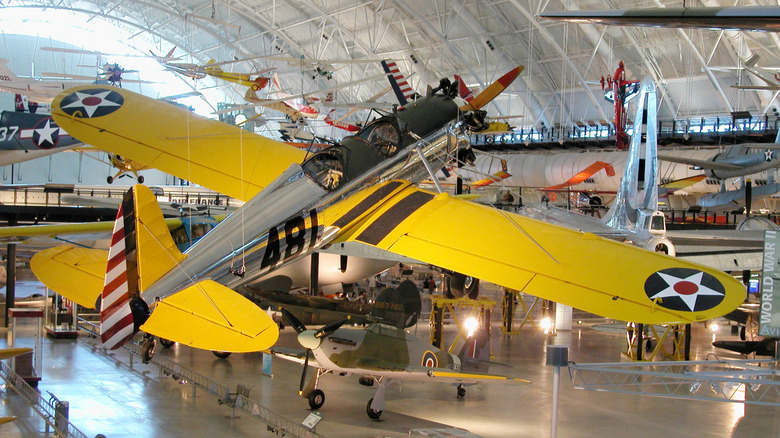
At the time of the Pearl Harbor bombing, U.S. airplanes used something similar at the core of their own insignia — a red circle (sometimes called a "red ball") inside a white five-pointed star inside a blue circle, mimicking the colors of the American flag. Due to its similarity, American pilots feared they would mistake friendly planes for enemies and began painting over the red circle to eliminate any uncertainty. At the end of May 1942, orders came down to remove the red circle entirely from all combat aircraft. The following month, all U.S. military aircraft were mandated to do so.
The color red caused real controversy
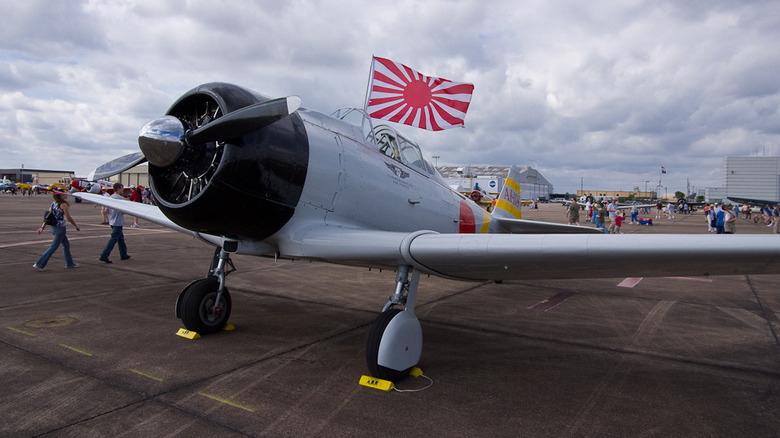
The red circle on the Japanese flag and insignia represents the sun goddess Amaterasu, who is believed to be the ancestress of the Japanese imperial line. In 1854, Japanese vessels were ordered to fly the symbol so they wouldn't be mistaken for foreign enemies. In 1870, the Meiji government (which ruled between 1868 and 1912) was the first to use the Hinomaru flag as a symbol of a modern Japan.
Meanwhile, in the United States, the first national insignia — a red five-pointed star — appeared on U.S. Army aircraft during the Mexican Punitive Expedition in 1916. In May 1917, the U.S. officially adopted as its national insignia a red circle within a white five-pointed star within a blue circle. However, that changed after the U.S. entered World War I in January 1918 to a roundel to match those of the Allied nations (but only used one) with a white circle inside a blue circle inside a red circle. That symbol was subsequently changed in April 1919 to a red-centered white star within a blue circle, with only a minor shade change to the blue circle happening in the 1920s.
This remained the insignia until 1942, when they were all but forced to address the issue of the red ball. In June 1943, U.S. forces added rectangles to the left and right sides of the blue circle, along with a red border outlining the entire design. The pushback over the red border from air units still fighting Japanese forces was immediate, and in August, the border color was changed to blue.