

Why Using A Torque Wrench As A Breaker Bar Could Be A Bad Idea
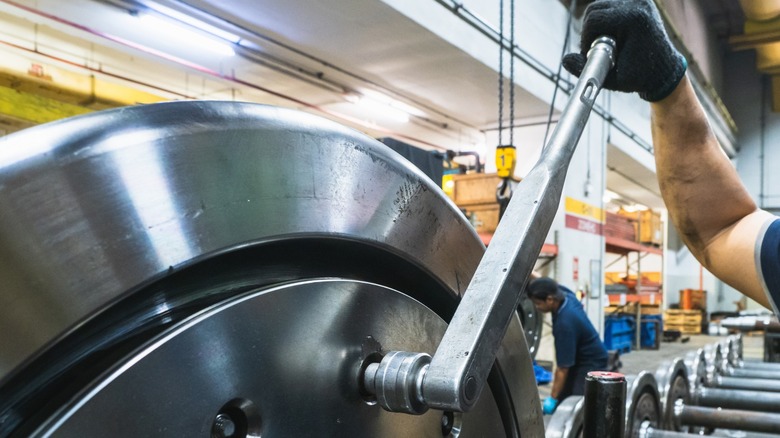
A breaker bar is one of those specialty tools that every home mechanic wishes they had sooner or later. It's useful for encouraging stuck nuts and bolts to turn as a last-ditch effort to remove them before resorting to heating, grinding, or melting.
One of the breaker bar's advantages over standard ratchets and wrenches is its length. A longer lever equals more torque applied to the fastener using the same amount of force. Another advantage is the breaker bar's simple construction that eliminates gears, springs, and locking mechanisms found in ratchets and torque wrenches.
When trying to remove a stubborn bolt or nut, and you don't have a breaker bar, you may lock your eyes on your torque wrench in the heat of the moment. You'll notice that its handle appears robust, longer than any ratchet that you have, and it might even have a larger square drive. Avoid the impulse to put that torque wrench toward the strenuous task of breaking loose stuck bolts. Remember, it's likely one of the tools you splurged on when building your tool kit.
It's true that torque wrenches, especially larger varieties with ½- and ¾-inch square drives, are designed to deliver heavy torque to threaded fasteners during assembly. However, the brute force required to budge a stuck nut can easily exceed the physical limitations of a torque wrench, causing internal damage and ruining its calibration.
The dangers of overloading a torque wrench
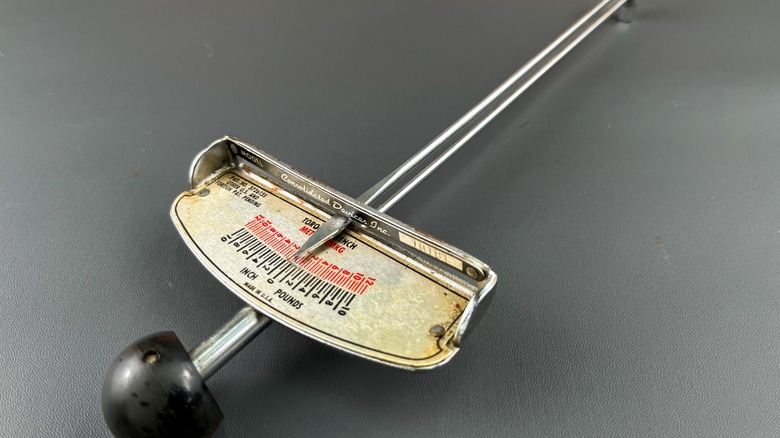
Torque wrenches are used to apply precise amounts of torque, a measure of rotational force, to threaded fasteners such as screws, nuts, and bolts. They come in many sizes and shapes, but for our purposes, we'll focus on ½- and ¾-inch square drive types as they are commonly found in mechanics' tool kits.
After narrowing our focus, we're left with four basic types of torque wrenches: beam, clicker, dial indicator, and digital. Beam-type torque wrenches are the simplest. As force is applied to the handle, the main beam of the wrench, with an attached scale showing progressive torque values, deflects while the pointer, attached to the torque wrench's head, remains straight to indicate the torque value achieved. Using this type of torque wrench as a breaker bar could overstress the beam or bend the pointer.
Other types of torque wrenches have hollow frames and internal parts that could become damaged at higher than rated torque values. Micrometer and split-beam clicker-style torque wrench mechanisms operate inside the hollow shaft of the wrench in addition to ratcheting heads containing fine-tooth gears.
Dial indicator torque wrenches operate like a beam-type inside, except the pointer activates the dial indicator. Digital torque wrenches use a transducer, or strain gauge, to convert the force applied to the beam into an electronic signal. While they have fewer moving parts internally than some other styles, they can still suffer damage from overloading.