

How Limousines Are Made Is Way Wilder Than You Think
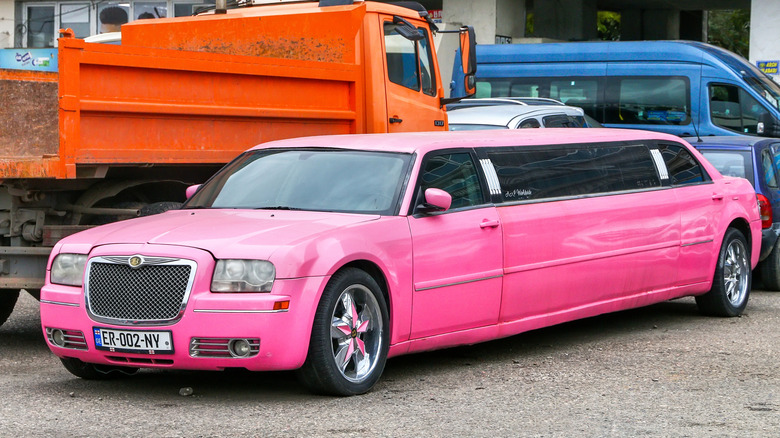
If you come from an earlier generation, likely one older than Gen-Z, you probably remember a time when stretch limousines were a common sight on American roads. Maybe you even rode in one for a high school prom or another big event. At the very least, you're familiar with them from those Hollywood red carpet gatherings of the past. At one point, the longest stretch limo was a wild creation that could hold 75 people and had a helipad on the back.
These days, the traditional stretch limo is a much rarer sight, with its job mostly replaced by party buses or the large, luxuriously appointed SUVs most commonly used to haul VIPs and celebrities around. But because they are rarer these days, when you do happen to see a stretch limo on the street, it's a bit of a special occasion. But it's not only the outward appearance of these limousines that draws the eye, or the classically glamorous feeling of riding inside one that fascinates us — it's also the way they are built. While it might seem straightforward, the work that goes into creating a stretch limousine is one of the wilder sides of the transportation industry. Let's take a quick look at how it all goes down.
Cut and then stretch
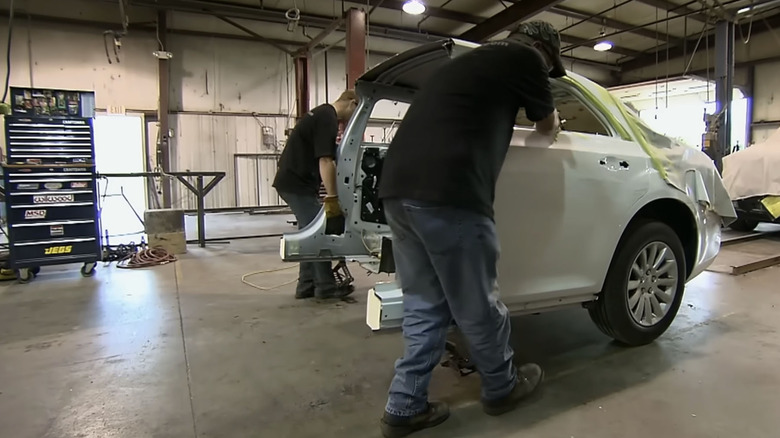
Traditionally, stretch limos were built from luxury sedans such as Cadillacs, Lincolns, and, more recently, Chrysler 300s. There have also been SUV-based stretched vehicles like the Hummer H2, and on occasion, you find really crazy, one-off limo projects like a stretched Lamborghini Aventador. The key thing to know, though, is that most stretch limos are not built by the car manufacturers themselves. Instead, they begin life as your typical, standard-length sedan, and once that car arrives at the third-party coachbuilder, the process to turn it into a stretch limo begins.
The conversion typically begins by stripping the interior from the stock vehicle, along with the driveshaft, fuel tank, and other components, before the car is completely cut in half. With the two ends of the car separated, a new, extended frame is fabricated to go between the two halves. The fabrication process will include new frame rails, an extended drive shaft tunnel, roof rails, steel flooring, vertical support pillars, and a roof panel.
Once the new "stretch" frame is complete and welded to both ends of the car, side panels to match the existing body are added, before windows, paint, and bodywork to tie everything together for a factory-like appearance. From there, the limo's interior is outfitted with features such as bench seats, electronics, TV screens, speakers, ambient lighting, and more.
An antiquated art
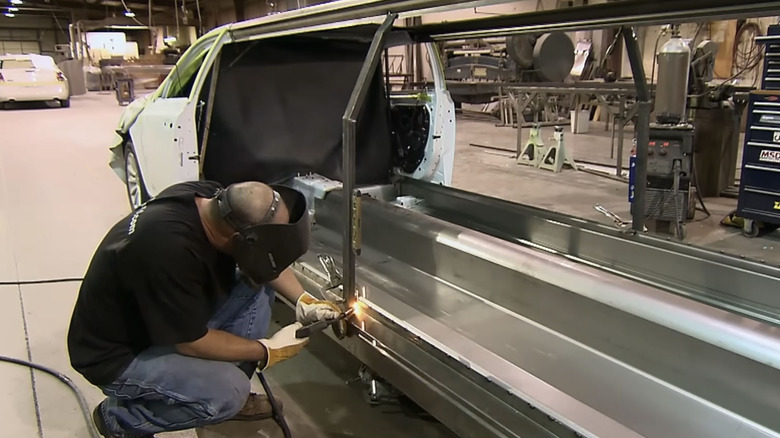
While the 'chop, build, and stretch' method of limousine construction is fascinating to observe, it also helps to demonstrate some of the reasons why the classic stretch limo has fallen out of favor. When breaking down the construction process, you can see how much raw fabrication and bodywork are needed to turn a normal sedan into a stretch limo. And that's before you even get to outfitting the interior.
By contrast, a party bus is effectively just a small bus designed for leisure use rather than maximum passenger capacity. That means more money and labor can be invested in outfitting the interior rather than fabricating an existing vehicle into something entirely different. And that's before you get to all the functional benefits that make party buses so popular for weddings, proms, and other events. Compared to a long, low limo, a bus will have more seats, more room to stretch, and a much easier entrance and exit for passengers. Likewise, for most passengers, a luxury-appointed, assembly-line version of a modern GMC Yukon or Cadillac Escalade can have all the comforts of a limo without all the custom work.
Still, especially knowing all the work it takes to build one, there's just something about the swagger of stepping out of a stretch limo versus stepping out of a small bus. And even the President of the United States still rides around in an old-school limousine – albeit an armored, $1.5 million version, famously known as The Beast.