

Toyota's 2026 Prius Plug-In Hybrid Beats The Honda Civic In More Than Just HP
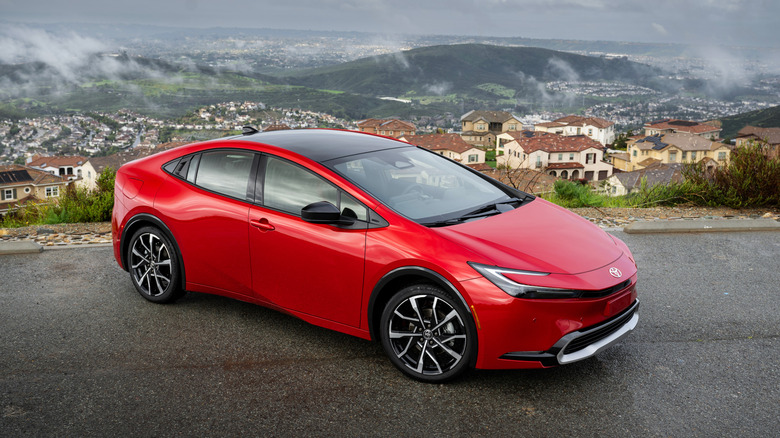
When people think of the Toyota Prius, a certain quality comes to mind: efficiency. Not looks, not exclusivity, and certainly not power. And that was true for a time — the Toyota Prius represented the Japanese automaker's first mass-produced hybrid, and indeed one of the first modern hybrids ever sold in bulk. It was a car designed with one philosophy in mind: Make a roomy, four-door compact car that would sip gas. Overall, that made it relatively nondescript, generally about the furthest thing away from an "enthusiast's car" as one could go, hence why it's so often hated by enthusiasts and loved by owners.
Originally, the Prius more closely resembled a Corolla with a body kit; the second-gen was the one that started the whole bubbly hatchback look that most people recognize. By subsequent generations, Toyota attempted to make it progressively more appealing, to varying levels of success, but it was still not exactly stylish. That, in the eyes of many, ends with this latest generation, with the 2026 Prius outperforming its Honda Civic hatchback rival in almost every aspect: power, styling, and specs. The latter points are subjective, though we certainly see the appeal. The design is sleek, sporty, and contemporary. Plus, it's markedly more efficient than the Civic: 52 MPG combined versus Honda's 48 MPG. And, lastly, it boasts 220 horsepower versus the Civic hybrid's 200. Is it fast? No, not against traditional sports cars. But it'd certainly be peppier than the Honda, which is the major selling point here.
Areas where the Prius shines
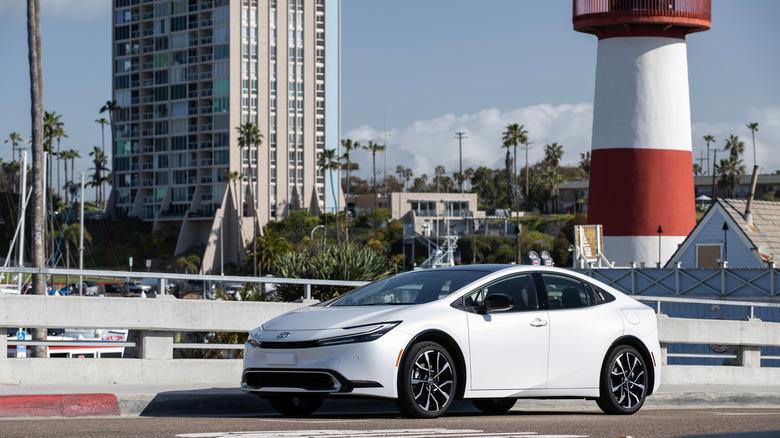
This generation of Prius underwent a marked styling transition, one which is unquestionably more modern-looking than the Civic's. It has a prominent front lightbar, an aggressive profile, enlarged fenders with that swooping accent on the side skirts, and a teardrop-like shape. Both cars' interiors also feature similar levels of features, with both having a prominent tablet screen accompanying a digital dashboard — though the Prius's layout features a more futuristic, less conventional design than the Honda's, which may be more to some people's taste.
Where the Prius really excels, however, is in the hard statistics. People generally buy a Prius to save money at the gas station, and it delivers exactly that. A Prius is definitively more efficient than a Civic. That's accounting for its more powerful gasoline engine as well: 150 horsepower versus 141 on the Civic. Being more efficient, the Prius also out-ranges the Civic, to the tune of 600 miles in its most efficient trim, as opposed to 530 miles on the Civic. The Prius and Civic both feature roughly the same level of integrated services like Android Auto and Apple CarPlay (something which GM decided to omit from all its new cars for some reason).
Overall, then, this is likely the car for you if you're shopping for something with modern, minimalistic styling and solid creature comforts. Toyota's been on a roll lately when it comes to these compact cars in the United States, and with more American consumers opting into these markets, the Prius is looking more and more appealing by the hour.
Honda's redeeming factors
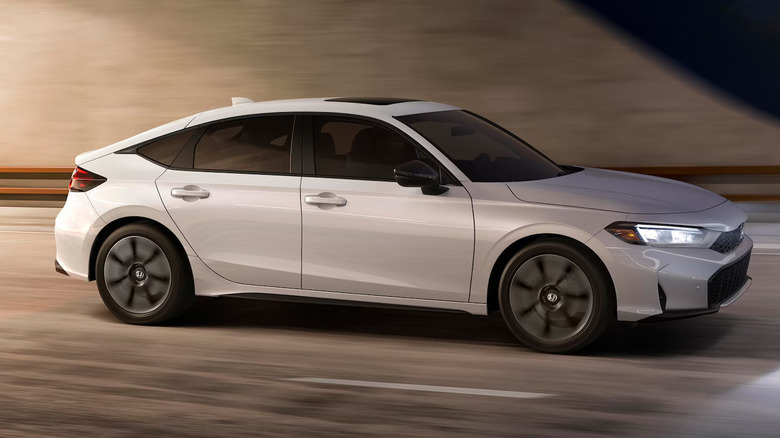
Of course, Honda's got something to say about the 2026 Prius, despite the generational gap. The Prius may be thoroughly modern in design, but that LED lightbar at the front is definitely not to everyone's taste. Some people appreciate the characteristic look of a car with two headlights and a grille, and the Civic's got you covered there. Arguably, the dashboard design is nicer as well, with that slick-looking grating giving users a more distinctive design. In addition, the infotainment system appears, at a glance, to be less obtrusive than the Prius, and the traditional gauges are more intuitive to read for some. It's not Prelude levels of Toyota-beater, but it's close.
Apart from aesthetics, there are two factors where the Civic shines — the first being its electric motor. The Civic features an AC synchronous motor with 181 horsepower, beating out the Prius' 161 horsepower. This means that, given that both vehicles weigh pretty much the same, the Civic will be peppier off the line when the electric motor kicks in, providing a sportier feel in low-speed driving. The second advantage of the Civic is important to road trippers, namely the cargo volume. Because of the Prius' sleek profile, it only has a 20.3 cubic-foot cargo capacity with the seats up, against the Civic's 24.5 cubic feet, which provides 20% more. Headroom is also better than the Prius as well, being an inch higher.
Overall, then, the Prius is for people who prefer a cheap, hybrid-powered Tesla lookalike, rather than the Civic's unchanged body style. Both cars have their pros and cons. However, at least on paper, the Prius is better at the tasks that matter most to compact hybrids.