

Does Tire Speed Rating Affect Your Car's Ride Quality?
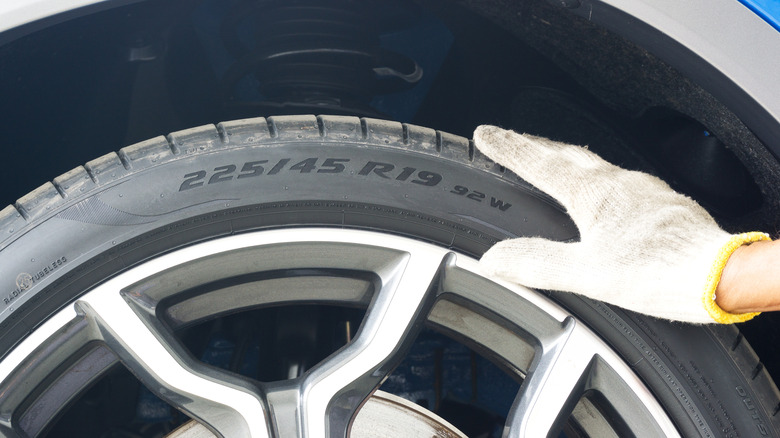
Different tire compounds excel in different areas, which is why tires have speed ratings — not all materials can handle the extra heat and stress that come with high-speed driving. However, upgrading your tire's speed rating does come with trade-offs. So, does tire speed rating affect your car's ride quality?
Yes, tires with a higher speed rating typically rely on reinforced construction in order to better cope with the stress. This means that a higher speed rating may result in reduced comfort and a noisier ride. A tire with a higher speed rating is also designed to reduce flexing because added flex also increases the tire's heat signature. It's the same story with a sporty suspension setup, where less flex and more stiffness increases control and reduces body roll.
The idea here is to keep the car planted, much like swapping a cozy car seat for a firm bucket seat — you gain precision, but you feel everything. Here is everything you need to know about how different speed ratings affect comfort, and whether it makes sense to upgrade for your vehicle.
Why higher tire speed ratings mean a harsher ride

According to Pirelli, tires with a higher speed rating can lead to a stiffer ride. Additionally, a 2023 study published in the Energies Journal found that increased tire stiffness can reduce ride comfort by transmitting more vibration to vehicle occupants. More precisely, the study found that increasing tire air pressure by 15% led to an 11% increase in the tire's stiffness index. It also led to a 4% decrease in damping – which reflects a slightly rougher ride.
Although the study did not examine different speed ratings, it did demonstrate that higher stiffness changes how vibrations are transmitted, and that may influence comfort. Speed ratings are categorized by alphabetical letters. The higher the letter, the higher the rating. For example, an L-rated tire means it was rated for up to 75 mph. This is the type of tire you'd normally find on off-road vehicles and heavy-duty trucks.
More often than not, they will last longer compared to tires with a higher rating. On the other hand, a Y-rated tire is designed to withstand speeds higher than 186 mph. These are characterized by a firm design, minimal flex, and can be found on dedicated performance cars and exotic supercars. If you're wondering how to know the top speed rating of your tires, look for the single letter after the load index on the sidewall.
Best tire speed rating for your car
When thinking about a tire's speed rating, it's important to note that having a higher rating is rarely a necessity. Even L-rated tires are able to go 75 mph, which is not far off the maximum in U.S. states with the highest speed limits. If you own a true performance car and want the best possible handling you can get, whether for track days, the drag strip, or canyon carving, having a high tire speed rating can make sense.
However, in basically all other scenarios, the comfort and longevity trade-offs are rarely worth it. For a mainstream daily driver, a car you commute to work and get groceries in, an S, T, or U rating is typically enough. These are able to withstand speeds of between 112 mph and 124 mph. On the other hand, they also tend to be much more comfortable than tires with the highest speed ratings.
Besides comfort, these are likely to be quieter, last longer, and be more affordable. If you spend a lot of time cruising on the highway, upgrading your speed rating to H or V is worthwhile. After all, being able to withstand speeds between 130 mph and 149 mph is rarely insufficient. Lastly, also make sure to meet or exceed your automaker's recommended minimum speed rating, and if your tires have different speed ratings, always follow the lower rating.