

The World's 5 Heaviest Buildings Ever Moved (And How They Did It)
The construction of a new building is a very complicated process. With permits and other permissions to be secured, specialists in every trade from construction to architects to be consulted, a large range of materials to be sourced and, of course, a considerable financial outlay to consider, it's a huge commitment. Whether it's a small home or a massive shopping center, the hope is typically that it's going to stay in exactly the spot it's being constructed in for the very long term. Sometimes, though, this simply can't be the case. It's impossible to know all potential future variables when the work begins, and whether because of damage, the sale of land, the development of a new road, or a different reason besides, sometimes a building has to be moved.
The thing to bear in mind in such cases is that the less dismantling has to take place in the process, the less reconstruction has to take place at the building's new destination. Many of us are comfortable in the notion that buildings stay right where they are and this isn't necessary, but the fact is, professionals with the right equipment can move all kinds of buildings you'd never expect. Here are some of the largest buildings in the world, the story behind why they had to be moved and, most importantly of all, how the workers in charge actually approached a project of this scale and got those buildings where they ultimately needed to be. They may not top the extraordinary builds of some of the world's biggest freight trains, but they're astonishing feats of construction and even more impressive achievements from the engineers who had to relocate them.
The Cape Hatteras Lighthouse
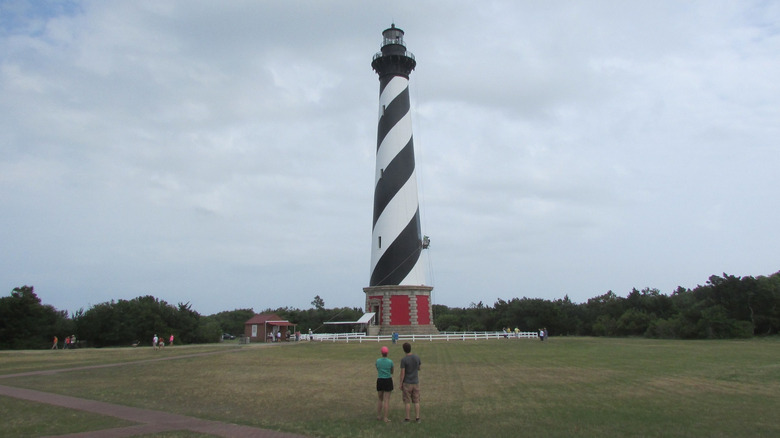
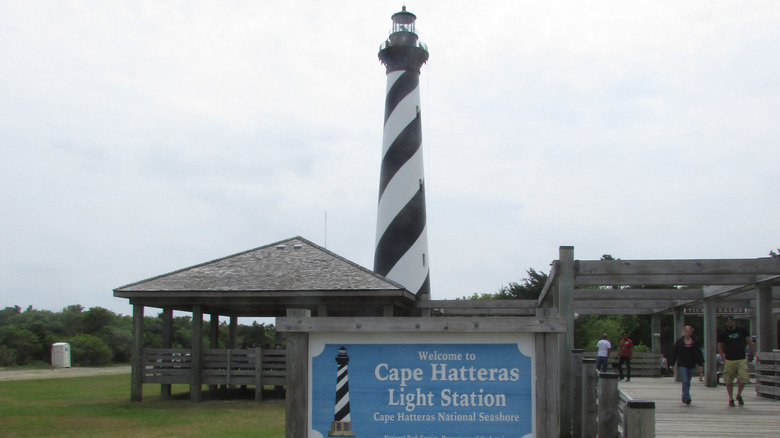
Thanks to its proximity to water, a lighthouse is exposed to the elements more than almost any other building. This is essential for their purpose but also means that they may occasionally have to be moved for their own preservation. This is exactly what happened to the Cape Hatteras Lighthouse, of Buxton, North Carolina. The majestic structure had stood for over a century in its original position, where it entered service in 1870. As the National Park Service notes, Hatteras Island had always borne the brunt of the ocean, with the land gradually retreating as the sand from the beach was redeposited by it. In 1999, a plan was hatched to move the whole structure to safety, before the freshwater or timber that were critical components of its foundation were compromised by the sea. This was ultimately deemed to be the most practical means of protecting the lighthouse, over other options such as a protective wall against the tides, after decades of experimenting with other measures.
To go about moving a 4,830-ton lighthouse, innovative measures are called for. The service explains that the delicate process involved "lifting it off its foundation, transferring the load to a transport system, moving the tower along a prepared move route, and installing it on the new foundation." The lighthouse's new home was only about half a mile away (much safer at just under one-third of a mile from the waters), but getting there took from June 17 to its settlement on its concrete and steel foundation on July 9 1999. Hydraulic jacks and steel rollers laboriously led the lighthouse along the path to its ultimate destination. Some lighthouses are still in use by ships today, and so it's essential they're cared for and maintained, autonomous or not.
Newark Airport Building 51
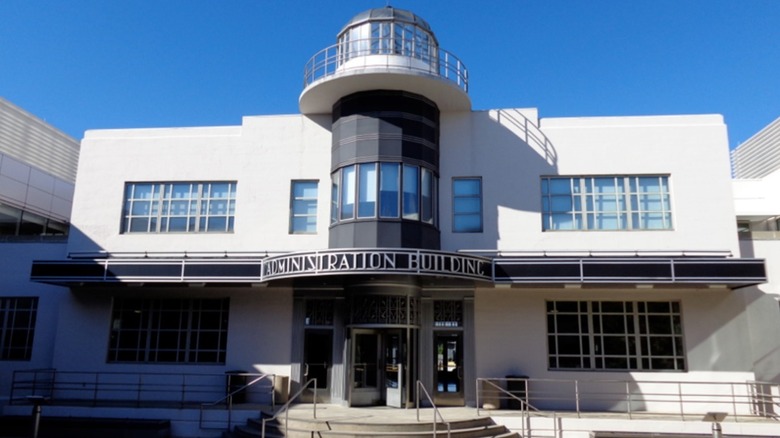
You might think it would be out of the question for a huge airport building to be moved. Nonetheless, sometimes needs must, as proved to be the case with Newark Airport's Building 51. The project, which a March 2001 press release from Port Authority NY NJ described as "the heaviest structure move on rubber-tire dollies in U.S. history," was necessitated by big changes at the airport and would see the building divided into three pieces, with a total combined weight of up to around 9,000 tons. The building consists of a central portion with a lengthy wing on each side and started being used 65 years prior to the press release. It had not been in use as part of the functioning terminal of the airport since 1953, and the idea at the turn of the century was to use the space that Building 51 had been occupying to extend parking facilities, while the building itself would be moved to a new spot.
That spot, about three quarters of a mile away from the original location, became a new Port Authority Police building, as well as housing a museum for Newark International Airport. These additional features were added onto the substantial framework that the former Building 51 offered. In order to move it, the aforementioned rubber dollies, carrying 50 tons apiece, were placed beneath each segment of the building. This was stage two of the operation, the press release explained, after "hydraulic jacks slowly lifted each segment of the building eight feet." It's an extraordinary feat of logistics to move a whole building (or rather, three parts of one) in this fashion, but it was considered a necessary step in the modernization of the airport.
39 Fizuli/Fuzuli Street, Baku
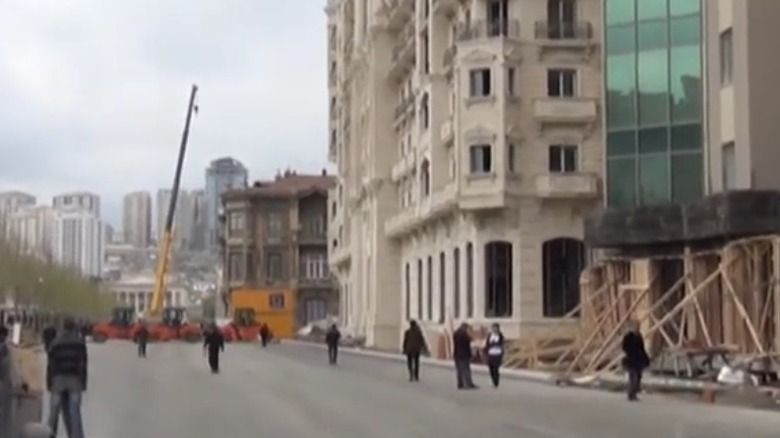
For transportation over a considerable distance, re-assembly at the new site might be more time-consuming but safer in the long run. In the case of the grand house at 39 Fizuli/Fuzuli Street in Baku, the capital of Azerbaijan, the situation required a rather different approach. According to Guinness World Records, this building, which was constructed by Isa Bey Hajinski in the early twentieth century, was the Heaviest Building Moved Intact. The home, all 19,840 tons of it, was moved in April of 2013, 105 years after its construction. Isa Bey Hajinski was a monstrously wealthy oil magnate who may well have had the power to demand such a move simply on a whim, but this move, six years before his death, was actually performed because the roads were being made wider and the elaborate home was in the way of the process.
Cars are becoming ever more numerous, after all, and some of the heaviest cars ever made require quite some space. This was a relatively minor hop of 35 feet in order to accommodate the roadworks. Needless to say, though it wasn't physically far to go, it was a logistical nightmare to move a great mansion at all. In order to pull it off, a new system of foundations had to be constructed with a fortified series of steel supports. The idea was that the grand building could slip from its previous foundation into the new one securely, and this was exactly what happened. As for the moving itself, this was provided by a series of nine jacks, which elegantly shunted the elaborate building into place. It can still be seen at its familiar address and is a stunning example of the fine homes that the extremely wealthy have created in Baku.
The Abu Simbel Temple

Icons like the Great Pyramid, the Sphinx, and the Valley of the Kings are just a snapshot of the wonders left behind by the Ancient Egyptian civilization, which has captured the imagination of the planet for centuries. Just like any other building, drastic measures are sometimes necessary to rescue them from impending disaster. Lake Nasser's water level rose during the construction of a dam near the river Nile, which could have meant irreparable damage to the Abu Simbel temples. This complex is home to the Great Temple and a smaller accompanying one, which were built in the 13th century. Fascinatingly, these temples are no longer found exactly where they were built. With painstaking care, they were disassembled into a combined total of exactly 1,042 blocks in the 1960s, each approximately 30 tons, for a total weight of around 31,000 tons, which were catalogued so that they could be put back together exactly as they were when they reached higher and more secure ground.
As such, the whole temple complex was transported in kit form to a location where the water from the dam would not be able to catch up with it. There, the temples were returned to their original ancient glory. The temples were constructed in a mountainside by the Ancient Egyptians, and though there wasn't an exact replica of that mountainside in the temples' new position, which UNESCO reports was "64 m above the old site and 180 m inland," one was specially constructed there to ensure that the new location was as faithful as possible to the original. The price of the project totaled $80 million, but it was a collaborative project from UNESCO that would go on to define the organization as a critical global force in preserving such historical sites.
London Bridge, Arizona

Of course, if you had to hazard a guess as to where London Bridge is, you'd probably venture "London." Originally, London Bridge was indeed found in the U.K. capital, but practicality problems ultimately led to it being found to be unfit for its intended purpose. London Bridge had stood over the river Thames in the capital since 1831, but into the next century, it hosted an array of cars that its original creators could never have imagined. As a result, the strain on the bridge in its original location became too great. Overwhelmed by the constant weight it was having to bear, it was extremely dangerous for the bridge to remain where it was. Fortunately, American entrepreneur Robert P. McCulloch came along in 1968 with a solution to this problem: He'd buy the bridge for a total of $2,460,000. It was a nice way for the U.K. to make some money from their bridge dilemma, but then McCulloch faced a considerable one himself, that of getting his new bridge back home.
Clearly, no amount of suitcase space would suffice, so he had to think bigger. The solution, which cost an additional $7 million, was to have the blocks of granite that formed the bridge shipped all the way to California's Long Beach, marked for easier reassembly, which was still a very long way from the bridge's ultimate destination of Lake Havasu City in Arizona. The granite was then taken by road to the neighboring state, where it was reconstructed using a more supportive and far lighter framework that cut 100,000 tons off its now 30,000-ton frame. Meanwhile, back in London, the new London Bridge was completed in 1972, constructed right where the former one had been.