

Ukraine Keeps Sinking Russian Ships In The Black Sea Without A Conventional Navy — Here's How
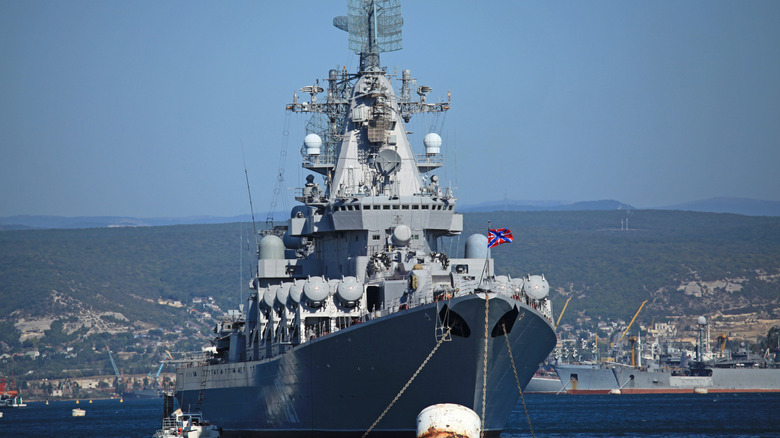
When Russia invaded Ukraine in 2022, many thought the battle for the Black Sea was a foregone conclusion. Ukraine's minuscule navy was merely a remnant of its split with Moscow, when Ukraine ended up with just 18% of the Soviet Black Sea Fleet assets. Twenty-five years of ineptitude, corruption, and neglect left Ukraine with a collection of degraded Soviet warships and one flagship, the frigate Hetman Sahaydachniy. Russia's annexation of Crimea eight years earlier only worsened the problem, causing the Ukrainian Navy to lose its largest port, nearly three-quarters of its ships and sailors, and a majority of its ship repair capabilities.
Within the war's first weeks, Ukraine had lost its strategic outpost on Snake Island, closed its port in Odesa, scuttled its only flagship to prevent its seizure, and lost most of its remaining ships. Many believed that it was only a matter of time before it ceded control of the Black Sea, a geopolitical disaster that would allow Russia to blockade Crimea's Kerch Strait, cutting off Ukraine's only natural sea route for critical grain exports.
A little over a month later, however, Ukrainian forces flipped the script, sinking the flagship of Russia's Black Fleet. In the years to follow, Ukraine's Navy has used unmanned sea drones, anti-ship cruise missiles, and sea mines to not only push the Russian fleet out of its territorial waters but also damage a reported 29 vessels and attack several Russian ports. In 2024, Ukraine sank several high-profile Russian warships, including several of the fleet's newest missile corvettes. Now, three years into the conflict, Ukraine's tactics offer a unique look into the changing landscape of naval warfare, providing several key lessons for those looking to understand how changing technologies may shift naval strategies.
A new type of naval war
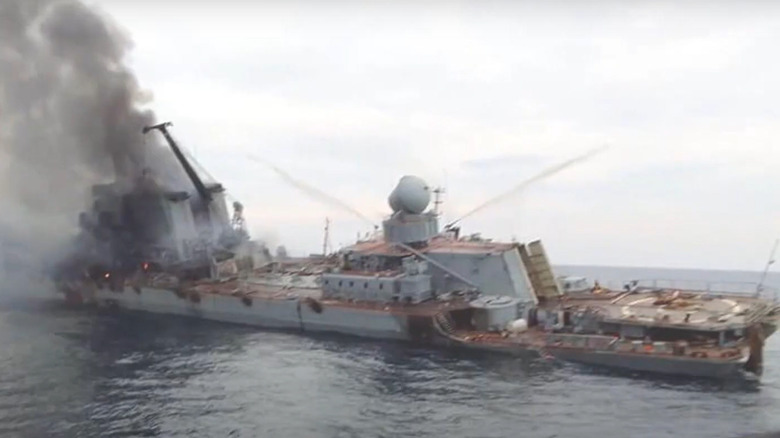
The flagship of the Black Sea Fleet, the guided missile cruiser christened Moskva, was a powerful force in the Kremlin's initial push into the Black Sea. Notorious for its capture of Snake Island, the Moskva was Russia's third-largest warship, equipped with 16 long-range cruise missiles, surface-to-surface and surface-to-air missiles, deck guns, mortars, and torpedoes. But on April 13, 2022, Ukraine launched two Neptune anti-ship missiles at the 12,490-ton cruiser, striking its ammunition and causing a fire that killed at least 18 sailors. It was the largest sunken Russian warship since World War II.
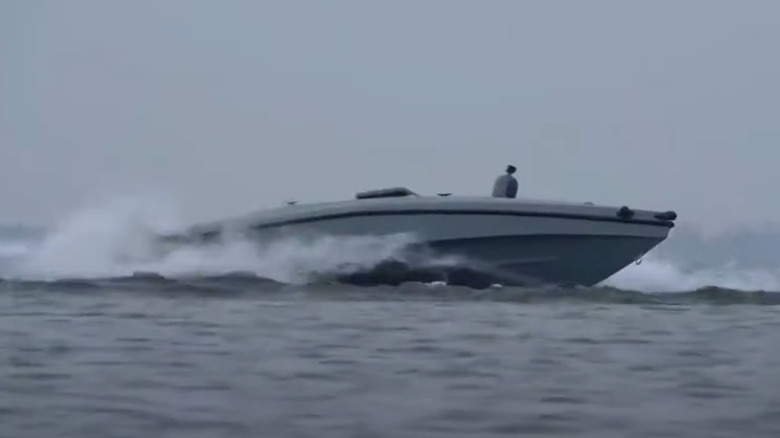
Following this success, Ukraine began deploying its secret weapon: the world's first combat-deployed sea drones, the Magura V5. Resembling a small speedboat, these unmanned surface vessels (USV) can carry 700 pounds of ammunition at speeds of over 50 mph undetected by radar. In October 2022, Ukraine launched at least seven of these unmanned suicide drones towards Sevastopol harbor — then home to the Black Sea Fleet — damaging the newest flagship, the frigate Admiral Makarov, and two other vessels. Together, these attacks would be a portent of things to come, as Ukraine's airborne and naval arsenals would pepper the Russian fleet, forcing Russia to evacuate the majority of its forces from its Crimean port. They have been so effective that Russia began implementing drone-specific defensive measures. Within a year of the first sea drone strike, the majority of the Black Sea Fleet had retreated to Novorossiysk, located outside occupied Crimea. A February 2025 Ukrainian General Staff release stated that Ukraine had damaged 29 vessels in Russia's fleet. According to Oryx, Ukrainian forces have destroyed at least 21 vessels, including 9 warships, eight patrol boats, and an improvised submarine. Russia, meanwhile, has destroyed 13 Ukrainian vessels and captured 19 more since 2022.
An innovation game
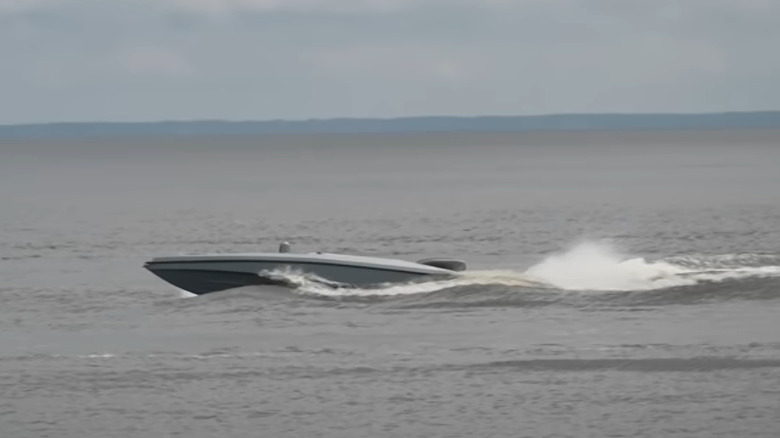
Unfortunately for Russia's navy, the retreat wasn't enough to forestall Ukrainian attacks. In fact, Ukraine escalated its pressure on Russia's navy by developing long-range sea drones capable of attacking targets half a thousand miles away. Since October 2022, it has launched at least four types of drones against the Russian fleet: the Magura V5, Sea Baby, Cossack Mamay, and the newly revealed larger cousin of the V5, the Magura V7. Sea Babies, for instance, rose to notoriety in July 2023, when Ukraine's Security Service launched two of the sea drones loaded with nearly 1900 lbs of explosives at the Kerch Strait Bridge connecting Crimea to mainland Russia, a prevailing symbol of Russia's hold on the region.
Technological and tactical innovations have evolved these satellite-guided USVs to feature more intricate, complex systems. The 18-foot Sea Babies, for example, began as remote-controlled, explosive-laden suicide boats that depended on stealth tactics to reach intended targets. But to combat evolving Russian defense tactics, in which warships and ports are protected by helicopters and patrol boats, the Ukrainians have added machine guns, surface-to-air heat-seeking missiles, rocket launchers, and aerial drones to engage in firefights with Russian forces. The Magura V7 showcased the effectiveness of these additions in May 2025 when Ukrainian Defense Intelligence Chief Kyrylo Budanov credited the drones with downing two Russian Su-30 fighter jets with supersonic air-to-air missiles, a feat hailed as the first time an unmanned surface vessel took out a warplane. In July 2025, social media footage posted by Ukraine's Ministry of Defense showcased USVs launching aerial bombing drones against Russian radar facilities on the Crimean shore, revealing how drone boats can now serve as launch points against land targets. Mines have also been an effective combat tool for Ukraine's sea drones, damaging at least four ships in 2023.
Navies of the world take note
Whether drones constitute a revolution in naval tactics or an inevitable application of existing strategies is debated. But at the very least, Ukraine has challenged whether large naval fleets are a surefire means of projecting geopolitical power unimpeded. In particular, the conflict in the Black Sea has showcased how asymmetric warfare– in which adversaries make up for unequal military capabilities with nonconventional tactics – can challenge even the most advanced navies. In a 2024 interview with CBC, the head of Ukraine's drone operations, pseudonymed Call Sign 13, said that Ukraine's naval tactics showed "that having a large fleet is not equivalent to power" in today's naval landscape.
Both large and small navies have taken notice of this shift. For instance, in June 2025, Taiwan's state-owned weapons manufacturer, National Chung-Shan Institute of Science and Technology began developing explosive-laden unmanned sea drones, hoping to begin production in 2026. The development is a sign that smaller nations may look to the Black Sea as a blueprint for asserting naval autonomy against larger, better-equipped foes. Other navies have followed suit, including Israel, Poland, Lithuania, and the UAE, with each taking preliminary steps to add sea drones to their naval fleets. Even Houthi rebels in Yemen have used sea drones to attack vessels in the Red Sea. China, which sports the world's largest naval fleet, has steadily incorporated drones into its naval strategies. As of 2025, China has developed a large unmanned combat vessel, an amphibious assault ship drone carrier, an extra-large submerged attack drone, and the first submarine-launched aerial drone.
The Black Sea laboratory

Nothing indicates the increasing role of drones in naval warfare more than the U.S. Navy's 2026 budget request. Although the U.S. Navy has invested in drone-technology in the past, the Pentagon's proposal shows a massive increase in the Navy's development of underwater, surface, and aerial drones. According to senior defense officials quoted by Defense Scoop, the Pentagon is requesting a record $13.4 billion for drone development and defense capabilities in 2026. The Navy, for its part, looks to double its drone funding from 2025, requesting $5.3 billion. The report states that roughly $2.43 billion will go to surface and underwater drones.
How the U.S. Navy deploys these resources will be heavily influenced by the conflict in the Black Sea. At a February 2025 panel, U.S. Rear Adm. Michael Mattis — commander of the Naval Task Force charged with integrating Robotic and Autonomous Systems into fleet operations — stated that the Russo-Ukrainian conflict will directly inform the Navy's drone efforts, going as far as to call it "the Black Sea Laboratory." For Mattis, the conflict is uniquely enlightening because of its various innovation cycles, in which one can observe the "action, reaction, counteraction" of both countries adjusting to the other's evolving drone attack and defense strategies. In an interview with Business Insider, Mattis noted that the U.S. Navy deployed defense strategies gleaned from the conflict in its 2025 Baltic Operations exercise with NATO partners. In a move that further indicates how the Black Sea is informing U.S. sea drone strategies, the DoD's Defense Innovation Unit released a solicitation for underwater drones, including its first "kinetic, one-way attack" unmanned underwater vehicle. On balance, these developments show that even the world's most powerful military may be taking notes from a navy without a flagship.