

USS George H.W. Bush Vs Abraham Lincoln: How The Two Nimitz-Class Carriers Compare
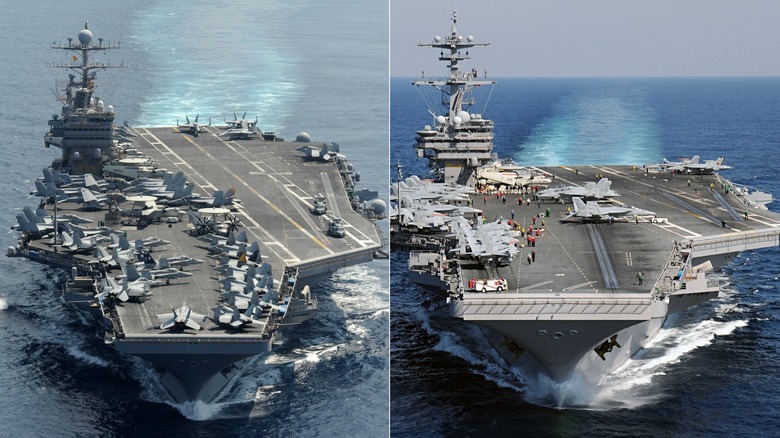
In September 2026, the USS Abraham Lincoln (CVN-72) got a lot of press for its extended deployment. When the ship was finally redeployed back to the States, pictures of rust along the hull became news about how long aircraft carriers typically stay out to sea. Similarly, the USS George H.W. Bush (CVN-77) recently had its deployment to the Middle East extended to as much as a year, according to information provided to the families of service members serving aboard the ship.
Both vessels are Nimitz-class aircraft carriers, named to honor Fleet Admiral Chester W. Nimitz. While they're of the same class, there are several differences between the two carriers, due largely to when they were constructed. The United States Navy (USN) commissioned the Lincoln on November 11, 1989, making it the fifth ship of its class. The Bush received its commissioning on January 10, 2009, nearly 20 years after the Lincoln. The Bush is also the final ship in the Nimitz-class line, and a lot changed between the construction of the two carriers.
Nimitz-class aircraft carriers were built with a 50-year service life, requiring a single mid-life Refueling and Complex Overhaul (RCOH), so when the Bush entered service, the Lincoln was just about ready to undergo its RCOH. During that process, the ship is retrofitted with all of the modern upgrades available at the time. The Bush benefited from those upgrades right out of drydock, and when it undergoes its own RCOH sometime after 2030, it will receive similar upgrades, making it more advanced and capable than its sister ships.
The USS Abraham Lincoln (CVN-72)
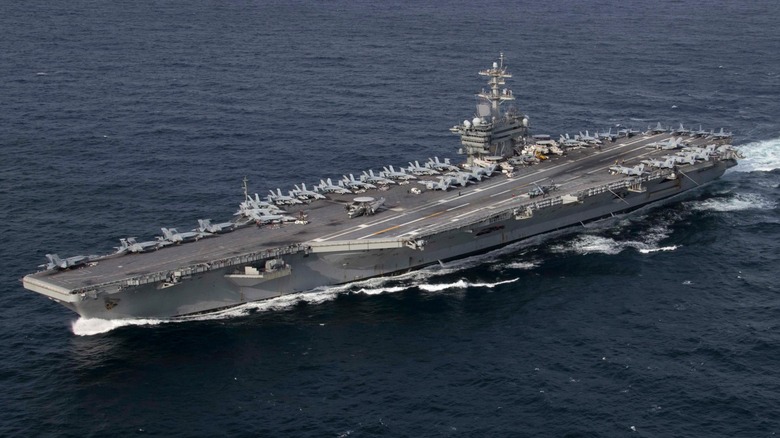
When it entered service, the USS Abraham Lincoln, or "Abe," as it's affectionately known by its sailors, didn't take long to find itself conducting combat operations. The brand-new carrier's maiden deployment came when it supported Operation Desert Storm following a brief humanitarian stopover in the Philippines, where it evacuated 45,000 people following the eruption of Mount Pinatubo. Following this, the ship's Carrier Air Wing participated in combat air patrols and reconnaissance over Kuwait and Iraq during Operation Desert Storm.
The ship and its crew continued to serve with distinction for years, participating in numerous combat operations around the world. When it entered service, the Lincoln was a top-of-the-line Nimitz-class carrier, measuring 1,040 feet long with a displacement of around 102,000 tons. Like other ships in the class, it's powered by two nuclear reactors, boasts its own wing of impressive aircraft, and is crewed by over 5,000 USN and U.S. Marine Corps personnel.
During its RCOH, the Lincoln received numerous upgrades over a four-year period, during which it was docked at the Newport News Shipyard in Virginia. In addition to refueling the reactors, which gave it another 25 years of operational capability, approximately 33% of the ship's lifecycle maintenance was performed. The combat systems, infrastructure, and more were all upgraded to modern specs, which brought the Lincoln up to the same level of operational readiness as the USS George H.W. Bush despite their 20-year difference in construction and service entry.
The USS George H.W. Bush (CVN-77)
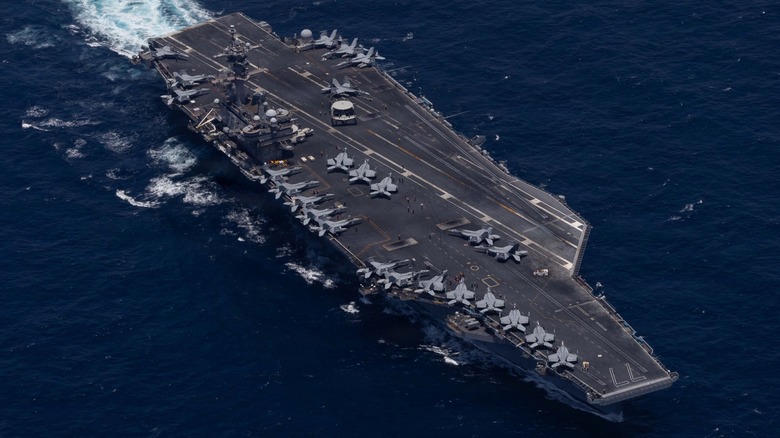
Like the Lincoln, when the USS George H.W. Bush first entered service, it was a top-of-the-line aircraft carrier featuring all of the modern bells and whistles. It was built with the same primary ship specifications, displacing the same amount of seawater, holding the same capacity of personnel, it maintains around 56 fighter jets, and it too will need to undergo an RCOH after around 25 years of active service. Like the Lincoln, the Bush entered service during a period of conflict, and its maiden combat deployment took place between May and December 2011 after relieving the USS Enterprise (CVN-65).
This deployment also marked the first for the Boeing EA-18G Growler, a then-new electronic warfare aircraft. The Bush carried out missions in support of Operation Enduring Freedom in Afghanistan, and it later took part in Operation New Dawn in Iraq. While there are many similarities between the two Nimitz-class carriers' designs, the Bush entered service with several improvements and enhancements of the Lincoln's legacy systems. It's the second Nimitz-class ship to feature a bulbous bow for increased buoyancy, and its propellers were redesigned.
The flight deck also features a curved design to reduce the carrier's aircraft signature. It featured upgrades to the onboard communications and weapons-handling systems. Additionally, the Bush was constructed using high-strength, low-alloy steel, which improved strength while reducing weight above the waterline. While there are differences between the two carriers, they both operate with distinction, projecting the USN's might across the world as members of the largest and strongest naval fleet in active service.