

Can A Tankless Water Heater Be Installed Directly Against A Wall?
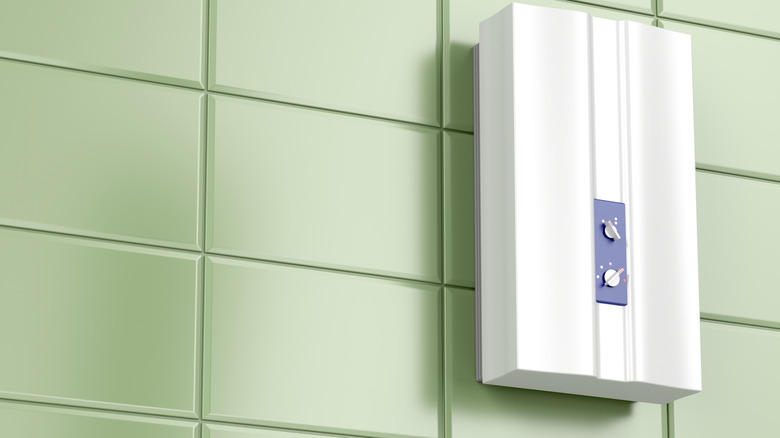
If your water heater is in dire need of replacement, you have options. For starters, you could stick with a regular one (the model with the tank), even though one of the biggest drawbacks of a tank water heater is that they tend to bite the dust quicker. The plus point is that they're cheaper in terms of upfront costs, but the fact that you'll have to shop for the replacement sooner tends to erase the longer-term cost savings. Also, the tank itself is large and cumbersome, which doesn't leave you with much room (literally) in terms of placement. Tankless versions, on the other hand, are an upgrade in the true sense of the word. It's true that tankless water heaters come with their own set of disadvantages, with higher upfront costs being a big one. But if you can look past the initial impact on your wallet, they provide hot water on demand, and their smaller form factor means you'll save space, which is enough for many to make the switch.
Now, can you place it snug against the wall to maximize your space? Yes, you can. Because it's installed on the mounting brackets that came with the unit, it can be as snug to the wall as possible. However, you can't just put it anywhere. Despite the much greater palette of placement options than with a tank model, you still need to provide it with enough wall clearance. You want to leave around 12 inches of clearance in all directions around the unit for both venting and easier service access. Plus, with gas-powered units, you'll have to leave anywhere from 12 to 18 inches of space for the twin-pipe vent for safety.
Where is the best location for a tankless water heater?
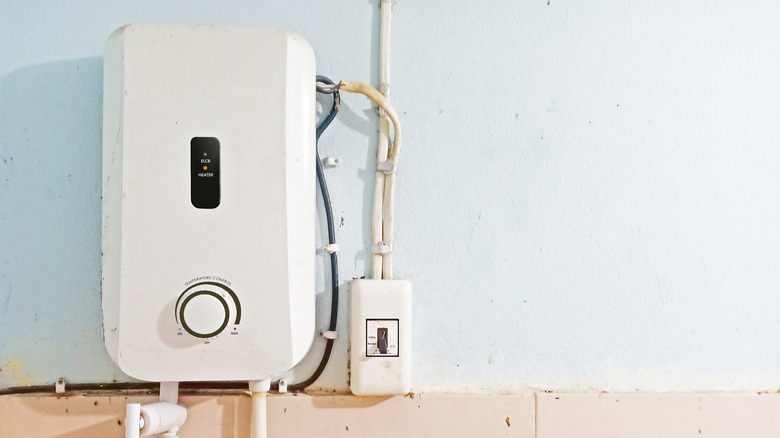
The whole point of tankless heaters (or at least a part of it) is hot water on demand. Nonetheless, since there is no tank, you can't store any water, meaning that the primary consideration in terms of placement is how far the heater will be from your faucets — you don't want the water to travel too far. Avoid placing it in a basement, as it's not exactly good at handling cold weather, and keep it clear of windows and doors.
Safety is another factor, so you'll also have to keep the heater away from combustible objects. Water heaters produce carbon dioxide, so the place should have adequate ventilation. Last, but certainly not least, you need to connect the heater to a utility, so consider the availability of power, gas, and water lines. A good option (if you have it in your home) is a utility room that is properly ventilated. An insulated garage can work too, if it meets the above criteria. Despite having to provide it some clearance, a tankless heater will still take up less room than a large tank. After all, these machines can be as little as 11 inches tall, so when you combine the clearance, it takes just under 25 inches of space.