

What Those Orange And White Stripes On Road Barricades Actually Mean
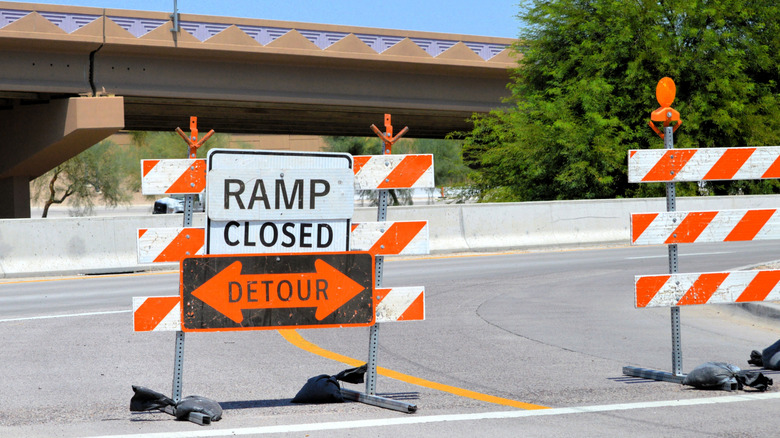
You certainly don't want drivers accidentally speeding into road construction zones and wrecking any progress (and themselves), so to prevent that, authorities set up barricades. Built around guidelines specified by the Manual on Uniform Traffic Control Devices (MUTCD), barricades are grouped with traffic cones as devices that guide drivers away from such zones. One type has orange and white stripes printed on it, slanting to either side depending on the situation. Specifically, the rulebook states that such barricades are supposed to have "alternating orange and white retroreflective stripes sloping downward at an angle of 45 degrees."
The appearance is pretty similar to yellow-and-black striped markers, which also tilt 45 degrees, and the reason why stripes slope this way is because they're designed to double up as arrows. So if they slope left, that's the direction you need to head; if it's right, you go right. That said, depending on whether the barricade blocks a part of the road or the entire road, this can mean two things. With barricades that block only part of the road, the stripes point you toward the lane you need to switch to. But when they act as a full block, the stripes point you toward the detour.
Sometimes, though, a detour opens both ways. With those, the stripes end up pointing two ways by starting from the inside and sloping downwards in both directions. There are also cases where both turns are closed; with those, the stripes start from the outside and slope inwards to create a V. Spot one and you know it's time to find a different road entirely to get to your destination.
The stripes come with a bit of a catch, though
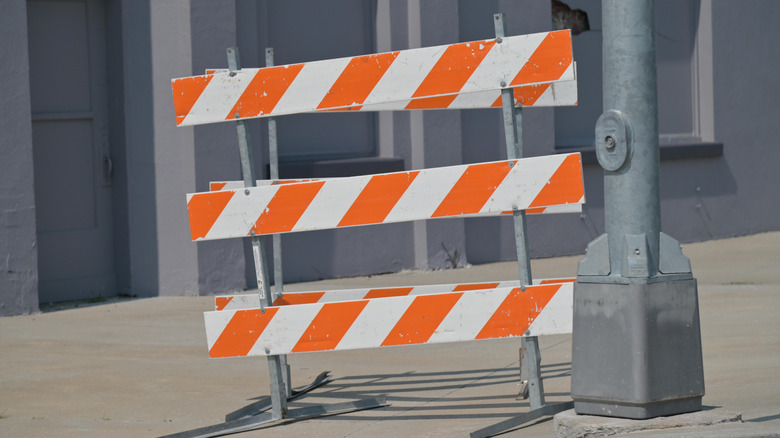
It's certainly a clever implementation when you think about it. But what makes it clever is, unfortunately, exactly what can make things murky. The thing is, you spot barricades as you drive, and because they're a little vague in this case, with the directional cues coming from simple stripes, this information can be difficult to register. In fact, an old study from all the way back in 1981, later summarized by the FHWA, found that diagonal stripes "conveyed no consistent directional information." Chevron patterns — which do provide arrow hints — were found to be more reliable.
It doesn't help that crews sometimes don't even set barricades up properly. For instance, in Montana in 2014, it was found that barricade use was only "for the most part, correct." Montana's transportation department, which reported the findings, suggested there's some scope for improvement in this regard because crews sometimes overlooked the striping direction.
That said, we can cut barricades some slack because helping you figure out which direction to go is sort of their secondary function. The main job is still to prevent vehicles from ending up in work zones — something that actually happens more frequently than you'd think.
As a matter of fact, a spring 2026 survey of more than 700 highway contractors found that 60% of them saw at least one crash involving a moving vehicle in their work zone through the year. Add to that the data from the National Work Zone Safety Information Clearinghouse, which stated that work zone crashes killed 850 people in 2024. Barricades are designed to prevent such accidents by steering people away from such zones, but we know some signals and signs can be more confusing than helpful.