

5 Harley-Davidson Motorcycles Most Likely To Last 100,000 Miles
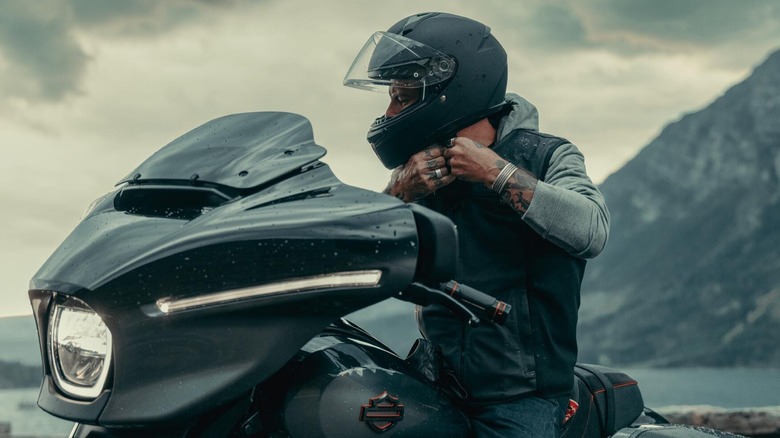
Harley-Davidson motorcycles are known for being big and powerful, with plenty of low-end grunt and a deep, rumbling sound. But one thing that people don't often mention about the brand is the surprising reliability of its newer models. Consumer Reports released a reliability survey in 2015 covering more than 12,300 motorcycles, using owner-reported problems to estimate repair rates by the fourth year of ownership. Unsurprisingly, the Japanese brands Yamaha, Suzuki, Honda, and Kawasaki took all of the top spots. But you might be intrigued to learn that Victory and Harley-Davidson scored in the middle of the pack, outclassing the European and Canadian brands.
That said, early failure rates are just one measure of reliability. Another factor that you might want to consider is longevity. Motorcycle engines don't often last as long as cars. Only a precious few of them manage to make it past 100,000 miles without needing a major engine overhaul. There are a handful of touring and cruiser motorcycles out there that can pass that marker, so long as they're cared for and receive regularly prescribed maintenance.
Those who are interested in getting a bike that's made to endure long miles and keep on kicking might be eager to hear about a few of the Harley-Davidson motorcycles that are most likely to hit, or even surpass, that 100,000-mile threshold. While the 1984-1994 Evolution FXR performance cruiser certainly merits an honorable mention, it probably doesn't come as much of a surprise that the top five models are all touring motorcycles.
Harley-Davidson Road King
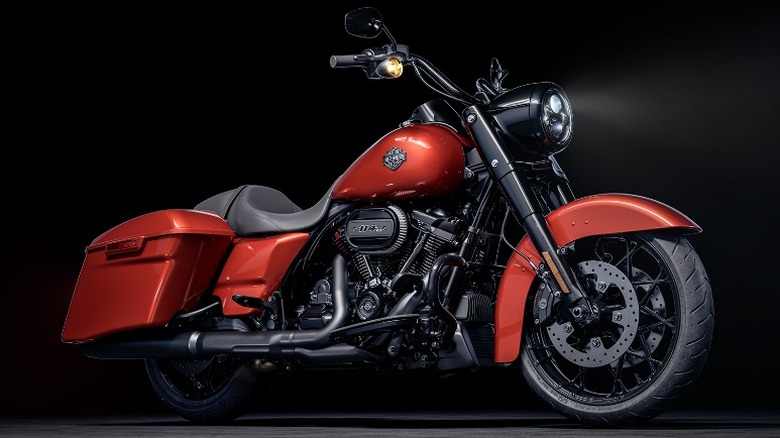
One of the first bikes that you'll hear about when you start looking into high-mileage Harley-Davidson motorcycles is the Road King. This is a heavy-duty touring bike that launched in 1994. The 1999-2016 production run used the famously easy-to-manage Twin Cam 88, Twin Cam 96, and Twin Cam 103 engines. The latest variations are now powered by the Milwaukee-Eight 114 — a 1,868cc 45-degree V-twin engine that gives the bike up to 95 horsepower at 5,020 rpm and 122 lb-ft of torque. Harley-Davidson developed the Milwaukee-Eight engine specifically to enhance the overall touring experience by increasing displacement and minimizing vibration.
The Road King has frame and fork assemblies that are similar to Harley-Davidson's heaviest full-dress baggers, but it lacks the fairings, speakers, and digital displays that introduce electrical complexities and add front-end weight. Additionally, the six-speed Cruise Drive transmission in post-2006 models helps to keep engine speeds low at highway pace, minimizing internal piston, ring, and valvetrain wear over long distances.
According to the YouTube channel Everything Harley, those who own the Road King regularly manage to hit over 120,000 miles without ever needing an upgrade or anything beyond basic maintenance. There are dozens of reports on sites like Reddit with users claiming to have easily cleared 100,000 miles on their Road King. One user on the Harley-Davidson riding forum reported having put over 224,000 miles on a 2020 model without the need for any major mechanical intervention. There were some concerns about the reliability of early Harley-Davidson Milwaukee-Eight engines regarding oil pooling in the crankcase, but this appears to have been resolved in post-2019 models.
Harley-Davidson Electra Glide
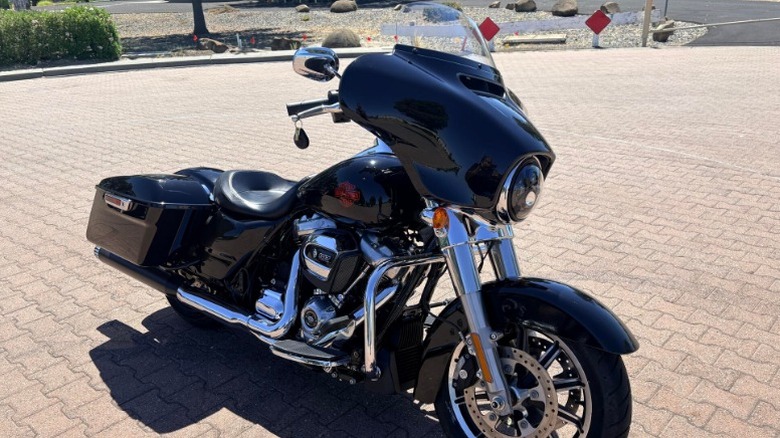
Now let's turn to the Harley-Davidson Glide family of motorcycles. The word "Glide" is used for Harleys as a reference to the suspension system, and not necessarily the type of motorcycle that bears the name. There are several bikes, like the Dyna Super Glide and Hydra Glide Revival, that are more traditional cruisers and not long-haul touring machines. That said, the touring bikes that bear this name tend to eat up miles without breaking a sweat.
The first to consider is the Harley-Davidson Electra Glide. These were introduced in 1965, earning the name "Electra" by being the first large-frame motorcycle sold by the brand with an electric starter. It was also one of the earliest models Harley put out that was built for the explicit purpose of accumulating steady, low rpm miles that stack up the odometer without wearing out the bike. Dozens of Electra models and editions have been released over the decades, before the series was put on hiatus. Older versions featured the legendary Evolution engine that is well known for lasting well into six-digit mileage; then it was powered by the aforementioned Twin Cam, which is also extremely highly regarded. Finally, this most recent generation ran from 2019 to 2022 and featured the Milwaukee-Eight 107.
Riders regularly claim that this bike easily crosses the 100,000-mile threshold and continues to run smoothly when given proper care and maintenance. Rider's Share states that many of them hit more than 160,000. In fact, South East Harley-Davidson posted about a guest who came in from out of state and had his Electra's mileage verified at 450,898 miles, claiming that he averaged 75,000 miles a year.
Harley-Davidson Road Glide
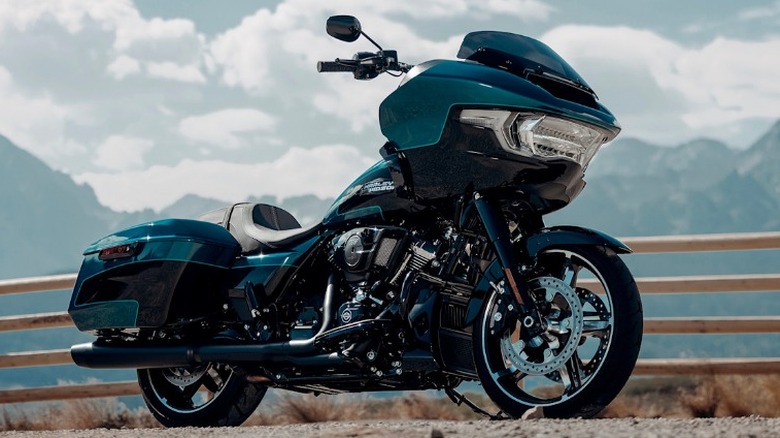
The next glide model to watch out for is the Harley-Davidson Road Glide, which was introduced in 1998. This sharknose touring bike uses the same FL chassis and six-speed Cruise Drive transmission as the models we've already looked at, while also boasting several matching engine options.
The 2026 Road Glide is built on the Milwaukee Eight 117, giving it 105 horsepower at 4,600 rpm and up to 130 lb-ft of torque. But the biggest thing that sets it apart is that distinctively bulky front fairing, which is highly regarded for its wind protection. That isn't the only feature that makes this design unique, though. The massive fairing and instrument cluster are actually mounted directly to the frame instead of the front forks. This takes a tremendous amount of weight off the steering system, making it easier to operate and reducing mechanical stress on the steering neck and forks. Lower strain on the bike's hardware helps it power through long miles despite its bulky front end.
Cross-country tourers frequently log massive distances on the Road Glide. These bikes easily exceed 75,000 miles, and it's exceptionally common for them to surpass 100,000. Used models with over 100k can be seen all over the internet. Harley-Davidson's own site has a 2025 model that already has 141,133 miles currently listed and several others in the high 80-90k area just waiting to cross that threshold. One man reportedly managed to put 100,000 miles on a 2021 model in just 100 days. What's more, many of these people have stated that they have logged these distances on much of the bike's original hardware.
Harley-Davidson Street Glide
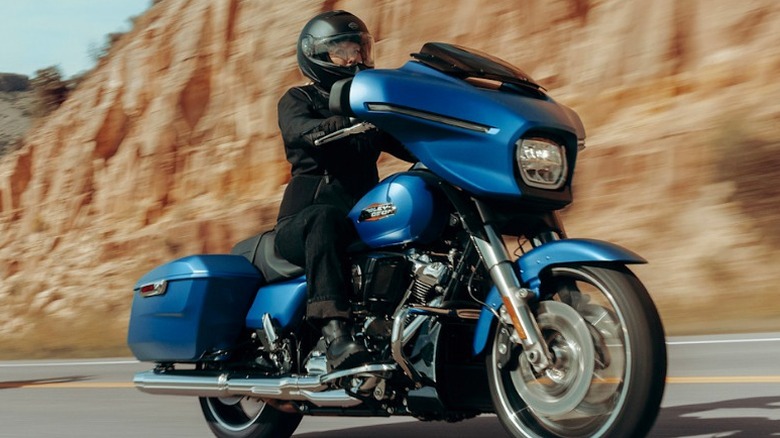
The third model in our trifecta of long-mileage Glides is the Harley-Davidson Street Glide. The bike debuted in 2006 as a stripped-down, custom-styled variation of Harley's touring platform, using the Twin Cam engine family. Underneath its fork-mounted fairing is that same FL touring foundation used by its siblings, complete with those heavy engine cradles. In the modern 2026 model, these also carry a Milwaukee-Eight 117 engine, giving it 105 horsepower and 130 lb-ft of torque.
The Street Glide naturally attracts riders who use their motorcycles for extended highway journeys rather than short urban trips because it features aerodynamic wind protection and standard hard saddlebags. High-capacity oil coolers and liquid-cooled cylinder head configurations on late-model Twin Cam and Milwaukee-Eight versions keep engine oil temperatures within stable ranges during long summer tours as well, preventing thermal breakdown over time.
Like the rest of the FL family, these bikes should be able to easily hit 75,000 miles with proper maintenance, and 100,000-mile Street Glides are fairly common on the second-hand market. The Harley-Davidson website even has a listing for a 2012 model with a full 500,000 miles on it. This bike might need a little more help than some of the others in getting there, though. The fairings rest directly on the front forks, not the frame, so riders operating older high-mileage models will occasionally have to adjust neck bearing preload or replace fork bushings, but the underlying engine and transmission hardware are built to comfortably endure six-figure mileage.
Harley-Davidson Evolution Sportster
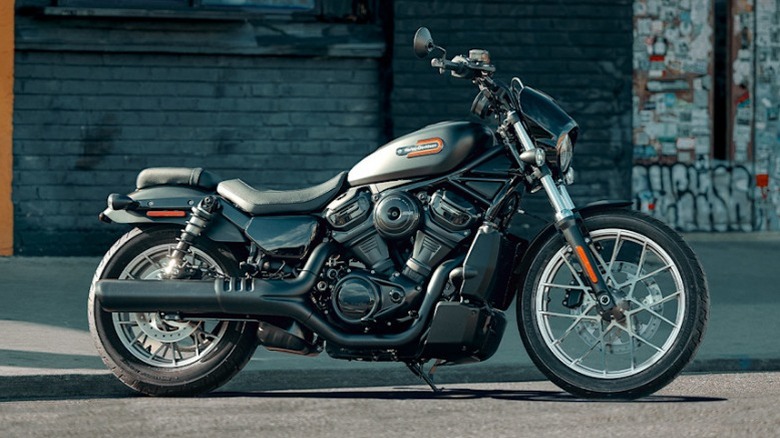
The Harley-Davidson Sportster has had a lot of different names and submodels over the years, but it has always been a popular line of machines. While the Dyna, Softail, and Fat Boy all deserve an honorable mention, there's a reason the Sportster is the only non-touring bike to make this list. Because there are so many different variations of Sportster out there, it's worth noting that the Evolution Sportster that was in production from 1986 to 2022 is particularly well known for its durability and longevity. This was sold in 883cc, 1,100cc, and 1,200cc displacements, with the Evolution 883 in particular standing out as one of the most reliable Harley-Davidson engines ever built.
Unlike the big-twin models that use separate cases for the engine and transmission, the block-head Evo Sportster uses a unit-construction design where both components share a compact, rigid case layout. The air-cooled Evolution V-twin is widely regarded by motorcycle mechanics as one of the most mechanically sound engines Harley-Davidson ever produced. It utilizes four gear-driven camshafts and self-adjusting hydraulic roller lifters, completely eliminating the need for periodic valvetrain adjustments. Its simple, under-stressed architecture runs cool and experiences minimal internal wear over tens of thousands of miles.
The older versions of this bike had solid-mounted frame configurations, while the post-2004 models utilized rubber-mounted setups, but all of them have a long record of reaching 100,000 miles without requiring a top-end rebuild. Although there don't appear to be quite as many of these motorcycles as the touring models, you can still find plenty that have crossed this threshold.