

What Do Two Red Pennant Flags Mean In Boating?
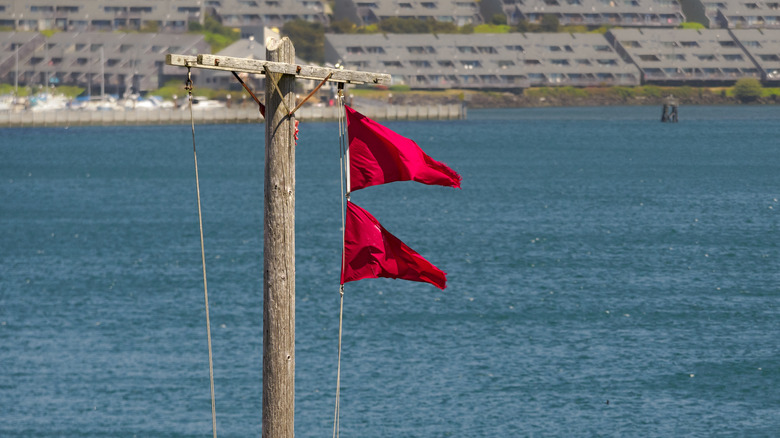
A key part of staying safe when docking or when you're out on the water is being able to understand the meanings of the flags that officials, agencies, and other boaters display. However, there are so many of them that it's easy to overlook a few. One particularly important flag that's worth remembering is a set of two red pennant flags: It's part of the warning system used by the Coastal Warning Display Program, and it's there to warn you about an upcoming or existing gale-force winds.
Specifically, the flag warns that there are consistent winds or frequent gusts of between 34 knots (39 mph) and 47 knots (54 mph) inclusive. These conditions can either be current or forecast to happen imminently, but either way, they're a sign that boaters should prepare accordingly. Low visibility means that there's little point in flying the flags at night, so instead, boating stations that use the system will display two lights instead. Those lights are arranged vertically, with a white circular light at the top and a red circular light at the bottom.
If you see one red pennant flag rather than two, it's a small craft advisory warning. This warning informs boaters that there will be brisk winds in ice-covered waters. At night, that small craft advisory warning is displayed using two vertically-stacked lights, but this time, the red light is at the top and the white light is at the bottom.
The warnings aren't just for boaters
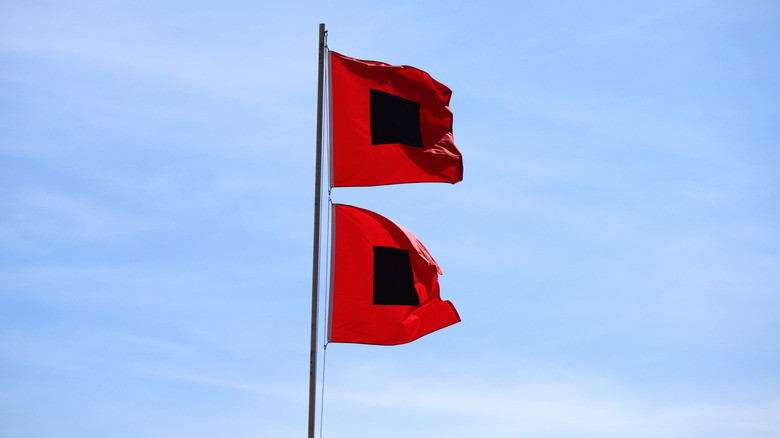
The two other key weather warnings issued by the Coastal Warning Display Program take the form of either a red flag with a black square in the center, or two of those flags stacked on top of one another. One of those flags means that a storm warning has been issued, while two means that a hurricane warning is in force. At night, a storm warning is displayed by two red lights stacked vertically. A nighttime hurricane warning sees a trio of lights stacked vertically, with a red light at the bottom and at the top and a white light in the middle.
The system of flags and lights is a traditional way to warn boaters of adverse weather conditions, and the current system has been in place since 2007. It isn't just for mariners though: In a press release issued at the system's launch, Capt. Jim McPherson, the Coast Guard's chief of public affairs, said that "flags indicat[ing] changing weather from gale to storm to hurricane conditions [mean that] everyone, not just mariners, must tune in to National Weather Service broadcasts and start thinking what they will do to prepare for the worst." He added that the flags "communicate to the American public the lesson of past hurricanes to take personal responsibility for individual safety in the face of an approaching storm."
There are plenty more important warning flags to be aware of
While the Coastal Warning Display Program displays flags at Coast Guard boat stations, boaters should also make sure that they know the meaning of the flags that other craft might display. One particularly important flag is the checkered yellow and black flag, which is known as the Lima flag in the International Code of Signals, or ICS. When it's flown by another boat, that boat is signalling that you should bring your vessel to a standstill as soon as possible. Usually, it's flown to indicate a significant hazard ahead.
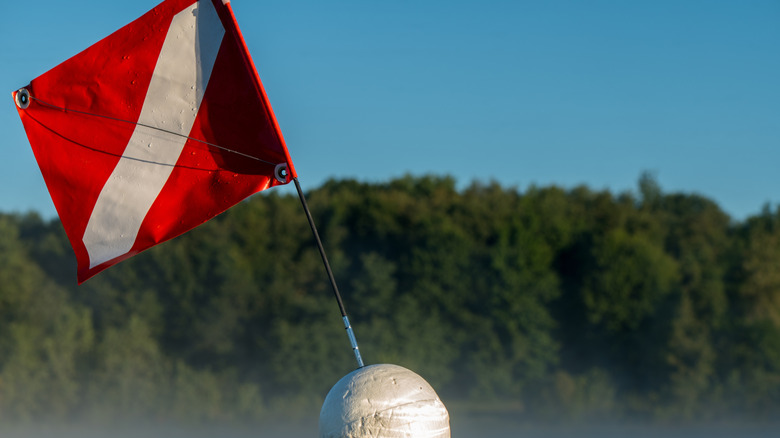
A red flag with a diagonal white stripe is another safety-critical flag to know the meaning of, since it indicates that there are divers in the water in its vicinity. Where it is displayed, boat operators need to reduce their speed to idle within 300 feet of the flag in open water, or within 100 feet of the flag on rivers or on narrow channels.