

What Does A Checkered Yellow And Black Flag Mean In Boating?
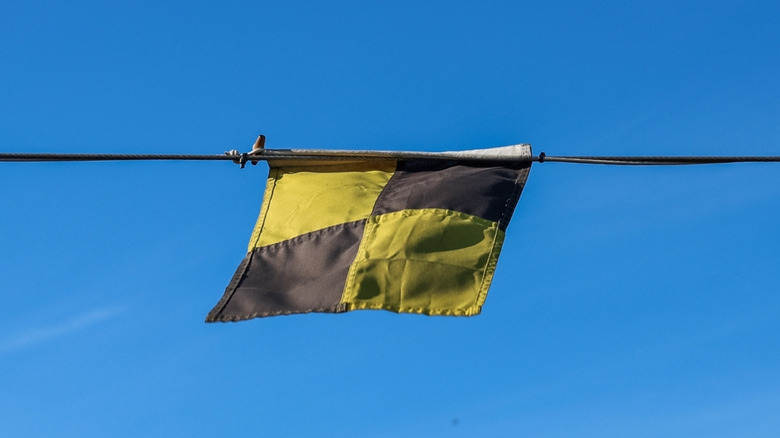
If you aren't familiar with the International Code of Signals (ICS), you might not know that a boat waving the checkered yellow-and-black flag has an important message for you: Stop your vessel immediately. Known as the Lima flag in the ICS, this distinct pattern should be taken as an urgent directive from the boat waving it. Don't pass by it like it's nothing; it's a signal that you need to stop your boat right away.
Of course, boats can't just slam on the brakes like a car can. (Hence the 100-foot rule in boating.) At the sight of a checkered yellow-and-black flag, you should nevertheless do your best to slow down and stay put until you can figure out why that boat is flying that flag in the first place. Perhaps there's an obstacle you'll collide with if you continue on. Or maybe there's a chance of running aground up ahead. Whatever the reason ultimately may be, there's specific information that another boat is trying to communicate to you, and they'd like you to stop and hear it.
Why flags matter so much to boaters
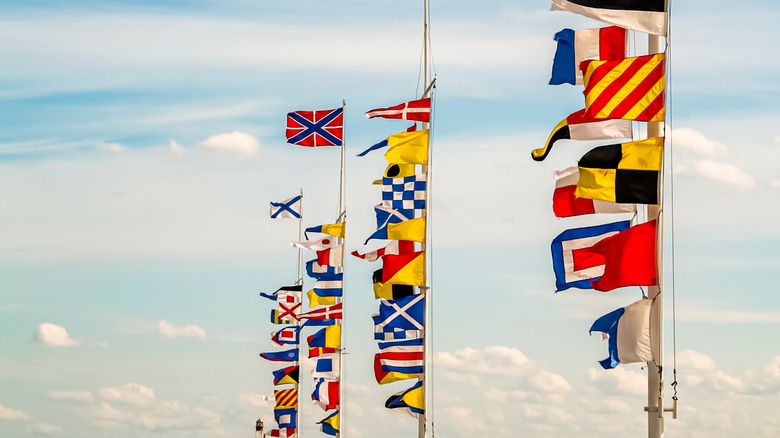
The Lima flag isn't the only pattern in the International Code of Signals that a boater needs to understand. There are dozens in all, each with its own message for fellow boaters. Knowing the look and the meaning behind the Lima flag (or any other flag with an urgent message, such as the blue, white, and red Whiskey flag) allows you to act more responsibly out on the water.
And remember, not all vessels can rely on spoken communication alone. This is an international code, after all, and not everyone speaks the same language or uses the same technology to communicate out on the water. That's what signal flags are for. They provide a visual method of communication that lets crews exchange information, even when radio communication is down or a language barrier stands in the way.
It also shouldn't be confused with other checkered flags in the ICS. The November flag is blue-and-white checkered, and it means no. The Uniform flag is checkered red-and-white, and it means there's danger ahead.