

Why Manufacturers Keep Trying To Combine Spark And Compression Ignition
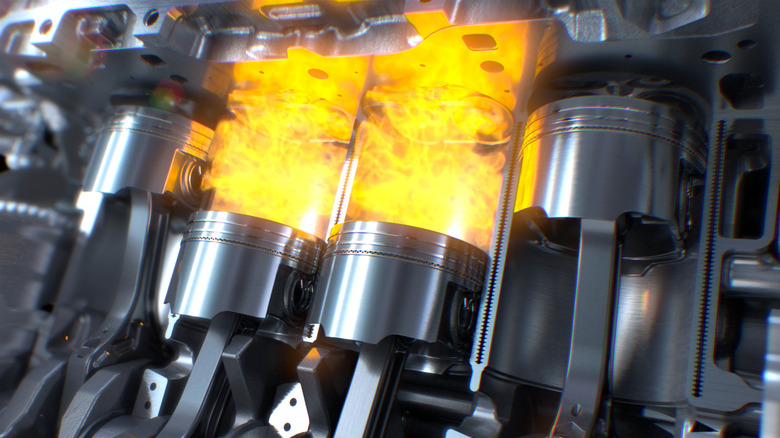
In terms of internal combustion engines, there are essentially two roads you can go down — gasoline or diesel. Both engine types have pros and cons. However, one of the defining differences between them is efficiency. Diesel engines are inherently more efficient than their gasoline counterparts. There are a couple of major reasons behind this — the first is that diesel is more energy-dense than petrol, up to 15 percent in some cases. The second reason is how diesel is ignited — diesel engines don't use spark plugs to ignite the fuel. Rather, they compress the air in the cylinder to such a temperature that when the diesel is injected, it spontaneously combusts.
To achieve the temperatures needed for ignition, diesel engines compress air to ratios of between 14:1 and 25:1. For comparison, gasoline engines usually operate somewhere in the 8:1 to 12:1 range. Aside from the energy density of the fuel itself, the higher compression ratio of diesel fuel is important; engine efficiency and performance are both improved with higher compression. And although there are cons as well as pros with diesel engines, this raises an interesting question — if compression ignition works so well, why don't gasoline engines use it too?
Of course, we're not the first to ask this question. As long ago as 2019, Mazda hadn't just played with the concept — but had actually released a commercial version. Although never available in the US, the company's Skyactiv-X engine was termed a "spark controlled compression ignition (SPCCI) engine." Other manufacturers including Ford, General Motors, Honda, Mercedes, and others all also explored the underlying homogeneous-charge compression-ignition (HCCI) technology.
HCCI -- The gasoline engine that thinks it's a diesel
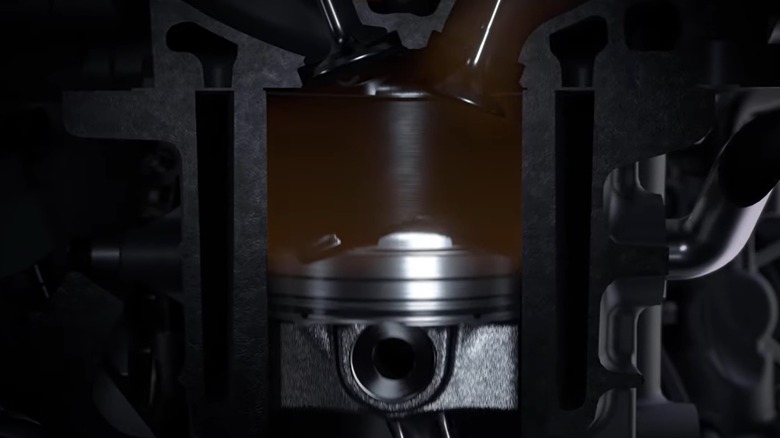
The goal of engineers developing these engines was simple — produce an engine with the efficiency of a diesel and the cleaner combustion of a gasoline engine. It was this pursuit that led to the development of the HCCI engine. To understand why manufacturers pursued this goal, it's worth looking at a downside of gasoline engines. Something you might not know about diesel engines is that they only compress air. Gasoline engines compress both the air and the fuel and use a spark plug to ignite the mixture. This is a relatively clean approach but, as noted, it limits how much it can be compressed; too much compression and the fuel can prematurely combust.
HCCI attempts to get the best of both worlds. Like normal gasoline engines, it injects a mixture of fuel and air into the cylinder. However, instead of relying on a spark plug, the mixture is compressed until spontaneous combustion occurs, much like in a diesel engine. In theory, this should be a win-win situation, with higher compression ratios offering more bang for your buck (Mazda's says its SPCCI engine has fuel efficiency improvements of up to 30 percent at compression ratios of 15:1) while retaining the relative cleanness of a gasoline engine.
However, turning this concept into a reality proved challenging, and Mazda remains the only major manufacturer to release a commercial version. Let's examine why this is the case, and whether there's a future for the technology.
Why HCCI technology is rare
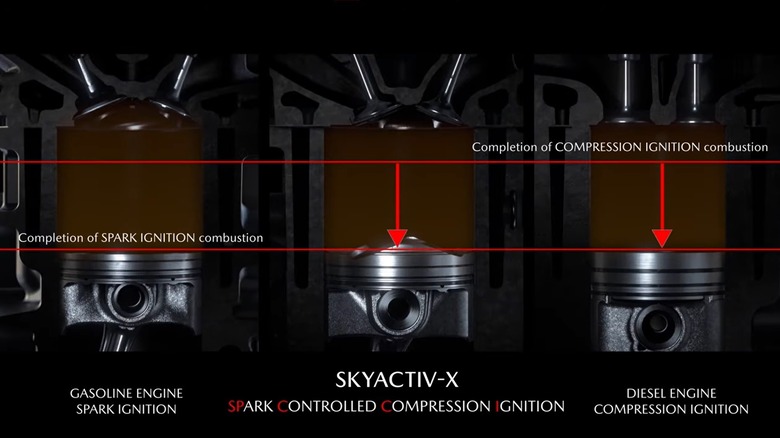
While the concepts of the engine and what it could achieve are relatively simple to understand, the exact opposite can be said of the engineering challenges that developers faced. Essentially, HCCI removes many of the controls engineers use to control combustion. In gasoline engines, the spark plug ignites at a precise moment, while diesel engines inject fuel at an equally precise moment. However, HCCI engines rely on the mixture igniting spontaneously when the temperature and pressure both become high enough, and changing engine loads affect when that auto-ignition occurs.
For decades, these engineering problems prevented manufacturers from developing an engine reliable enough for full-scale production and roll-out. It was Mazda's approach to the problem that saw the engine become feasible enough to go into production. Rather than a 100 percent reliance on compression for the combustion event, Mazda introduced the "hybrid" SPCCI design. In this system, a spark ignites a precisely injected pocket of fuel. In turn, this small explosion increases pressure to the point that the leaner air/fuel mix in the rest of the cylinder combusts. A pressure sensor in each cylinder determines whether the conditions are right for compression ignition; if this isn't the case, then the system simply resorts to conventional spark ignition.
As for the future, Mazda at least seems to be still invested in the technology. Its new Skyactiv-Z engine uses the same SPCCI method, but can use leaner fuel mixtures and a new heat insulation technology that converts more of the waste heat energy into usable power.