

The US Military Faces A Growing Problem Impacting Vital Hardware
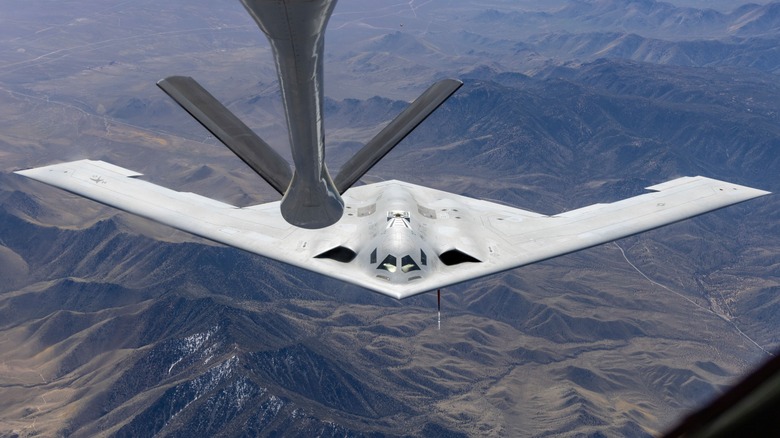
When it comes to weapons development, the United States military has some of the best vehicles, missiles, and bombs around. The U.S.' defense industry is immense, and it's not unusual for a new plane like the pictured B-21 Raider to make headlines as it progresses through development into production. While it's typical to read about a weapon's capabilities, destructive power, or how it might be used, one thing you never really hear about is what it's made of. That's partly because much about U.S. weapons is classified, but also because it's not particularly interesting to the public.
However, that changes when the conversation centers around a lack of a vital resource that goes into their construction, which is a growing problem facing the military today. You've likely heard of rare earth elements before, as they're necessary in the production of smartphones, batteries, steel alloys, permanent magnets, electronic displays, and more. As it happens, they, and several important, rare metals, are also needed for tons of U.S. weapon systems and vehicles.
Because of this, these elements are among the most important strategic resources on the planet, and the vast majority of them are found, mined, and processed in China. That's proving to be a problem, as China and the U.S. teeter on the edge of a possible future military conflict. As China and the West prepare for such a potentiality, the fact that China controls most of the world's rare earth elements and strategic metal resource operations puts the West in jeopardy of advancing technologically. Beyond that, a reduced amount of imported rare earth elements and other metals puts numerous current U.S. weapons and vehicles at risk.
The US weapons that rely on rare earth elements
The Special Competitive Studies Project think tank published a white paper outlining the potential shortages in key metals and rare earth elements and the impact it would have on the U.S. defense supply chain. The study utilized AI to do a deep dive into thousands of components and whole weapon systems, using each one's National Item Identification Number (NIIN) to identify any that contained critical metals. These included anything that required gallium, antimony, tungsten, and germanium.
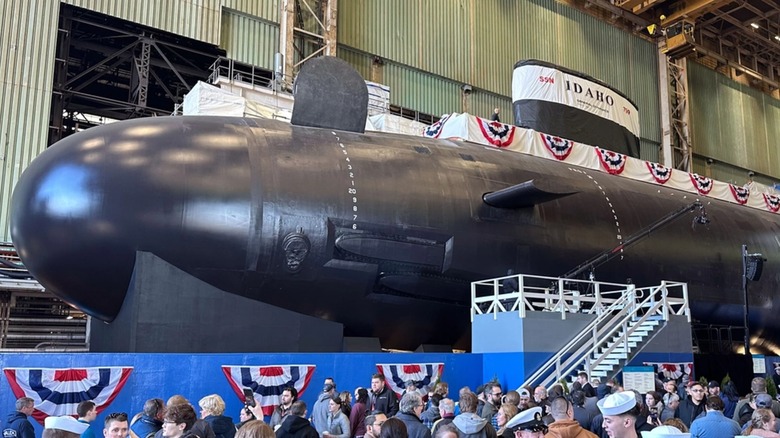
The study looked at nearly nine million parts across 3,000 weapons systems, and what it found is concerning. Over 28,000 individual parts across 1,400 weapon systems require rare metals for their production. Should the U.S. lose its ability to acquire those elements, replacement parts for existing systems, as well as the procurement of new ones, would become impossible. Some of the more important weapons systems needed in today's environment include interceptor missiles and Virginia-class submarines, like the pictured USS Idaho (SSN-799).
A Virginia-class submarine requires over 300 NIINs that contain the aforementioned four metals, none of which are rare earth elements, but they're largely controlled by China. A majority of parts require germanium, and without it, the U.S. is incapable of refitting, repairing, or replacing those parts. China controls 68% of the world's refined germanium, putting the U.S. at a disadvantage when producing new submarines is vital to global defense. Meanwhile, China's military continues to grow exponentially.
China has limited its exports in the past
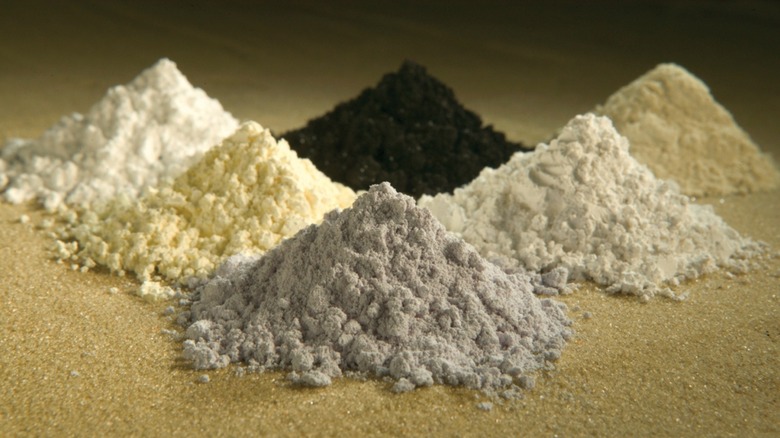
In 2023, China restricted the export of gallium and germanium, both of which are used in the construction of semiconductors. The move was made in retaliation for U.S. export controls, and it demonstrated how China could potentially grind worldwide production to a halt, as the U.S. lacks significant processing and refinement capabilities, especially when compared to China.
As of this writing, China holds the global monopoly on rare earth element supply chains, controlling up to 90% of the total processing and refining capacity. That's on top of China's 70% of mining production. At one point, China was responsible for 100% of the production of the rare earth element europium. That was just the beginning of China's dominance in the extraction, refinement, and production of one of the modern world's most vital resource. That, in a word, is a stranglehold, and it puts China in the enviable position of controlling something the rest of the world needs.
Meanwhile, the U.S. isn't taking its inferior position lying down, and is actively attempting to locate and exploit rare earth elements and strategically important metals in its own territory. One proposal outlines a 75-year lease of 200 acres at Tooele Army Depot, Utah, where the rare earth elements dysprosium and terbium could be mined. Another venture in the U.S. marks the first new operation for lithium extraction, which hasn't happened since the 1960s, potentially closing the gap between what China exports and what the U.S. requires.