

You Should Always Use Your Chainsaw's Choke To Start It - With One Key Exception
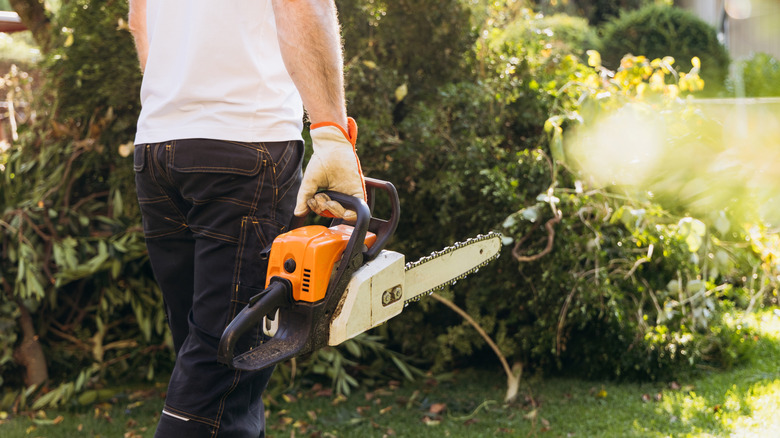
Chainsaws, especially gas-powered versions, are fairly simple machines, which shouldn't be all that surprising for a tool invented over 100 years ago. It consists of a two-stroke engine that spins a chain around a bar at high speed once you pull the starter cord and push on the throttle. The engine is similar to that you would find in an old car, and those engines have a choke valve in their carburetor - and so do chainsaws.
The choke is a simple plate that controls how much air is flowing into the engine, the main purpose being to control the air/fuel mixture during the starting process. Gasoline has different properties depending on the temperature, meaning that when you start a cold engine, fuel won't vaporize as easily and the engine will struggle to start. For chainsaws and cars alike, the solution is closing the choke. Doing this cuts the amount of air and creates a richer fuel mixture (higher fuel-to-air ratio), helping the engine go boom a lot easier.
You'll probably always have to close the choke during startups, with one exception — warm engines. Failing to start is one of the biggest potential issues with gas chainsaws, but in warm weather it's a lot easier. Heat makes gasoline evaporate faster, so if the fuel mixture is too rich when starting a warm engine (more fuel), it can flood the carburetor, and the engine won't be able to start. This is why some chainsaws have a summer and winter mode. If your saw is still warm from previous use or you left it out in the sun, then you'll have to start it with the choke open.
How to use the choke on a chainsaw
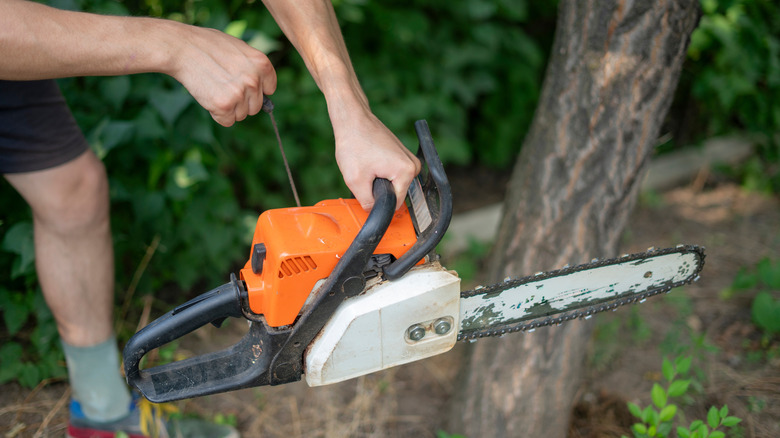
With most basic chainsaws, you start by flipping on the chain brake and activating (i.e., closing) the choke. Pull on the handle until you hear the engine fire and then move the choke to the run position. Generally, after pulling the handle again, the saw will start, so you only need to rev it a few times for the engine to idle, and the chainsaw will be ready for cutting once you release the chain brake. As you can probably guess, whenever you're cold starting the chainsaw, you'll have to do it with this exact choking maneuver.
In the summer or if you're restarting the saw, you may have to do the opposite. Generally, heat doesn't play nice with chainsaws, so to avoid flooding the warm engine, open the choke to lean out the fuel mixture, and pull on the handle. Afterward, just put the chainsaw in the run position and you're in business. If the engine is still too hot and doesn't start, it's best to leave it to cool down for about 20 minutes before you try again.