

The F-117A Nighthawk Got Its Designation From One Very Fed-Up Air Force Pilot
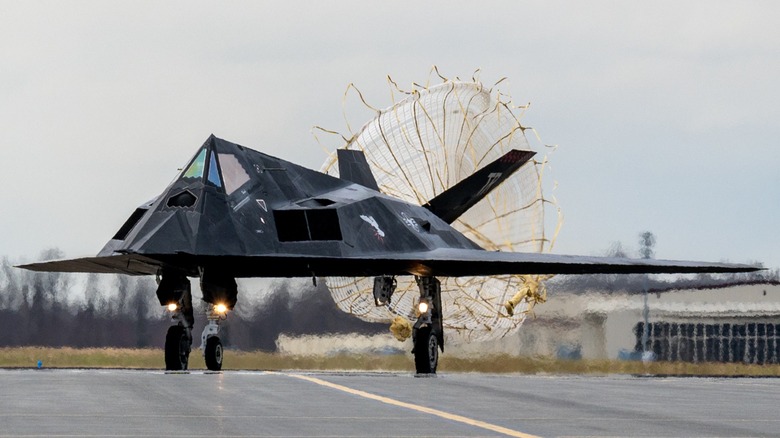
Of the many amazing aircraft produced in the United States for the military over the years, few are as legendary as the F-117A Nighthawk. Not only was the F-117A the world's first operational stealth aircraft, but it was also one of the most successful and important planes of the last 50 years. When you look at the F-117A, it's easy to see why it was named the Nighthawk, thanks to its sharp, angular lines and black coloration that gives it a distinctive bird-of-prey-like appearance.
While that name makes sense, the designation doesn't follow suit. Mainly, it doesn't align with how the U.S. Air Force (USAF) numbered its jets around the time it was made, but there's a reason for that. While the F-117A was being designed, a number of names were jokingly mentioned, including "Hopeless Diamond" and "Wobble Goblin," as not everyone believed it would actually fly and function as designed. Those weren't serious, but nobody could settle on a proper designation to fill out the AF Form 5, which is the USAF's System Discrepancy Report for aircraft.
Lt. Col. Skip Anderson, who was one of the F-117A's test pilots, asked around for the designation to use. Lacking any responses, he got fed up and decided to name the aircraft himself. He went with YF-117A, whereas YF is how the USAF designates its prototype (Y) fighters (F). It's unclear why he went with the number he did, but it was outside the norm when compared to the designations of the A-10 Thunderbolt and other attack aircraft produced in the late 20th century.
The F-117A's designation and inception
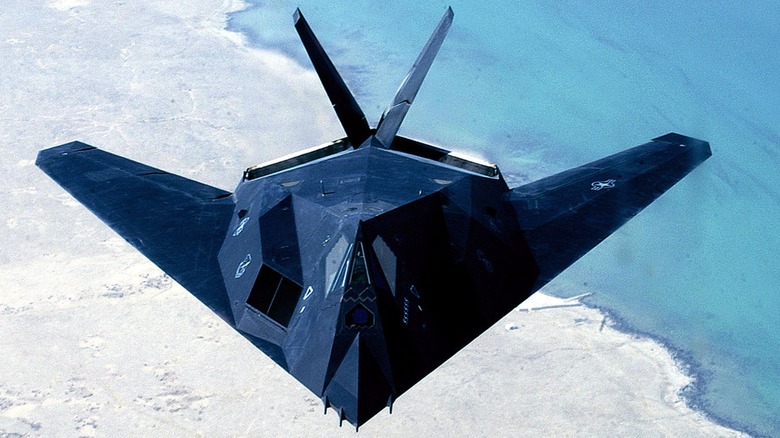
Before the USAF retired the F-117A from active service (though some still fly), the first five produced retained the YF-117A designation. The subsequent 59 produced throughout the program's life were designated the F-117A. That designation was inexplicably chosen by Lt. Col. Anderson despite the initial YF designation; the F-117A isn't a fighter, but instead an attack aircraft. Still, a far more interesting story is how the F-117A was conceived in the first place. In the 1960s, Soviet physicist Pyotr Ufimtsev published a paper outlining the Physical Theory of Diffraction.
The theory predicted how electromagnetic waves could scatter off objects, but the Soviets didn't properly understand it. The paper was declassified and published internationally, which was a mistake because, in 1971, the USAF translated it. That paper became the basis of the F-117A program, as it provided the missing piece of mathematical understanding of how radar could be scattered away from specific angles. This is why the F-117A looks the way it does, and it has everything to do with a declassified Soviet physics paper.
It took a long time to develop, but the first F-117A flew in 1981, and it achieved initial operating capability two years later, in October 1983. The F-117A distinguished itself throughout Operation Desert Storm, flying around 1,300 sorties with 1,600 hits on high-value targets as the only coalition aircraft to strike Baghdad, Iraq. More recently, a particular F-117A named "The Overachiever" made its final flight aboard a transport aircraft bound for the Smithsonian.