

Should You Sharpen Hedge Trimmer Blades To A Razor Edge?
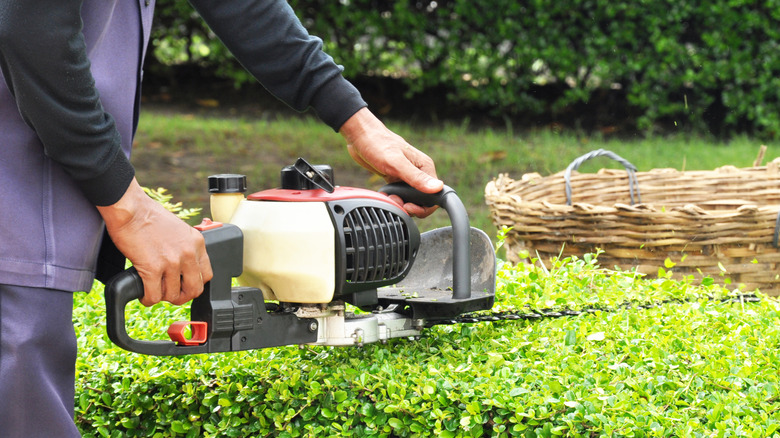
Hedge trimmers (and their sibling hedge cutters) make it easier to maintain clean and tidy hedges without wasting hours snipping away at individual branches with hand shears. However, just like any cutting tool, the blades naturally dull over time with normal use, making regular care and maintenance important. Similar to lawn mower blades, you shouldn't sharpen the hedge trimmer blades to a razor edge. Doing so makes the metal teeth fragile, and that extra-thin edge chips or dents much faster when it hits tough branches.
Instead, when sharpening, the goal is to get the hedge trimmer to make clean cuts through branches. In fact, that goal can be a great measurement to figure out if the blades need sharpening. For instance, if the trimmer starts tearing leaves and leaving behind ragged, messy cuts, that's a clear sign the blades are dull and need a tune-up. A few additional easy-to-spot signs are when the trimmer sounds like there's increased motor or engine strain while getting through bushes, or when you find yourself having to sweep over the same spot several times to get a clean cut.
Having sharp enough hedge trimmer blades is also beneficial for the plants' health. Tiny, clean cuts help the bush with fast and healthy growth, compared to the dull blades that mash and split the wood. As a rule of thumb, hedge trimmer blades should be sharpened once or twice a year for typical backyard upkeep. Otherwise, depending on the yard's size and the type of plants (dry twigs and hard branches wear down the blades faster), more frequent sharpening may be needed.
How to properly sharpen hedge trimmer blades
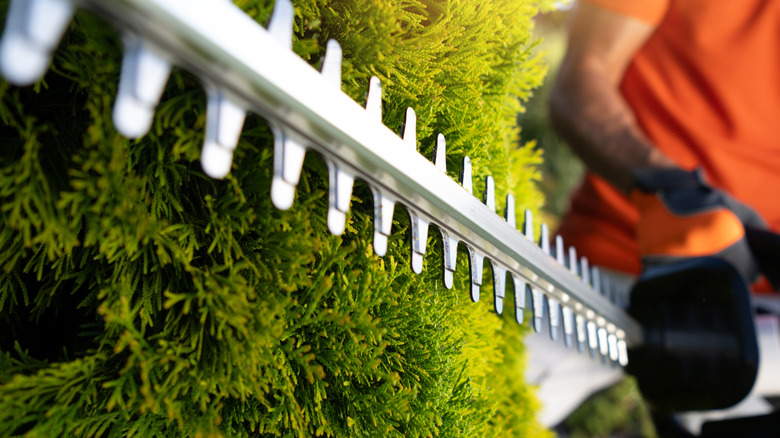
Before the actual sharpening, some preparation is in order. Above all, safety is a priority, so you should always use thick gardening gloves and safety glasses. Additionally, disconnect the trimmer from any power source to prevent accidental starts. Depending on the type of hedge trimmer, this can include unplugging it, removing the battery, or disconnecting the spark plug wire.
After all that is squared away, the next step is to clean the blades, since sticky plant sap and grime can coat the trimmer blades. You want a clean metal surface, so use a soft cloth to remove any gunk. Finally, make sure the trimmer stays completely still during the sharpening process, so lock it into place using a clamp or rest it flat on a sturdy workbench.
Some of the best tools you can use to sharpen hedge trimmer blades are a flat hand file and a whetstone. Using a hand file, work on one metal tooth at a time and push the file in smooth, single-direction strokes, making sure to follow the natural angle of the original factory bevel. Also, always push the file forward toward the sharp edge of the blade. Be careful not to file away too much metal while sharpening, as doing so weakens the metal.
To smooth off any rough metal burrs that formed on the blades when filing, a whetstone will be your best friend. Splash a little water on the underside, and slide the whetstone along each blade toward the tip to clean up the rough spots. When all is done, the final touch is to clean the metal dust with a dry rag and spray a thin layer of lubricating oil to protect the blades.