

The Original Toyota RAV4 From The '90s Is Weirder Than You Remember
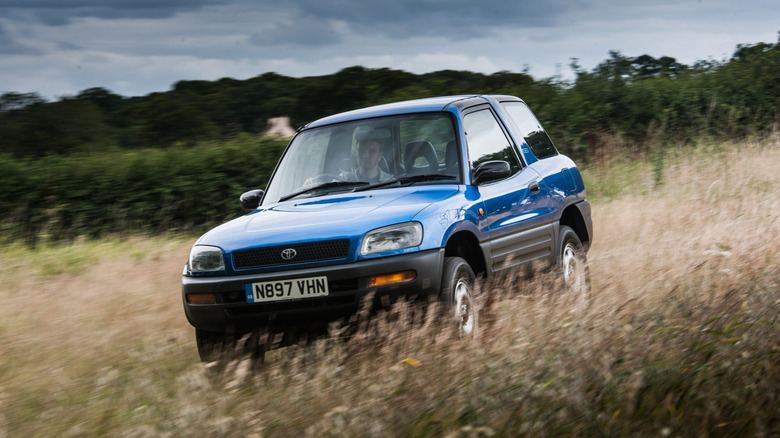
As far as SUVs go, the Toyota RAV4 looks as vanilla as humanly possible. With over 10 million of them sold by 2020 alone, it's such a popular car today that its design is synonymous with the word SUV, and you're bound to see a few during your morning commute. However, the original RAV4 from the '90s was quite quirky. It's by no means one of the worst-looking cars, but as one of the first crossover SUVs, it doesn't resemble the SUVs we know today, and you could even call it weird by modern standards.
The basic idea behind the RAV4 was to produce a compact car with 4WD, a market segment that didn't really exist in the early '90s. The segment started with a fanfare when the first RAV4 was introduced in 1994. Far from its current appearance, the original three-door iteration was only 145 inches in length, making it a subcompact car by today's standards. The RAV4 was technically like two cars in one; its urban pedigree was clear, courtesy of a modest 2.0-liter engine with a single-shell body. At the same time as being as comfortable and easy to drive as a hatchback, the outdoorsy 4x4 nature of this revolutionary Toyota was hinted at with a single spare tire mounted on the back.
Toyota also offered the option of removable twin roof panels. Its aluminum alloy construction decreased the weight drastically, and it also made them easy to remove, which would in an instant give you a soft-top vibe of a heavy-duty Jeep. This variant launched along with the four-door model, the latter of which won out in the end and became the standard, at least in North America.
How RAV4 became a household name

The RAV4 may not be the best Toyota ever designed, but if you look at the first run of the iconic SUV, it's the most coveted RAV4 generation. The seemigly strange compact 4x4 turned out to be rather successful, with sales of the model growing from around 53,000 in 1994, to double that by the next year, and it only grew from there. You could technically credit the success to the fact that Toyota created the compact SUV market, though there's also a case to be made for the RAV4 being in the right place at the right time.
When it originally dropped, drivers didn't have that many options. You could prioritize practicality with a sedan or wagon, or go heavy with a larger SUV, like the original Ford Explorer. Toyota's SUV was the only vehicle at the time with the ground clearance of a heavier vehicle and the off-road-worthy four-wheel drive, and it was also family-friendly and fuel-efficient (unlike traditional SUVs) – a winning combo.
The company didn't falter or rest on its laurels, as it provided well-needed updates with each subsequent generation. The second iteration stuck with what worked, and also gave the interior a ni-and-tuck to appear more premium. Toyota made driving more comfortable with new seat configurations and increased seat movement range.
As years went by, the SUV grew and became more spacious and more powerful, with Toyota jumping on the hybrid trend successfully back in 2016. The core spirit remains the same, though, regardless of the new bells and whistles – it's still a car that behaves exquisitely in both rural and city environments, and most importantly, doesn't waste fuel. All the while, every RAV4 makes you feel as if you're in control of a large SUV, and that will likely continue to be its main draw for years to come. While the early iterations were pretty weird given the market they were launching into, the RAV4 has evolved into one of the gold standards, and about as far away from weird as you can get.