

How Many Engine Hours Is Considered A Lot For A Kubota Standard L Series Tractor?
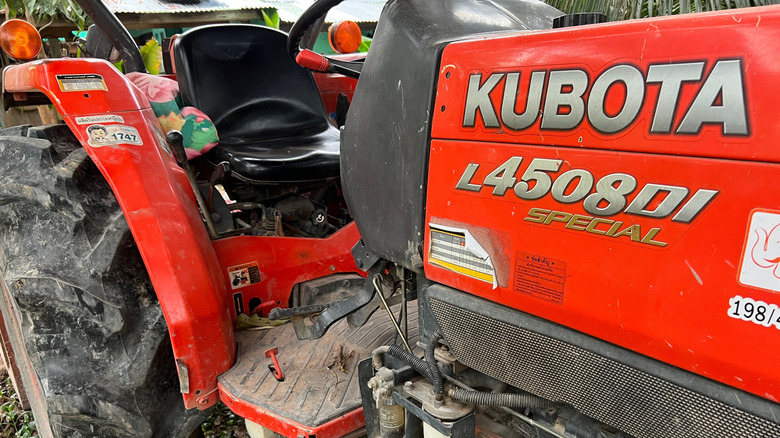
We all want the most bang for our buck out of vehicles and machinery, and it's no different with tractors. When looking at the lifespan of a tractor, the main focus tends to be the engine, as that's pretty much the heart of the machine. Interestingly, mileage doesn't matter (unlike with cars); instead, it's all about engine hours. Similar to engine hours in a semi-truck, a tractor's engine longevity can vary by quite a bit, differing by hundreds and sometimes thousands of hours. With that in mind, whenever there's a conversation about tractor reliability and longevity, Kubota tends to pop up. The company is considered one of the best-ranked tractor brands, with its standard L Series a popular line of compact tractors.
Under some general estimates, if a compact tractor hits up to 3,000 engine hours and is under 40 horsepower, that can be deemed a lot of hours. Most of the Kubota standard L Series tractors fall into this category, though there are certain L Series models that go a bit over 40 horsepower (up to 48.4).
This is a rough estimate, but focusing on Kubota's tractors, engines north of 3,000 hours of use may be viewed as high usage. Another potential piece of evidence supporting this "theory" can be seen in the company's own US warranty coverage. Kubota lists a 2,000-hour warranty cap on L Series powertrain coverage, which includes the engine. Now, that number is good to base your expectations on, but remember that a warranty limit and how long a tractor actually lasts are two completely different things.
How long do Kubota tractors typically last?
The above numbers aren't absolutes, since with proper maintenance, a Kubota Standard L Series (or any model, for that matter) can last a long time. In fact, a tractor that was regularly serviced and has high engine hours is more often than not in a better condition than one with low hours but nonexistent maintenance. As such, Kubota tractors can last up to 10,000 hours, as long as they have been taken care of with routine maintenance. In case you're not quite impressed, some users report even higher numbers than that.
As long as you don't slack off with engine upkeep (and keep the tractor clean), you should comfortably be able to reach the high-end hours. This would include regular oil changes and fuel filter swapping in addition to keeping the engine under light to moderate workloads. On the other hand, in case you've set your aim on a tractor with lots of engine hours on the clock, two things are of utmost importance. Check if it was serviced regularly and whether there's paperwork reflecting its maintenance history — that could help a great deal in evaluating how long a tractor will last.