

The World's Fastest Torpedo Is Basically An Underwater Rocket
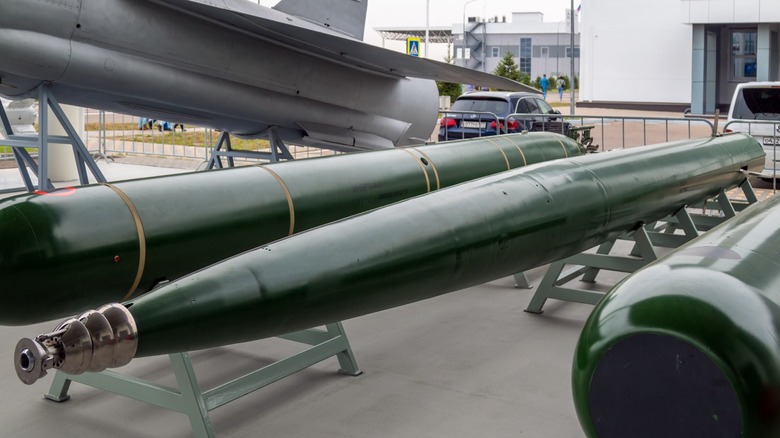
Torpedoes have existed in various forms since the 19th century, and in 1864, the CSS Hunley became the first successful submarine to destroy an enemy ship. The Hunley was destroyed in the process while using a spar torpedo, but thankfully, the technology has improved since that time. Modern torpedoes are incredibly complex vehicles that combine speed, maneuverability, targeting, and warhead lethality into a single package that often costs millions of dollars to produce.
The United States' Mk. 48 Heavyweight torpedo is the deadliest in the world, but compared to the fastest torpedo ever made, it's incredibly slow. Speed is one of the most important factors in torpedo operation, and the Soviet Union managed to perfect that particular aspect of torpedo design in the 1970s. The VA-111 Shkval entered into service with the Russian Navy in 1978, and it can travel at speeds in excess of 200 knots, which amounts to around 230 mph. Making something move that quickly underwater is an engineering challenge, to say the least.
Dodging an incoming torpedo moving more than four times as fast as the fastest sub is difficult. The Shkval is particularly effective at quickly reaching its target. To reach 200+ knots, the torpedo employs a process known as supercavitation, which is accomplished by continuously vaporizing water as it travels. This creates a thin bubble of gas surrounding the torpedo, significantly reducing friction from hydrodynamic drag. Of course, it doesn't hurt that the Shkval isn't powered by a propeller, and instead employs a rocket engine for thrust.
The VA-111 Shkval supercavitating torpedo
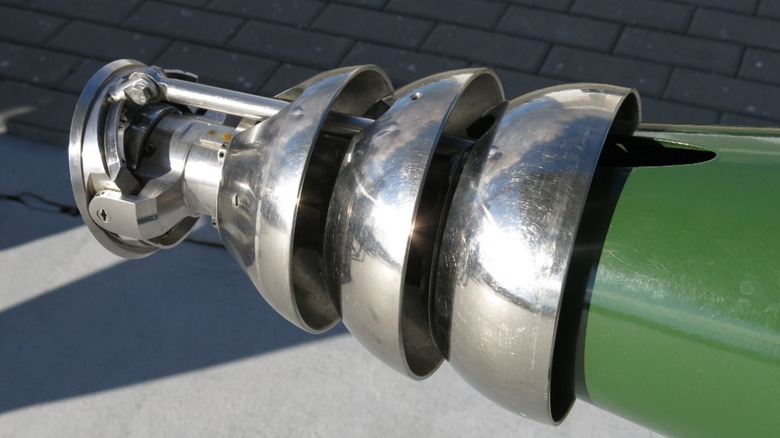
Torpedoes typically have domed or somewhat pointed forward sections, but the Shkval's nose doesn't follow this trend. Instead, its design was purposefully made as a means of diverting rocket exhaust out via several openings in front of the torpedo as it travels. This is what creates the gas bubble surrounding the weapon system as it moves, achieving its incredible speed.
With great speed comes a significant tradeoff in maneuverability, and the Shkval is neither highly maneuverable nor guided like most torpedoes. Instead, it relies on speed to close the distance between the launcher and the target, so it has an advantage there, since it's difficult for a submarine to outrun a normal torpedo, much less a supercavitating one. If the torpedo changes course or direction even slightly, it disrupts the gas bubble, canceling out supercavitation until it reforms around the torpedo's body. Because of this, once it reaches a target area, it slows down and switches on its targeting system to locate its target.
Interestingly, the earliest versions of the Shkval had no guidance system due to the incredible noise the rocket engine made, disrupting its ability to locate a target. When the Soviets designed the Shkval, it was likely meant to carry a nuclear warhead, so maneuverability wouldn't have been paramount in their design process. In terms of its size and specs, the Shkval has a maximum range of a little over 4.26 miles. It carries a 460-lb warhead, and the Shkval torpedo is used by the Russian and Iranian navies; the latter likely reverse-engineered the technology.