

Why One Custom Car Paint Job Costs $2,000 But Another Might Cost $20,000
When it comes to a car's aesthetics, paint is a major part of it. It doesn't matter if it's a Toyota Corolla or a Bugatti Tourbillon; at the end of the day, it is a slab of metal coated with paintwork. But not all paints are created equal.
Sure, most cars today have any combination of whites, blacks, and muted grays. But then you have oddball colors like those coming out of Stellantis. You have stuff with depth and tone, like Mazda's Soul Red Crystal, one of the deepest paints on regular cars today, and also pearlescent and iridescent color-shifting paints, like those made famous by TVR. That's one part of the equation.
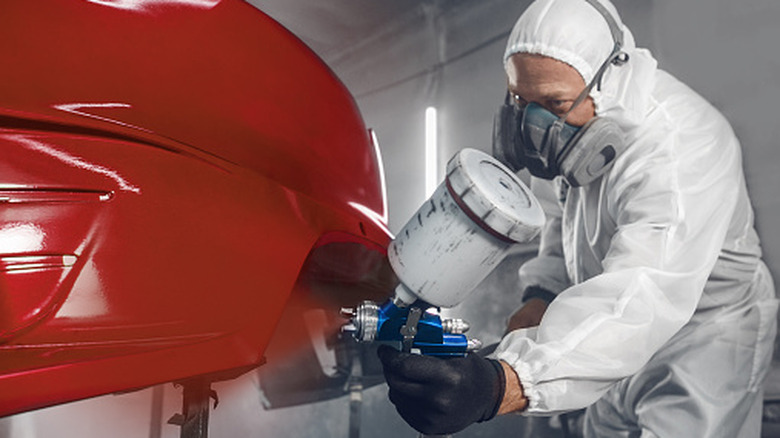
The other part of it is the actual quality of the workmanship. To do it properly, an actual paintjob is far more involved than simply driving into the Pay N' Spray in "Grand Theft Auto," or going nuts with a can of Krylon in your backyard. Painting a whole car is a labor-intensive process, necessitating ripping apart body panels, fixing any dents and imperfections, and applying multiple coats using specialized equipment. It doesn't come cheap.
So sure, some paintjobs do cost $2,000 if all you're doing is fixing scratches or undoing all the errors that ruined your car's paint. If you want deep, long-lasting, vibrant colors, expect five-digit sums and weeks or months' worth of work, depending on the request. It's a remarkably complex science, so let's break down the steps and why it's so much money.
What's involved in prepping and painting a car
Okay, forget the funky colors, let's say you have a white car but you want to paint it just a regular gloss red. What does that look like?
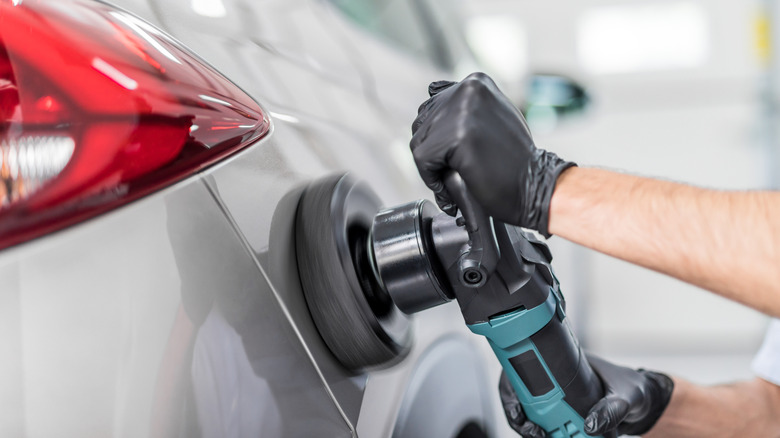
For one, it depends on how much you want to repaint. It's not just how big the car is, though that's part of it — surface area goes well beyond what you can see on the outside. Assuming you want a complete respray, that involves taking off all the body panels and getting it all down to bare metal or fiberglass, rendering the car "in the white." All dents are fixed and panels straightened, then the car is thoroughly cleaned. Even the smallest particles can mess with adhesion.
After that comes the paint itself. It starts with a rust-protectant metal electrocoating followed by a primer undercoat, which provides a rough surface onto which the main coats will adhere. Multiple coats are generally applied, each one in variations of colors to give it depth and hue, along with flakes or other elements, producing that gloss or metallic effect. All of that then gets topped with a clear coat, which serves as a physical barrier between the paintwork and environment. That's no less than five independent paint layers.
All told, it depends on how large the car is and how much prep work needs doing. If you bring a straight car that's already in the white, it'll substantially lower the cost of repainting versus bringing something with dents and dings plus no prep work. You can actually remove dents at home if you know the materials you're working with.
The paint itself can be expensive
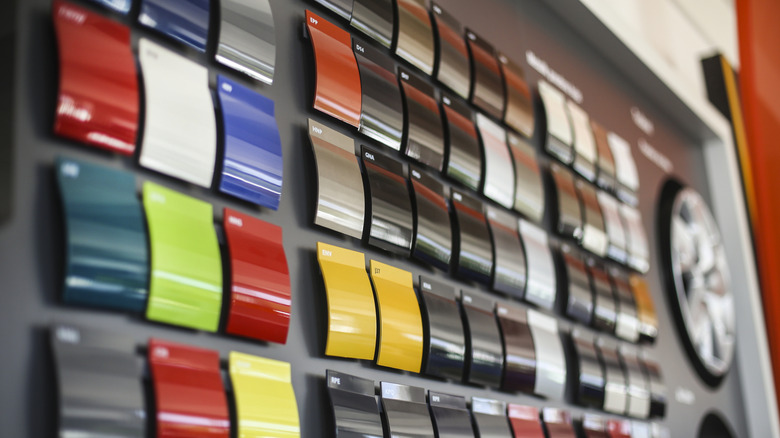
On top of all of that, you have the paint itself. You'd think that all paint is created equal, but it really isn't — some are proprietary blends that require multiple different colors, like Ford's Mystichrome or Nissan's several shades of Midnight Purple — every brand has its own cool colors. Others infuse elements like metal flakes to produce metallic paint, satin or suede non-gloss paints, matte paint, and so on. And that's before getting into hand-painting; the sky is the limit there. You could hand-paint on every single layer independently if you want, which is how lowriders get those outstanding custom paintjobs. They're canvases for artists, sealed with clear coat.
Let's suppose you just want a regular base color. You'll have to buy the paint, first of all. Prices per gallon increase exponentially based on what you want; a basic Toyota silver is less than $200 per gallon. But for rarer paints like Nissan's Midnight Purple II, it'll run you over three times that amount for just one gallon. Typically you'll need around two to three gallons for a regular sedan or crossover, so that could easily work out to thousands of dollars more in just material costs.
Lastly, we come to labor. Assuming you want it professionally done, the process of painting is time-consuming — with surface prep, paint, and curing, it generally takes at least a week for a normal respray. Of course, labor goes up if you want a full respray versus panel or color touch-up. But you get what you pay for, so if you want a paintjob that looks like it's worth $20,000, you'll probably pay that much.