

What Size Tankless Water Heater Do You Need For A Family Of Four?
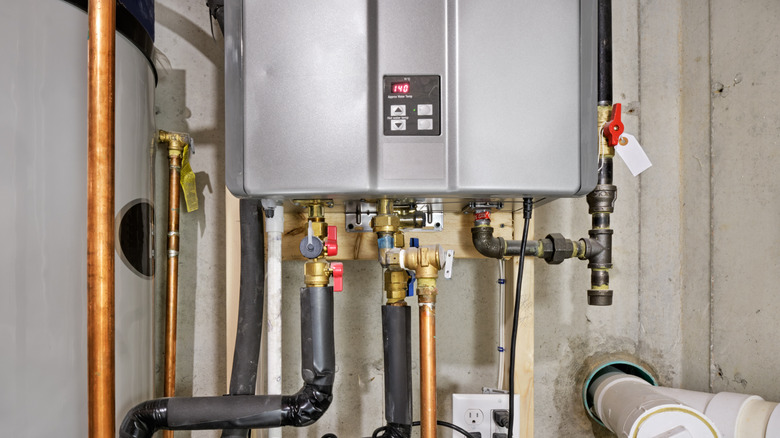
Shopping for a new water heater is one of those tasks that most homeowners dread, if only because doing so means your old water heater has likely failed. Moreover, water heaters are hardly easy on the wallet and tend to require complicated installs. Most of that is true whether you're eyeing a traditional tank water heater or a tankless model.
More and more, those in the market for a new water heater are looking to make the change from traditional models to tankless, as the latter option offers some notable advantages. If you are looking to go tankless, there are some important factors to consider before you pony up the money for the new device and the install. Chief among them is exactly what size flow rate best suits the hot water needs of your home. The number of occupants plays a big part of that equation, of course, as the more bodies there are to bathe, the more gallons per minute (GPM) may be necessary.
If you've only got two to three people in your home, you can generally opt for a lower GPM tankless model. When you push it to four people or more, however, it's time to size up, with some outlets noting a model that can heat 8 to 10 gallons per minute is the best size to roll with. In terms of British Thermal Units (BTUs), or the amount of energy needed to raise the temperature of 1 pound of water by 1 degree Fahrenheit, it is believed that a tankless water heater pushing 380,000 is right for a home with more than three residents.
The pros and cons of tankless water heaters
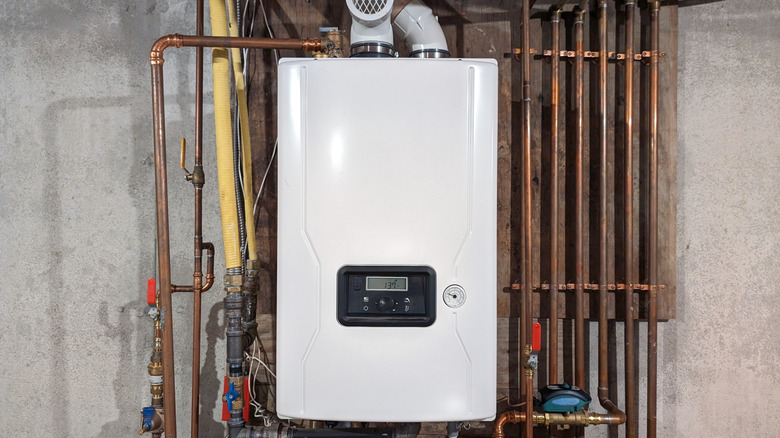
There are, obviously, some major differences between installing a traditional water heater in your home and a tankless model, with the latter style coming with its own range of pros and cons. For many in the market, one of the bigger pros of a tankless water heater is size, with the devices — which are generally wall mountable — taking up considerably less space in the homes, closets, and basements where they are installed.
Space-saving capabilities aside, tankless water heaters also deliver savings elsewhere, with the devices known to significantly reduce energy consumption over traditional models by eliminating the need to constantly heat a tank. They also last considerably longer than traditional tank models, with some tankless water heaters boasting a lifespan of up to 20 years. Most importantly, tankless water heaters can do one thing that a tank model will never be able to do, which is to provide a constant flow of warm water to users.
There is a catch to that feature, however, which is that a tankless build can provide only a finite flow of hot water to sources at once, so running multiple outlets like a shower, dishwasher, or laundry machine simultaneously can prove problematic. Perhaps one of the biggest deterrents to going tankless is that they tend to cost far more up front than tank-styled models, sometimes by several thousands of dollars. On top of that, installation of a tankless build is typically far more complex than a traditional model, particularly if you're switching from tank to tankless.