

Here's What A Toyota RAV4 Cost In 1996 Vs 2026
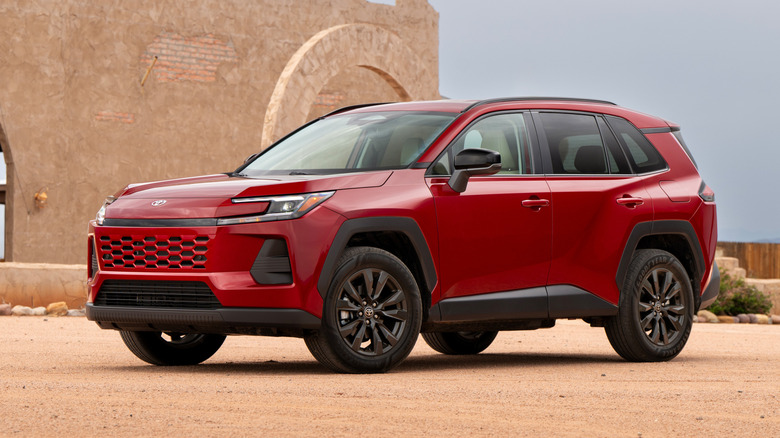
In recent years, the RAV4 SUV hasn't just been one of Toyota's most popular vehicles – the RAV4 is ranked among the world's best-selling cars, period. It hasn't always been that way, though. If you hopped in a time machine and traveled back 30 years to 1996, you'd find the RAV4 wasn't a default choice for families, but a new — and slightly unusual — addition to Toyota's lineup. At the time, the Toyota lineup was largely made up of sedans and compact cars, as well as traditional body-on-frame pickups and SUVs, and the new 1996 RAV4 aimed to bridge the gap between them as an early "crossover" SUV.
As you'd expect, the RAV4 has evolved significantly in the three decades that it's been on the market — in terms of size, performance, and technology — and of course exploded in popularity along the way. The 2026 RAV4 is larger and more tech-laden than the first-generation RAV4, but is it also more expensive?
In terms of straight numbers, the 2026 Toyota RAV4's $33,495 base MSRP is more than double the $14,948 base MSRP of its 1996 counterpart, but you obviously need to factor in inflation when comparing the prices of vehicles from different eras. When you do, the comparison gets interesting: the new RAV4 is actually cheaper than the original when you compare equivalent body styles and options. Let's break it down.
A lot has changed since '96
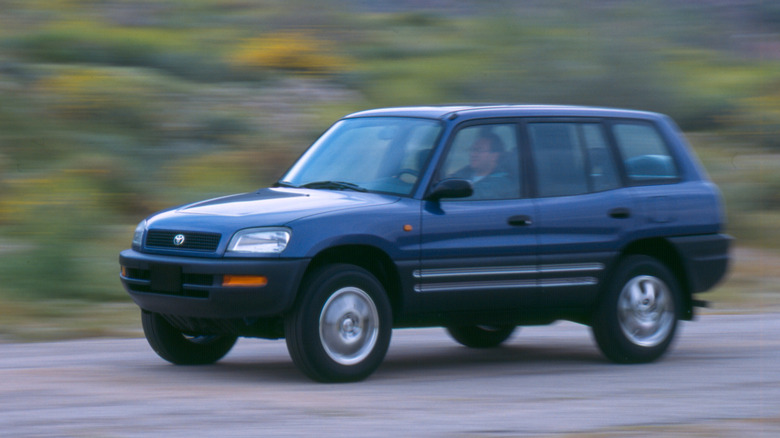
Before you can compare the 1996 RAV4's price to the 2026 RAV4, you need to understand how different that RAV4 was from the current one. This is important not just for seeing how much the RAV4 has changed over the last 30 years, but also for getting an accurate comparison of its pricing then versus now. The 2026 American market RAV4 is offered in a single, four-door body style, and beginning with the RAV4's 2026 redesign, it comes only with Toyota's 2.5-liter, hybrid-assisted powertrain. All 2026 RAV4s use Toyota's eCVT automatic transmission, and front-wheel drive is standard, with AWD as a $1,400 option.
Back in 1996, Toyota offered the RAV4 in both two- and four-door body styles, and the first-gen RAV4 came standard with a five-speed manual transmission. That $14,948 base price was for a two-door, manual-transmission model — and while a '90s RAV4 with two doors and a stick shift is a super cool vehicle, it's not an apples-to-apples comparison to today's base RAV4.
The base price for a more comparable 1996 RAV4 with four doors and an automatic transmission was closer to $16,000. Using the U.S. government's inflation calculator, that $16,000 base price would be about $35,000 in 2026 dollars — about $1,500 more than the base price of a front-drive 2026 RAV4 LE.
Bang for the buck?
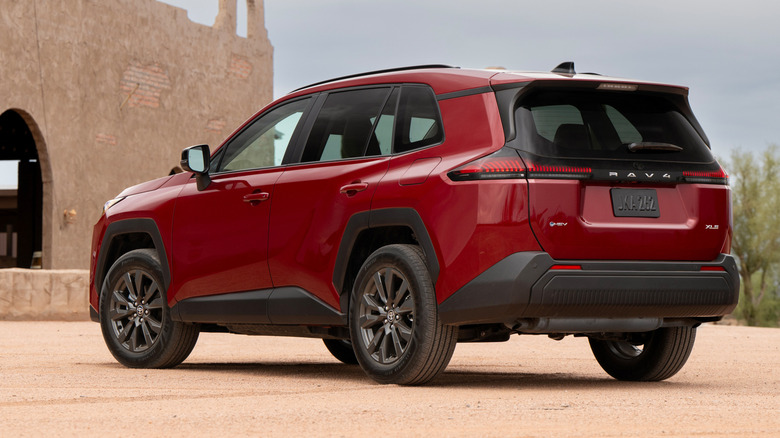
It's impressive enough to see the 2026 RAV4 having an inflation-adjusted price lower than the 1996 RAV4, and the comparison is even more impressive when you consider just how far the RAV4 has come since '96. Obviously, the 2026 model packs three decades' worth of tech and safety advancements, and by all measures is a more practical, more refined vehicle than its '90s counterpart.
The biggest difference is power and fuel efficiency. The 1996 RAV4 made just 120 horsepower from its 2.0-liter four-cylinder engine, while the hybridized 2026 RAV4 makes 226 horsepower in base, front-drive trim. The new RAV4 also blows away the old one in fuel efficiency. The '96 had a combined EPA rating of 23 miles per gallon, while the equivalent '26 has an incredible 44 miles per gallon combined rating. So maybe it's not surprising that Toyota is still struggling to meet demand for the new RAV4.
While average new vehicle prices are indeed rising to alarming new highs, the reality is often that vehicles themselves aren't becoming uniquely expensive compared to earlier decades. Instead, broader inflation and the dollar's lower purchasing power continue to be felt everywhere. New vehicle MSRPs are simply one of the most obvious examples of inflation — even if history shows the vehicles give drivers more for the money than they did before.