

Can You Use A Car To Jump Start A Motorcycle Battery?
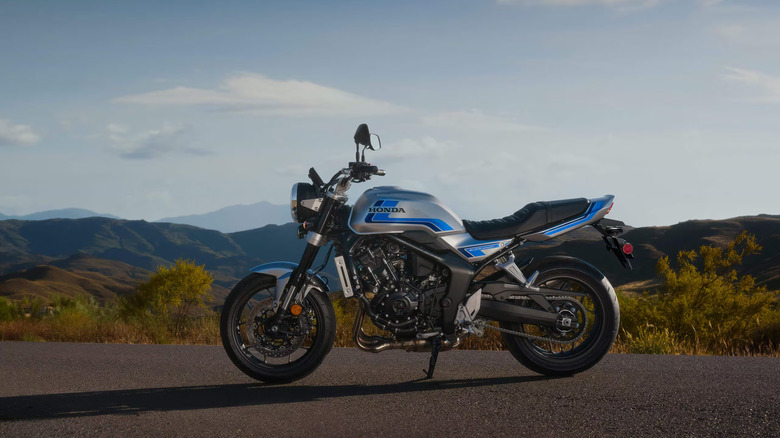
Bikes are just like cars — if you leave one unused for too long or forget to turn off the headlights while having dinner, the battery can die. And contrary to what some people may say or believe, you can absolutely jump-start a motorcycle battery with a car. While your components will not fry or get damaged, the process does require some care, and the main thing you need to check is the battery voltage. Most cars and bikes use a 12V system, so if yours does, jump-starting shouldn't be a problem.
Park the motorcycle close enough to the car for the jumper cables to reach. Typically, car batteries are under the hood, while a bike's battery may be under the seat or behind a side panel. Which way should you connect the terminals? Attach the red clamp to the positive (+) terminal on the bike's battery, and then connect it to the positive terminal on the car. Now attach the black clamp to the negative (-) terminal on the car, then connect it to an unpainted metal area on your bike to ground it. If you don't have motorcycle jumper cables and are using the car-sized ones, make sure they don't touch nearby metal components. Don't run the car, but if its battery has seen better days, it's okay to idle it.
Wait about 30 seconds to a minute, then try to start the bike. If it starts, then congratulations. If not, wait a minute more, then try again. Once running, remove the cables in the opposite order. That is: Start with the black clamp on the unpainted metal area, then the black clamp on the car's negative terminal, followed by the red clamp on the car's positive terminal, and lastly the red clamp from the bike.
Jump-starting a Lithium-ion battery
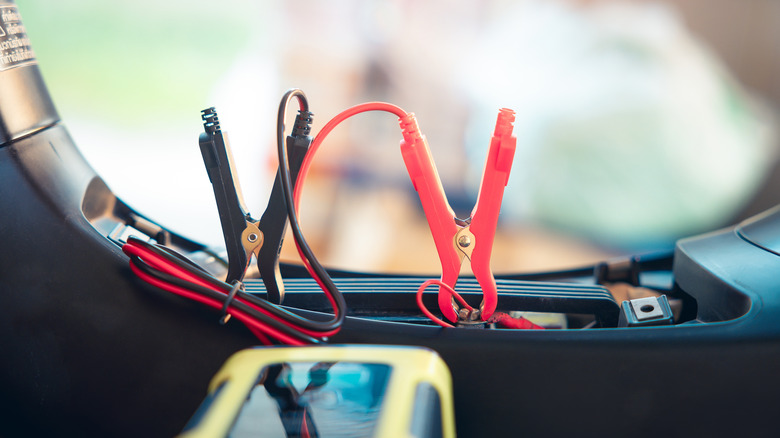
While many motorcycles still use lead-acid batteries, some newer models come with lithium-ion batteries instead. Jump-starting one, though, is a bit different. According to RevZilla, lithium-ion batteries come in different designs, so check the owner's manual for information about the battery management system (BMS), any protective sleep mode, and the manufacturer's jump-starting instructions. If everything checks out and the resting voltage is above 10V, it should be safe to jump-start using the same method as above.
No matter which battery you jump-start, ride your bike for about 20 minutes, then connect it to a dedicated charger when you get home. If, however, your bike discharged just a few minutes after you left the headlights on, check the battery health. For a lead-acid battery, leave it for about an hour, then connect it to a multimeter. A reading below 11.9V means your battery is discharging too quickly and may need replacement.
Can a motorcycle jump-start a car battery?
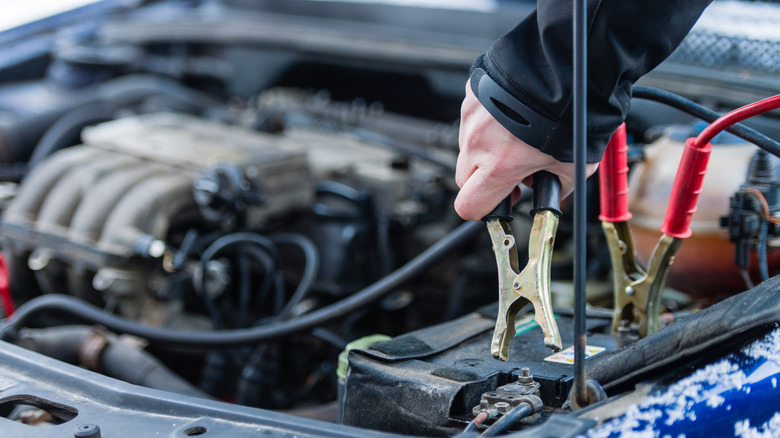
With the same 12V setup, yes, you can jump-start your car battery with a motorcycle, but there are a few conditions to keep in mind. For example, a motorcycle battery may not have enough cranking power for a car, particularly if the car battery is heavily discharged or damaged. It's also a good idea to keep your bike running during the process.
Unless the user manual says otherwise, connect the red clamp to the car's positive terminal, then clip it to the bike's positive terminal. Attach the black clamp to the bike's negative terminal, then connect it to an unpainted surface inside the car, preferably a bolt, to ground it. As a bike's battery is smaller, wait about 2-5 minutes, then try to start the car. After ignition, disconnect the cables in reverse order, then drive the car for about 20 minutes. If it loses its charge again, have it tested.