

Car Batteries Can Be More Dangerous Than You Think - Here's What Can Hurt You
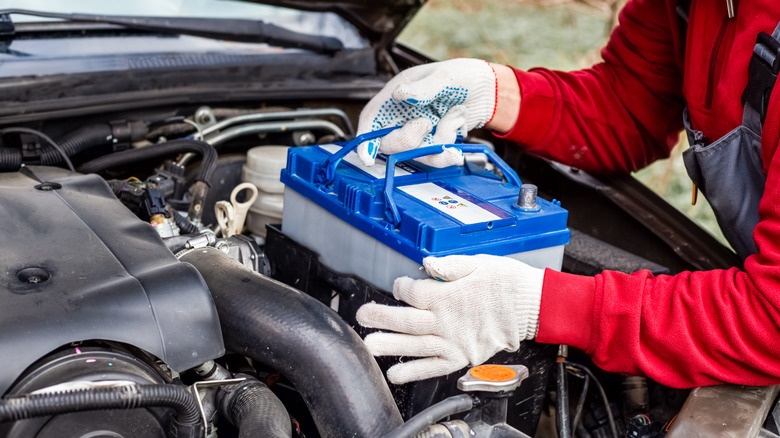
If you've ever thought about how dangerous your car battery could be, you've probably considered electric shock among the major risks. It turns out that getting shocked by a car battery is probably the least of your worries when it comes to things that can go wrong with it.
Most major car battery brands offer lead-acid batteries, which contain all of the potentially dangerous substances and scenarios we're covering here. However, other types of car battery are becoming more common, including absorbent glass mat (AGM) batteries. These are said to be more powerful and durable than lead-acid batteries, and they also lack the sloshy innards, thanks to the absorbent mat material.
However, while there are some differences between the two types of batteries, and there are also both problems with AGM batteries and their lead-acid counterparts. When it comes to the latter, there are a handful of risks to know about. For example, historical data from the National Highway Traffic Safety Administration (NHTSA) indicates the most common injuries from car batteries are chemical burns, contusions, lacerations, and eye problems, among others. Safety data sheets for Interstate Batteries also categorize them as explosive, corrosive, toxic, and carcinogenic.
So what can actually hurt you on a car battery? While the letters on car batteries can tell you a lot about how the battery works and what vehicle it will fit, it won't tell you all the risks. Here's what to know.
Sulfuric acid
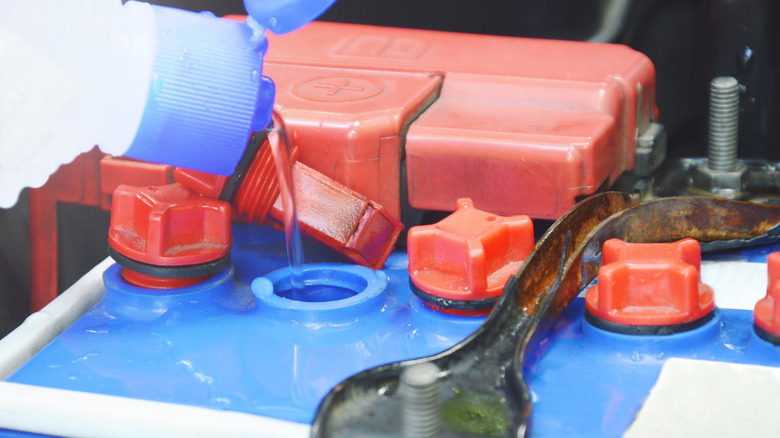
The very definition of battery acid is "dilute sulfuric acid," meaning the inside of your car battery contains a solution of sulfuric acid and water. However, just because the sulfuric acid is diluted doesn't mean it's necessarily safe to touch. Car battery dilute sulfuric acid is a solution that's between 29% and 32% acid, with the rest water. The sulfuric acid reacts with other substances (like lead) inside the battery to generate an electric charge.
Sulfuric acid's reaction with metals not only creates byproducts (more on those dangers later), but also corrodes metal. After a first-hand experience with a leaky car battery, I learned the hard way how corrosive sulfuric acid can be. My 1972 Volkswagen Beetle was totaled after someone rear-ended me, which of course messed up my engine. The car battery also wasn't secured properly, so on impact, it fell over in its compartment underneath the back seat. Months later, I found it had eaten a hole through the floor pan of my car.
If that's not scary enough, think of the impact sulfuric acid could have on skin. According to MedlinePlus, a site run by the National Library of Medicine and the NIH, sulfuric acid like what's in car batteries causes immediate pain upon contact with skin. Consuming the substance can cause severe injury, including burns, swelling, and vomiting. Even breathing it in can cause significant health problems.
Lead
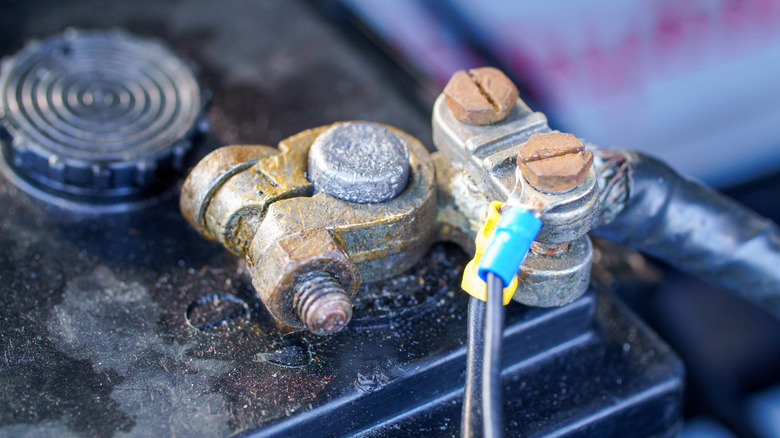
The combination of dilute sulfuric acid and lead inside a car battery leads to the chemical reaction that makes the energy the battery produces. Lead dioxide is involved in the process of manufacturing car batteries, but of course, all of the battery "ingredients" are still in there once the battery is placed in your vehicle. In theory, a split open battery could leach lead, among other potentially dangerous components.
Although lead is useful in other applications, its primary use by far is as a component in car batteries. However, lead also presents a significant health concern when it comes to practices like recycling batteries. While you're probably not going to break down an old car battery yourself, it's good to know what lies inside. After all, there's a reason automotive supply retailers take your used battery when you buy a new one.
The lead from car batteries can impact the people doing the dismantling as well as their surrounding environment. Improper recycling of car batteries is responsible for around one third of global cases of lead poisoning. As such, it's always a good idea to take your old car battery to a designated recycling center, rather than letting it deteriorate in your garage.
Hydrogen sulfide
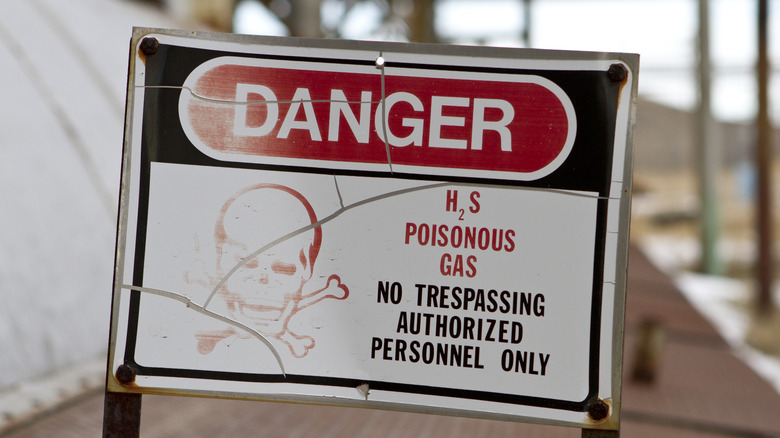
A weird smell is one of a few signs your battery may be dead, but that bad smell can also be dangerous. Hydrogen sulfide smells a lot like rotten eggs, although it's a clear gas that you can't see. If you do happen to breathe it in, it can cause everything from a headache and dizziness to death. you'll typically find hydrogen sulfide in places like oil and gas refineries, mines, and paper processing, among others. However, batteries also contain hydrogen sulfide, and that can pose a risk, whether you're working under the hood or driving a car with a defective battery.
Hydrogen sulfide poisoning doesn't seem to happen often, as evidenced by a case study in the American Journal of Respiratory and Critical Care Medicine that specifically called the scenario rare. However, the case in question was also an instance of it happening due to exposure to a malfunctioning car battery, so the risk exists. Though it didn't say how things turned out, the prognosis for the patient was poor, as there is no treatment for hydrogen sulfide poisoning.
All that said, it's a good idea to pay attention to any weird smells around your vehicle or in your garage. In the event you do smell hydrogen sulfide coming from your car, you'll know what's happening and that it's unsafe to be around.
Electrothermal burns
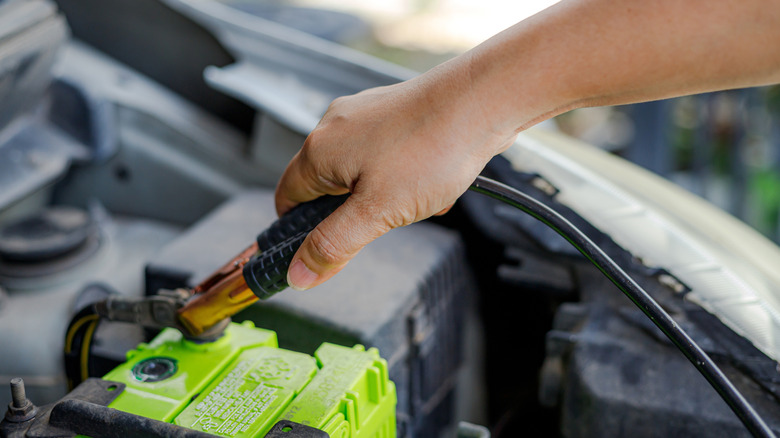
One concern that many people have about car batteries relates to the electricity they contain. A fully charged 12V battery shouldn't have enough juice to hurt you, but can a car battery shock you? Technically, it could, but a car battery can't kill you, and it probably wouldn't even hurt. In most cases, batteries are safe to handle from an electrical perspective, though you don't want to be careless given the contents.
However, a contact injury can still occur with car batteries. It turns out that people can and have sustained burns specifically due to wearing conductive materials while handling car batteries. For example, one case study published in the medical journal Orthopedics explored a scenario where a man was working on a car with a wrench and also wearing a ring on his finger. As he held the wrench in his hand, the metal contacted both the ring and the negative terminal of the battery. The man immediately sustained a deep burn, all the way around his finger, that the case study described as partial-thickness. Later, the man needed full thickness skin grafts to fully heal.
The case study couldn't explicitly confirm what happened, but it's assumed it was an electrothermal burn due to how quickly some metals (like gold) can heat up. Bottom line? Don't wear jewelry while working on your car.
Fire or explosion
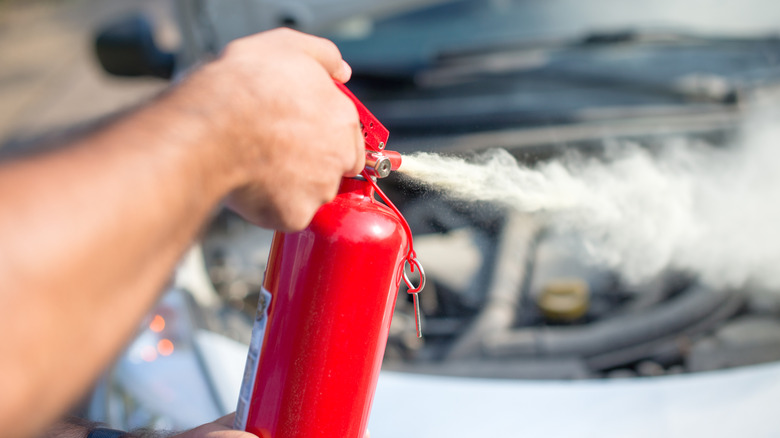
The same gas that can be harmful to breathe in is also highly flammable. Not only is hydrogen sulfide very flammable, but the lead dioxide inside a car battery is an oxidizing agent. That means lead dioxide can feed a fire, or even contribute to an explosion if hydrogen sulfide is escaping from a car battery.
Batteries don't generally explode on their own, fortunately. However, there are documented cases of a small spark creating a massive battery explosion, as discussed in a volume of the Journal of the American Institute of Chemists. In 1997, a man working on his car touched a battery tester to a car battery, which resulted in a spark that detonated the battery, and caused the man lifelong hearing damage.
As the case study shows, accidents can happen, but there are some ways to avoid the dangers of car batteries. Stay safe by using the right battery size, visually inspecting it every so often, being aware of any odd smells, and disposing of old batteries properly. Always handle the battery and connected components carefully, paying special attention to anything that could create a spark or conduct electricity.