

The NHTSA Wants Custom Lights To Identify Driverless Cars
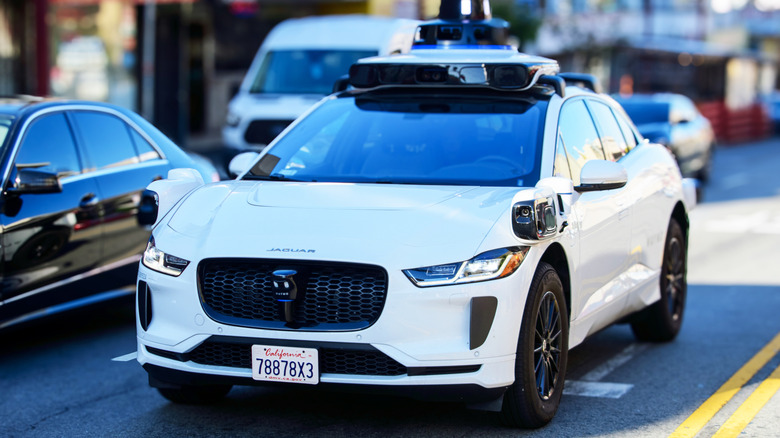
Autonomous vehicles are becoming increasingly common, and on paper, they're pretty remarkable. Self-driving cars know how to stay in their lane, brake, and more, but the technology isn't perfected yet. Thus, it's only right that lawmakers in the United States are prioritizing making autonomous vehicles easy to spot for nearby human drivers. One method the National Highway Traffic Safety Administration seeks to make a reality is the implementation of custom colored, steadily burning lights on such vehicles, making it clear to humans at a glance that they're near a self-driving vehicle.
The NHTSA has brought forward a potential amendment to the Federal Motor Vehicle Safety Standard No. 108, which pertains to legal standards for vehicle lights and reflective elements. Part of this amendment is the idea of having self-driving vehicles bear cyan-colored lights, specifically on the front, sides, and rear. The thought process behind the color is that it's unique enough so that there's no confusion regarding what the vehicle is, and it is easily distinguishable from other human-driven vehicles. The proposal also outlines specific standards for these lights, including requiring them to be on whenever the vehicle is in operation, strict adherence to the blue-green hue, and a minimum mounting height of 15 inches.
As of publication, the NHTSA's cyan light idea remains just that, an idea. Still, if it does go through, the proposal makes it clear that automotive manufacturers won't have to scramble to comply.
Cyan lights wouldn't be required, but they have industry support
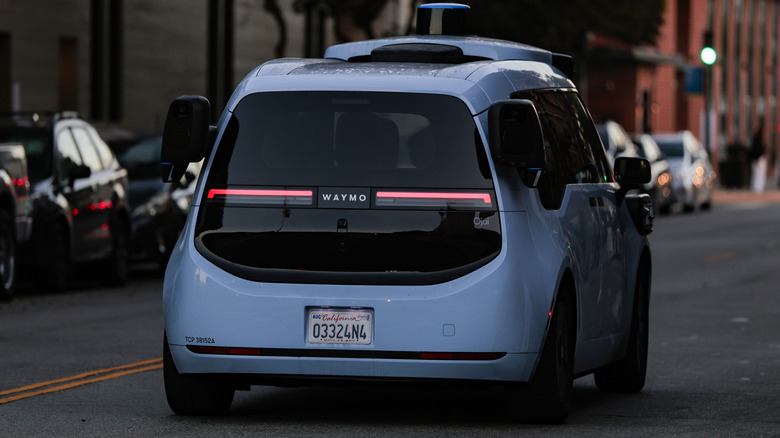
As noted, there are specific standards set for these cyan lights, dubbed in the FMVSS No. 108 amendment text as the "if equipped" standard. This term exists because, if this amendment passes, the lights will remain an optional addition that self-driving car manufacturers won't necessarily have to follow if they prefer not to. It seems less about forcing manufacturers to fall in line and more about streamlining, so that if self-driving car manufacturers want distinguishing lights for these vehicles, there's a set of guidelines in place to ensure uniformity across the industry.
Even with the self-driving vehicle cyan light concept currently standing as a concept alone, and it specified that it won't be a requirement should it pass, automotive giants have begun tossing in their two cents on the matter. Per the amendment, Mercedes-Benz sees the cyan light addition as a net benefit for humans on the road. As long as the public is properly educated on what these lights mean before they become commonplace, the company sees cyan lights as a useful way to quickly let regular drivers and law enforcement alike know an automated vehicle is nearby.
It remains to be seen what will become of this cyan-light-focused amendment, and how the wider automotive community will respond. One can only hope that, should it go through, the presence of such running lights will lead to increased awareness and safety among those driving in the vicinity of automated vehicles, specifically those falling under the higher levels of autonomous driving.