

How Does The M6 MacBook Pro Differ From M3 And M4 Models?
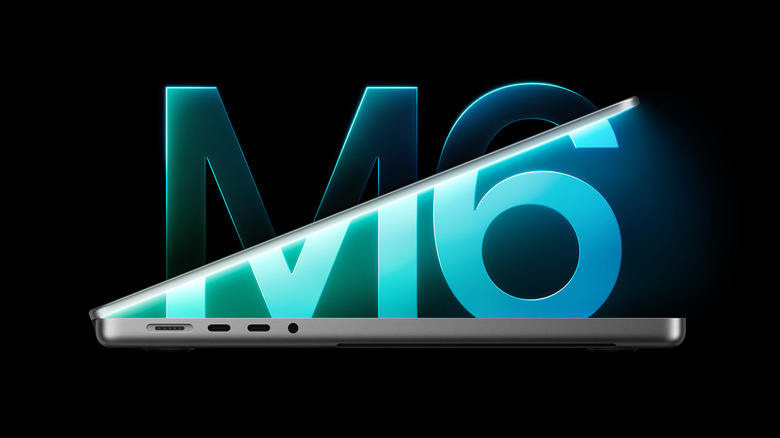
Apple has unveiled the next generation of its MacBook Pro laptop, powered by the new M6 chip. It replaces the previous year's M5-powered model and manages to deliver up to 30 percent better GPU performance and up to 25 percent faster AI processing speeds than its predecessor. Of course, most users aren't buying a new computer every year, so the MacBook Pro M6 might be a more meaningful upgrade for those still rocking older machines. Apple says the M6 performs up to 13 times faster in LLM prompt processing and delivers up to 11.7 times faster render performance with ray tracing in Blender compared to the MacBook Pro with the M1 chip.
People with an M3- or M4-powered MacBook Pro might also find the upgrade worth it, especially considering the significant year-over-year improvements in processing capabilities we've already seen going from the M3 to the M4 or from the M4 to the M5. Apple's M6 chip is based on the new 2nm process and has two more CPU and GPU cores than the M5 and the M4. The M3 falls further behind, with four fewer CPU cores.
In addition to having a 12-core CPU and GPU, the M6 chip features a dual 16-core Neural Engine and a higher memory bandwidth of up to 170GB/s — up from a single 16-core Neural Engine and memory bandwidths of up to 100GB/s and 120GB/s on the M3 and M4, respectively. You also get 16GB of RAM and 1TB of storage space with the base configuration, which starts at $1,999.
Familiar design with useful connectivity upgrades
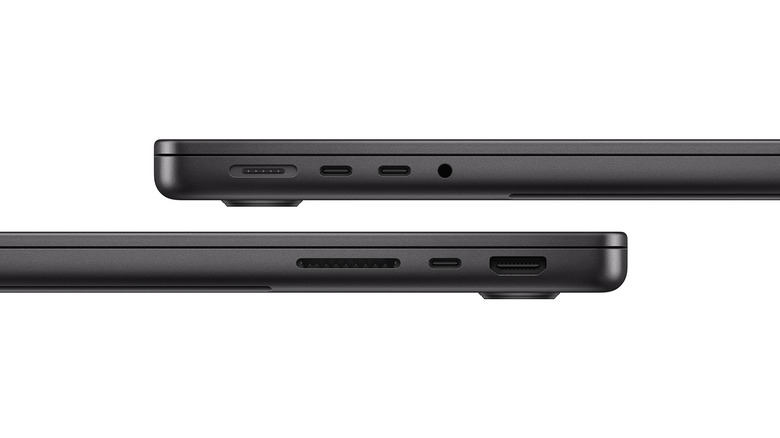
The MacBook Pro M6 doesn't feature a drastically new design — in fact, it looks identical to the ones that came before it. You still get an aluminum unibody design and a screen size of 14 inches. The laptop shares the exact dimensions as the MacBook Pro M3 and M4 models, too. The Mini LED 120Hz Liquid Retina XDR display remains unchanged, although SDR brightness is up from 600 nits to 1,000 nits starting with the M4 generation. All models offer the same six-speaker system and a three-mic array.
The MacBook Pro M6 comes with a 12-megapixel Center Stage camera, which the M4 version also offers, but the older M3 model makes do with a 1080p FaceTime HD camera. What is an upgrade over the previous MacBook Pro models is wireless connectivity. The MacBook Pro M6 ships with Wi-Fi 7 and Bluetooth 6 support, compared to Wi-Fi 6E and Bluetooth 5.3 on the previous three generations.
Apple is also offering modest improvements in battery life on the new MacBook, which packs in a 72.4Wh battery, compared to 70Wh on the MacBook Pro M3. This brings its rated battery life to up to 24 hours, compared to the M3's 22-hour rating. It's worth noting that the MacBook Pro M4 also boasts a 24-hour battery life, though. Compared to the M3, the M6 model adds a third USB-C port, expanding connectivity for accessories.
Is upgrading to the MacBook Pro M6 worth it?

It's been six years since Apple began switching to its in-house silicon, and since then its computers have made impressive strides in performance and power efficiency. The jump from the 2020 Intel-based MacBook Pro to the first M1-powered model released the same year was already a huge leap forward, but every subsequent generation has also brought noticeable performance improvements. So, even if you're coming from a MacBook Pro powered by the M3 or M4 chip, the MacBook Pro M6 can be a worthy upgrade, given the right workload.
Apple's recent price hike has affected its laptops, so the $2,000 price tag is definitely a tough pill to swallow, considering the MacBook Pro M3 launched at $1,600 – though it did come with a measly 8GB of RAM and 512GB of storage in its base configuration. It also didn't launch in the Space Black colorway, which the MacBook Pro M6 ships in.
Another notable upgrade coming from older generations is the MacBook Pro M6's ability to drive two external monitors while also keeping its built-in display active. The M5 and M4 models can do the same, but the MacBook Pro M3 requires its lid to be shut if you intend to use two external displays. All in all, if your workflow involves AI-heavy tasks like running local LLMs, the M6 chip's upgraded Neural Engine could make a noticeable difference.