

Risks To Know Before Storing Nitrogen In Your Workshop Or Garage
We may receive a commission on purchases made from links.
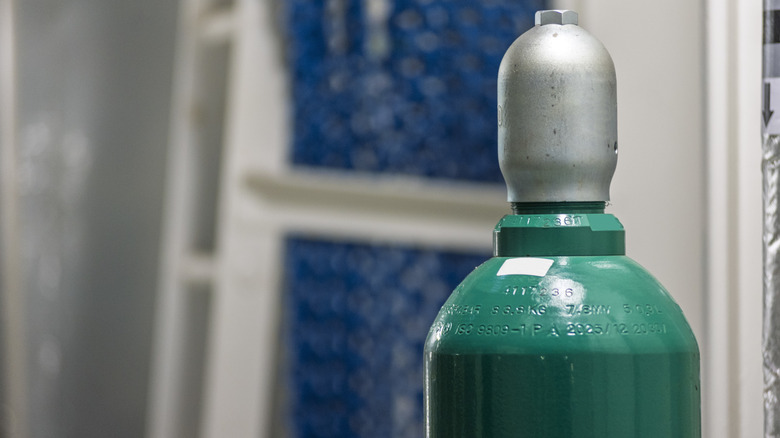
Nitrogen-filled tires have a small but loyal following. Costco or any well-stocked tire shop is a prime spot for getting nitrogen for your tires. Of course, there are a few drawbacks to switching exclusively to nitrogen, but for some, tires that hold their pressure a little longer are genuinely worth it. However, if you feel compelled to store a nitrogen cylinder (along with a tire inflation kit) in your garage or your workshop, you may want to brush up on the safety hazards associated with it.
Your primary concern with nitrogen is the asphyxiation risk, especially when storing it in a confined space. According to the U.S. Chemical Safety and Hazard Investigation Board, nitrogen can displace oxygen, which could potentially lead to death once oxygen levels get critically low. Unfortunately, while other gases like toxic diesel fumes have a notoriously pungent smell (it's easy to detect), nitrogen is an inert gas that's both colorless and odorless.
In addition to oxygen displacement, there's a small explosion risk associated with nitrogen. Though it's not flammable, nitrogen is kept in cylinders at very high pressure, and a damaged tank could let all that pressure out in a split second, resulting in a mechanical explosion.
How to handle nitrogen safely
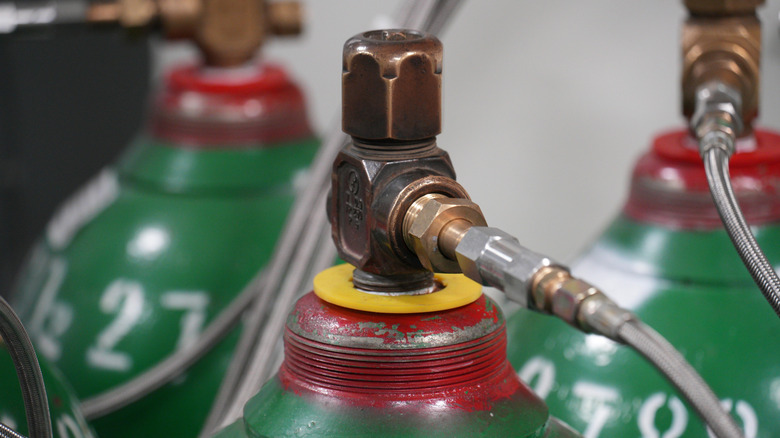
The best course of action is to keep the nitrogen tank in a well-ventilated area, which can significantly minimize the asphyxiation risk. You could also invest in a dedicated oxygen gas detector, such as the TopTes Guard-101 Gas Detector, available on Amazon. The device sounds an alarm when a nitrogen leak pushes oxygen levels down. Then, it's wise to be familiar with the early signs of hypoxia. Since nitrogen displaces oxygen molecules, your body will receive a decreased amount of oxygen with each breath, starving your cells in the process. According to News-Medical, you could initially feel fatigue, shortness of breath, lightheadedness, nausea, and heart palpitations. Other red flags include confusion, disorientation and uncoordinated movements, euphoria, and a sensation of dissociation from self. Watch for them if you're adamant about handling nitrogen gas on your own. Just keep in mind that a severe drop in oxygen can knock you unconscious with little to no warning.
It's always better to be safe than sorry, so you should store nitrogen cylinders upright and have them secured by a strap to minimize the chances of damaging the tank. Heat management is also important. Keep the tanks out of direct sunlight and away from flammable materials, and make sure the storage area never gets hotter than 125 degrees Fahrenheit, as a hot tank is more likely to rupture. Overall, nitrogen gas isn't as dangerous as liquid nitrogen, but you're still dealing with chemistry — an area where you should always cross your t's and dot your i's.