

Deer Crossing Signs Are Intentionally Placed (But That Doesn't Mean They Work)
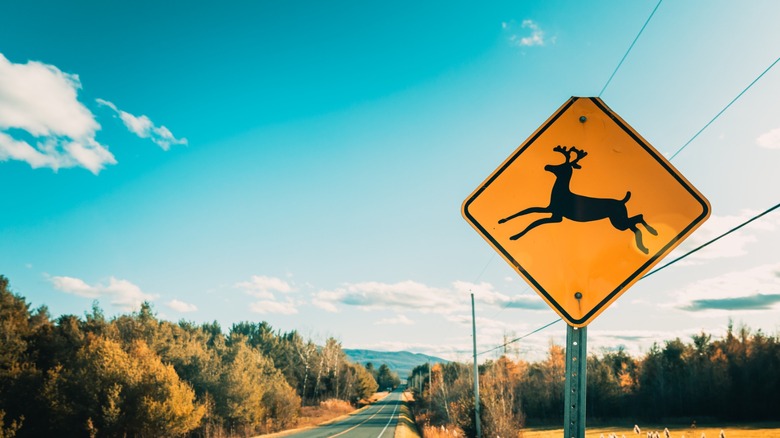
During a (hopefully) prank call to a radio station, a woman named Donna asked for deer crossing signs to be moved to lower-traffic areas. But deer crossing signs are not placed as indicators of safe places for deer to cross the road. They are, however, an indication that the area adjacent to the roadway is good deer habitat and deer have been known to cross the road along that particular stretch.
The design of deer crossing signs in the United States adheres to the Manual on Uniform Traffic Control Devices, or MUTCD, from the Federal Highway Administration, a division of the US Department of Transportation. The MUTCD states that deer crossing signs "can be installed in an appropriate location, based on engineering judgment."
Unlike some of the most confusing road signs, deer crossing signs are relatively straightforward. The specifications for signs warning of the potential presence of large animals, including deer, on the roadway call for a diamond-shaped road sign (a square with one diagonal vertical). They typically measure 30 inches per side on single-lane roads and 36 inches on multilane roads, although smaller 24-inch signs and oversized signs up to 48 inches per side are permissible in certain circumstances. Deer crossing signs have a yellow background bordered in black with black graphics, typically a stylized antlered deer that sometimes includes some variation of the words "DEER CROSSING."
Factors that reduce the effectiveness of deer crossing signs
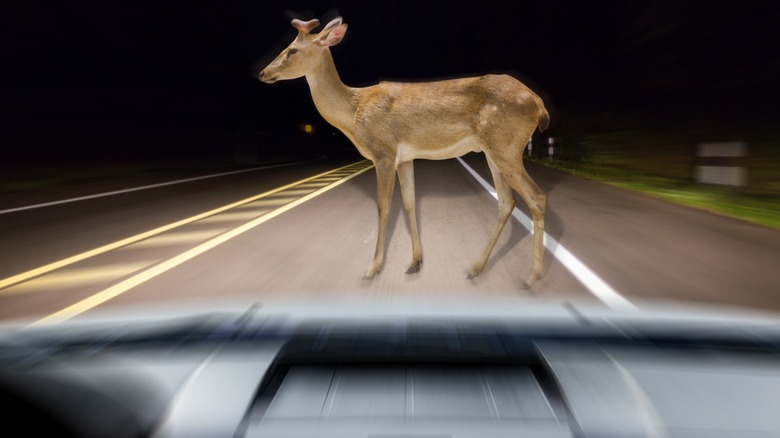
When evaluating the safest car models for first-time drivers, we naturally consider safety tech like automatic emergency braking. The downside to advanced tech is that drivers may become accustomed to it, giving them a false sense of security rather than relying on defensive driving techniques, like reducing speeds to below posted limits in areas with potential hazards.
A report from Iowa State University points out that deer crossing signs have low effectiveness due to the sporadic nature of actual deer crossings and their frequent misuse. For instance, a driver who's new to an area may reduce their speed when encountering a deer crossing sign for the first time. However, as drivers continue to pass that sign over the span of a few months with no deer sightings, it has less of an impact on their driving behavior. In addition, if the local Department of Transportation has installed signs excessively, without regard to potential deer crossings, drivers might start ignoring the signs altogether.
Factors that increase deer-vehicle conflicts
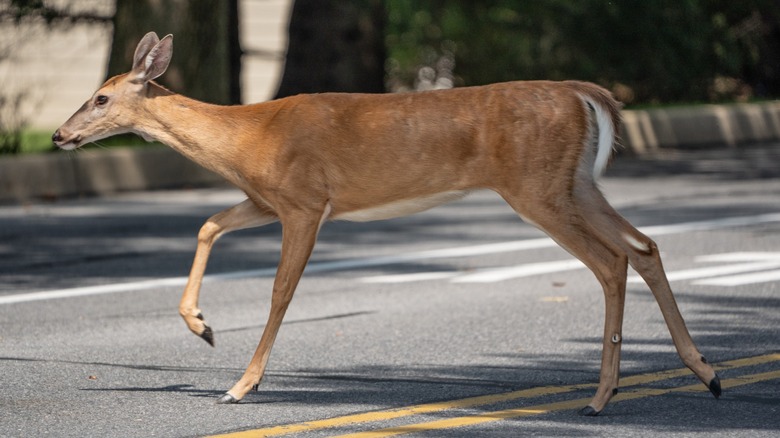
Periods of increased deer movement lead to more vehicle collisions involving deer. While deer can survive in sparse habitats surprisingly close to humans, we should keep in mind that riverbottom and farmland areas typically hold denser deer populations. Wherever they're found, as crepuscular creatures, deer are most active at dawn and dusk. Activity levels spike during their breeding season, which varies in different parts of the country but typically starts in early October and runs through January. Most of the year, deer are content to adhere to a bed-to-feed pattern. In areas with good habitat, they may rarely leave the woodlot they call home, but as habitat fragmentation increases, they often concentrate movement along habitat edges.
Edge habitat is important to deer for multiple reasons. First, it allows food sources, such as browse, to grow within their reach, something dense stands of tall trees lack. It also provides thick cover from briars, vines, and bushes that allows hiding places for adults and fawns. While edge habitats away from roadways are safest, deer are also drawn to those along highway rights-of-way, which can lead to conflicts. Staying alert during times of increased deer movement and reducing your speed, especially if you see deer anywhere near the roadway, are good ways to ensure safe travel through deer country. However, there are a number of additional safety tips for driving at night that'll help you avoid other dangers as well.