

Most Phone Service Providers Don't Actually Own Any Cell Towers - Here's Who Does
You could be paying for one carrier while using hardware that provides the signal from a completely different brand in the U.S. That's thanks to the existence of MVNOs, short for mobile virtual network operators. The thing is, only three carriers in the country actually run their own network hardware nationwide, namely AT&T, Verizon, and T-Mobile. While regional carriers with their own networks exist, other cell providers (some worse than others) are MVNOs that buy their network access from the bigger players. The big players like Verizon also own brands that share their hardware.
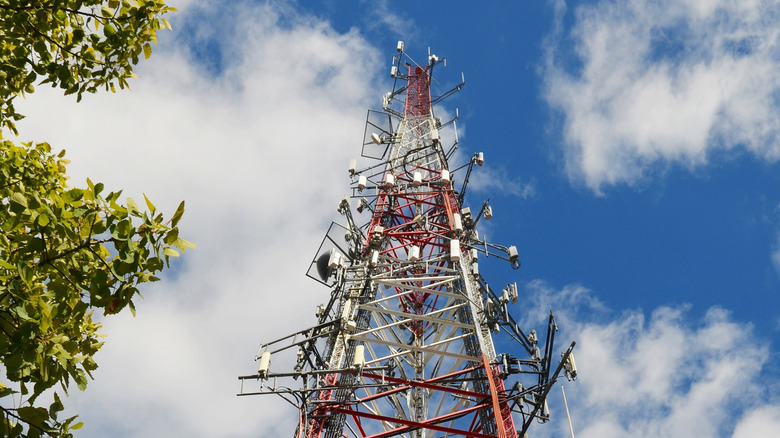
However, this networking hardware cannot simply be suspended in the air — it has to hang off something. That's where tower companies come in. Surprisingly, even the big players technically aren't complete owners of their own networking infrastructure. For instance, T-Mobile revealed back in 2012 that while it uses a massive fleet of 51,000 cell sites, most of them are leased from third parties. These structures are the steel towers and building rooftops, which the carriers mostly don't own. Instead, their radio equipment simply hangs off those.
The structures are owned by a handful of landlords or independent tower companies. The carriers only own a small minority. For perspective, there were reportedly 158,500 purpose-built towers in the U.S. as of 2025, according to the Wireless Infrastructure Association (WIA). American Tower owns 42,224 sites in the U.S. and Canada. Not far behind is Crown Castle with about 40,000 towers. Finally, there's SBA Communications with 17,394 sites in the U.S.
Why did the carriers give up their towers?
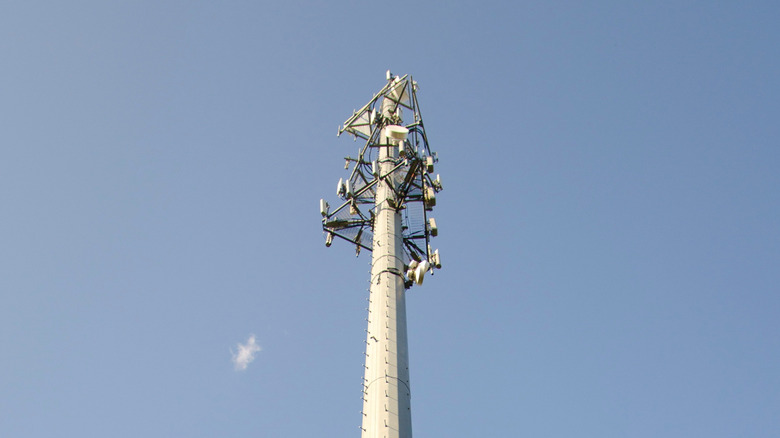
However, things weren't always this way. Until the late 1990s and early 2000s, the carriers themselves used to own most of the towers in the U.S., according to the WIA. The problem was that the networking industry (like most industries) keeps changing, and upgrading old hardware is an expensive affair. So the carriers decided to offload their towers, trading them for cash.
For instance, in 2012, T-Mobile handed about 7,200 towers to Crown Castle for a cool $2.4 billion. Verizon did something similar, handing rights to over 11,300 towers to American Tower for about $5 billion. In doing so, the carriers gained the billions needed to spend on network upgrades. T-Mobile, for one, had said at the time of the deal that the cash would help pay for its upgrade to 4G, which was a $4 billion project.
Funnily, just because a carrier sold its towers to one of the landlords doesn't mean each tower only holds the hardware for a single carrier. That's where the concept of shared towers comes in. T-Mobile has explained that each carrier bolts its own antennas and radios onto a shared tower. The shared tower itself can be in the form of things like plain poles, steel frames, or even pre-existing structures.
How many carriers can share one tower?
An average tower holds about two carriers. For instance, Crown Castle's towers host about 2.4 tenants each on average. For SBA, that figure stands at 1.8. SBA says that the number of tenants depends on factors like the tower's height, type, and how much wind it can handle. By sharing, a single landlord can collect rent from more than one carrier at once.
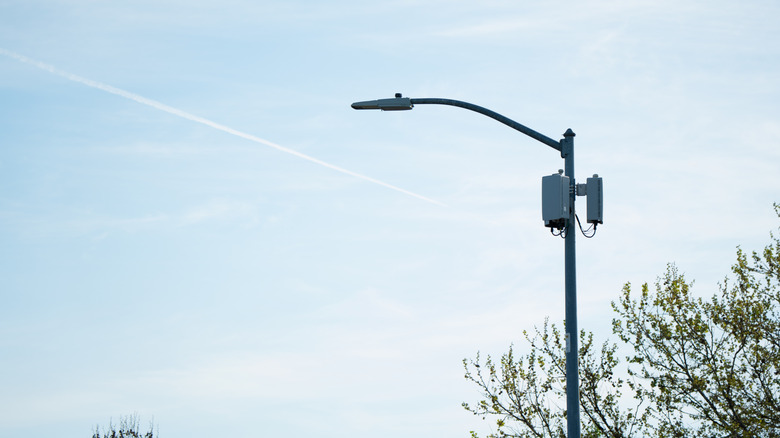
However, not every location can host an entire tower, especially dense urban areas. That's where smaller wireless facilities come in. Because some of the fastest 5G operates at much shorter wavelengths than 4G to deliver those astronomical speeds and ultra-low latencies, it needs to be deployed at much higher density. Towers alone can't really facilitate that, which is why much of the supporting hardware has to be mounted on everyday city infrastructure like streetlights and rooftops. At the end of 2025, the WIA counted 198,100 outdoor small cells in the U.S.
Ultimately, the hierarchy goes something like this: MVNOs rent some of the network provided by the big three carriers, while the big carriers rent towers from landlords.