

This App's New Feature Could Help You Dodge Flock Cameras On Your Route
Drivers surged to the MapQuest app after other mapping applications reflected the Trump administration's controversial renaming of Lake Ontario to Lake America. The company, which older drivers fondly remember from the days of printing step-by-step directions before GPS, refused to make the change but had some catching up to do tech-wise. Now it's offering a new feature that may appeal to the masses — a surveillance layer.
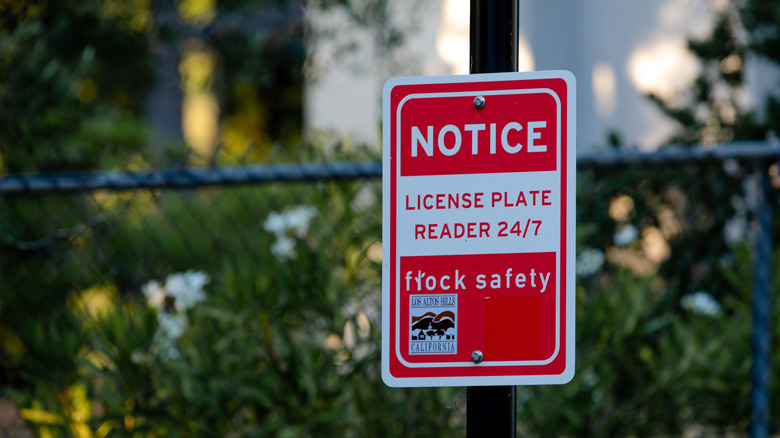
This new feature does the surveying for you so that you can avoid what many feel is an invasion of privacy: automated license plate readers (ALPRs). Though they are often referred to as simply "Flock cameras," Flock is just one of several companies that makes ALPRs. Others include Genetec, Axis Communications, Axon, PlateSmart, Verkada, and more. These readers don't just capture your license plate data. They also record the make, model, and color of your vehicle, and in some cases even your bumper stickers and vehicle's body damage. This information is then uploaded into a national database.
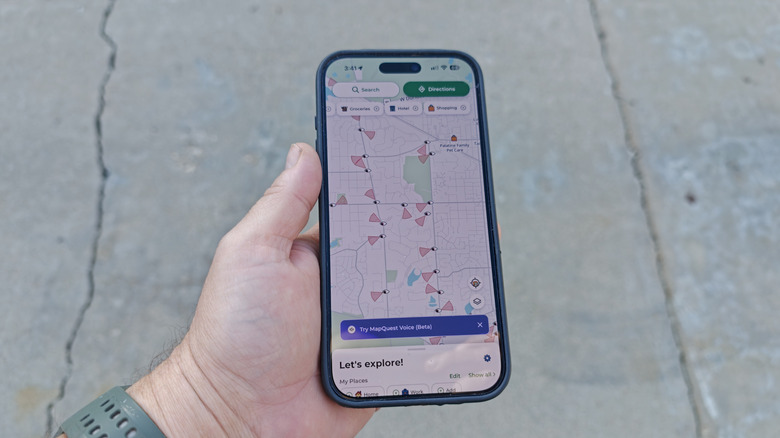
ALPRs are commonly found at intersections, on highways, near businesses, and even on private properties. They can be very difficult to avoid, but MapQuest's mobile app can help. Simply download or update your app, then click on the icon that looks like a small square sitting on top of another square. Then toggle "Surveillance" to view ALPRs near you and along your route. Each camera will appear as a small eyeball on your map.
The case against Flock Cameras
Flock Safety alone has more than 120,000 cameras across the country, and as of September 2026 there are an estimated 140,000 in total. The case in favor of these cameras is thin. They can help the police track down missing people and stolen cars, but according to the American Civil Liberties Union (ACLU), fewer than 1% of cars scanned are connected to a crime. Many view them as an invasion of privacy, and few states have laws that regulate how the collected data is used or even how long it's stored.
Federal lawmakers recently proposed new legislation that would ban federal agencies from using these cameras. It would also temporarily halt federal financial assistance to state and local agencies that use them. Public outcry has already made a small difference. The city of Tempe, Arizona discontinued use of ALPRs, and Los Angeles let its agreement with Flock Safety expire.
The ACLU reports that though Flock Safety does not have any official contracts with the U.S. Immigration and Customs Enforcement (ICE) or U.S. Customs and Border Protection, local police departments that do have Flock contracts can conduct searches on behalf of ICE.
In November 2025, CBS News reported that a Denver woman was accused of theft based solely on footage obtained from a Flock camera. She maintains that she had to use data from her own vehicle, a Rivian, to prove her innocence. If you're concerned about these cameras and how the data is used, use MapQuest's new feature and visit the ACLU's "Get the Flock Out" website.