

A Ukrainian Drone Actually Saved Someone's Life In A Battlefield First
Ever since the dawn of warfare, one of the most dangerous missions involves removing an injured person from a combat zone. A massive innovation in this regard came during World War II, when United States Army Air Forces helicopters medically evacuated (MEDEVAC) wounded personnel from battlefields so they could be treated further from the front lines. Modern military operations are no different, and getting hurt people to safety remains incredibly dangerous to everyone involved.
This has been apparent throughout the Russo-Ukrainian War, where thousands on both sides have been wounded in the fight. In a battlefield first, in mid October 2026, a Ukrainian drone flew to an injured soldier's position, picked him up, and took him to safety. This was especially necessary due to the hazards in the area, which included incredibly dangerous landmines, enemy combatants, and hostile drones. The man who was rescued had spent 491 days alone in his combat position, enduring that entire time under constant attack. He received all of his needed provisions and ammunition via drone delivery, which is another aspect of the technology that Ukraine is at the forefront of in terms of defense.
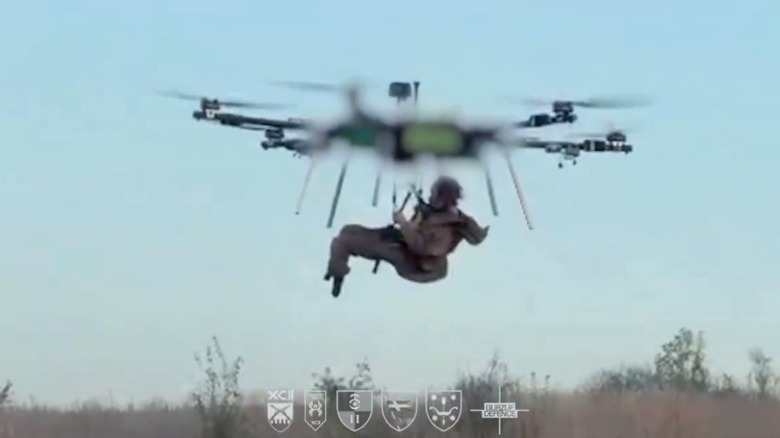
Once he was seriously wounded and his life was put at risk, the best way to get him out of the fight for treatment wasn't a helicopter or an ambulance; it was a drone. Despite the complexity of the operation, the Heavy Shot Ayudag-6 hexacopter drone made its way to the wounded soldier's position, he strapped himself into a harness, and the drone flew him to safety. This marks a massive change in how battlespace rescue operations are conducted, and is as innovative and important as the first helicopter MEDEVAC conducted in 1944.
The rescue of a Ukrainian soldier from the front lines
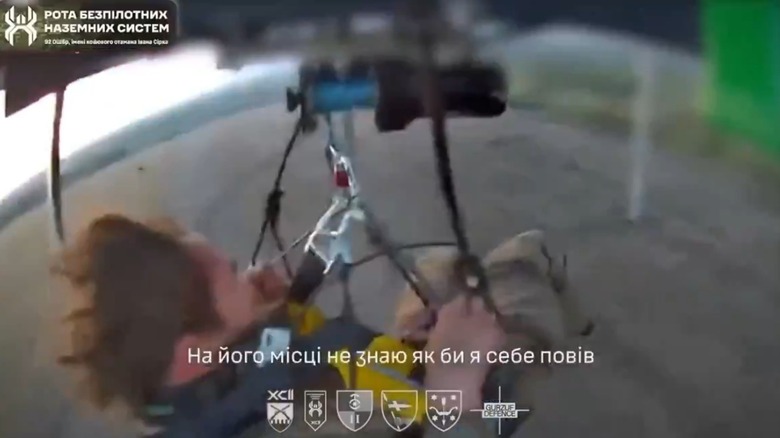
News of the unprecedented rescue operation found its way online on October 19, 2026, showing a video of how it played out. It begins in a command and control room, where drone operators direct the Heavy Shot Ayudag-6 hexacopter drone to the injured soldier's position. Once there, he quickly straps himself into the harness and lifts off the ground. You then see him progress over some fields and trees before landing so he could be treated. Essentially, it's the same thing a helicopter does during a MEDEVAC, but it doesn't endanger anyone's lives in such an operation.
The wounded soldier was Kostiantyn "Magura" Vlasenko of the 30th / 92nd Separate Mechanized and Assault Brigades, and he was stranded in a contested area near the Oskil River. That's at the Kupyansk front, and it's where a Russian drone dropped an unspecified munition atop his location, wounding both of his legs. To survive, Vlasenko amputated his own legs, and while a MEDEVAC over land was impossible and a helicopter landing was highly dangerous, a single drone was the ideal solution that seemingly makes helicopters obsolete.
The Heavy Shot Ayudag-6 hexacopter drone was provided by its manufacturer, Gurzuf Defense, and it weighs about 216 lbs. It has a carrying capacity of up to 287 lbs., which was more than enough to rescue Vlasenko from his position. The flight covered 39 miles and took around 1 hour and 15 minutes to complete. It brought along the harness and gear needed to secure Vlasenko, and it also included a cell phone with a video showing him exactly what to do.
A more robust MEDEVAC drone is already joining the fight
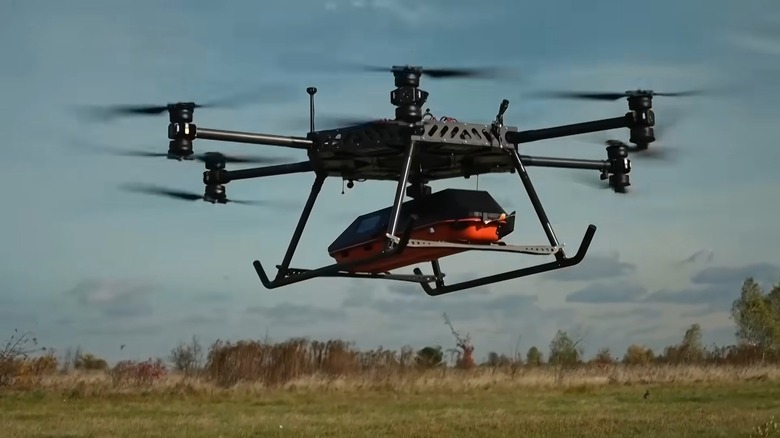
Using the Heavy Shot Ayudag-6 hexacopter drone to save Vlasenko was an unprecedented rescue operation, but it's only the first in what could become a standard high-tech tool used throughout the Russo-Ukrainian War. SkyFall, a Ukrainian company, developed the StarGate drone specifically to aid in rescue operations. The Ukrainian military began testing the new drone in mid October, 2026, right around the time that Vlasenko was rescued. The StarGate drone is also a hexacopter, but it was designed from the ground up for MEDEVAC operations.
According to Skyfall's spokesperson, "The idea came directly from the front line, from the trenches," where rescue operations have been hindered by the dangers of combat, leaving wounded troops on the battlefield for extended periods. StarGate has a maximum carrying capacity of 330 lbs., which is enough to carry a soldier, their body armor, and combat equipment. It features a MEDEVAC cabin that's built around a stretcher, so the wounded soldier is placed safely within.
The drone has a cruising speed of 40 mph, but it can go faster, hitting as much as 65 mph, and it's ready to fly within 10 minutes of notification. It's equipped with electronic jamming countermeasures to impede offensive combat drones, such as firing a net at a target drone, sending it off course or to the ground. For control and communications, it uses a proprietary L-Link system with Starlink and artificial intelligence to maintain control in GPS-denied areas. Not only is StarGate a potential game-changer for combat operations in and out of Ukraine, but it could be used to save civilians from hard-to-reach locations as well.