

What Does A Blue Road Sign With A Question Mark Mean?
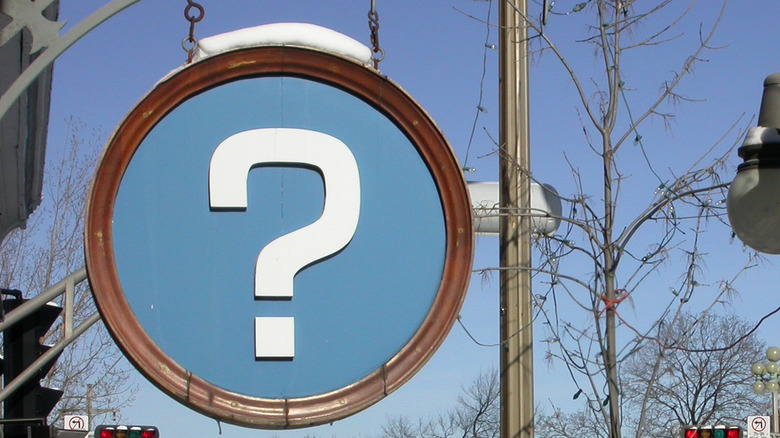
Although some road signs may be confusing, understanding the meanings of traffic signs and signals is imperative for all motorists. However, even if you're a responsible driver who prioritizes familiarizing yourself with the various signs you might encounter, you may still come across an uncommon one whose meaning you're unsure of. For instance, maybe you've seen a blue road sign with a question mark on it. Although this sign is meant to direct you to the location of a tourist information center, you're not alone if you have trouble determining what message it's supposed to convey.
This sign is an older version of the current sign classified as "D9-10" by the U.S. Department of Transportation Federal Highway Administration (FHWA). These days, the sign may feature the word "INFO" on it. Earlier versions used a question mark. The FHWA adopted the new design when surveys indicated that question marks might confuse some drivers, while the vast majority of motorists would understand the word INFO on a blue sign means a welcome center or tourist information center is nearby. That said, because it can take significant time and resources to replace older road signs with new updates, in some parts of the U.S., drivers might still spot the old sign.
Other versions of the blue road sign with a question mark
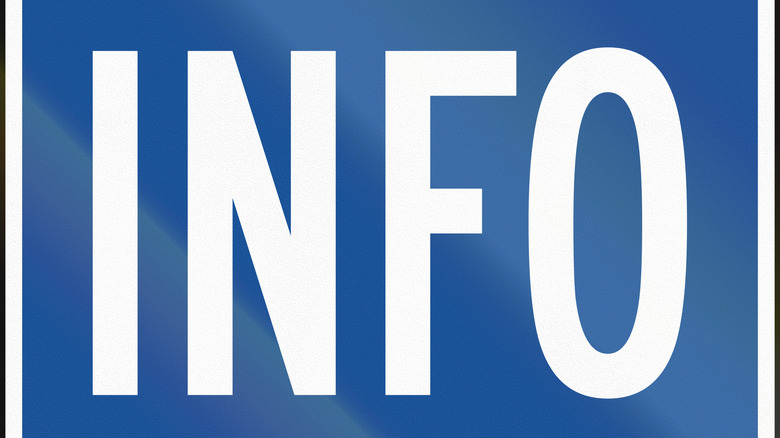
The standard blue square with the word INFO printed on it isn't the only type of road sign that might provide information about a nearby tourist center. Per the Manual on Uniform Traffic Control Devices (MUTCD), variations on this type of sign might be larger and may provide additional information.
For example, rather than merely featuring the word INFO on them, they may include lengthier verbiage, such as "REST AREA," "TOURIST INFO CENTER," or both. Some may also indicate how far away the welcome area is, or what exit or turn a motorist should take to access it. These types of signs may indicate how to access a tourist area with words like "NEXT RIGHT", or they may use arrows to indicate the area's location.
Keep in mind that this isn't the first time the FHWA has updated road signs based on new findings. For example, while words on older road signs may have included both capital and lowercase letters, it's now policy for road signs to feature solely uppercase letters, as these have been found to more effectively communicate information to drivers.
On the subject of blue road signs, now might be a good time to brush up on the difference between blue and green road signs, with green being the default and blue reserved for specific situations. Even seasoned drivers can benefit from relearning the basics. Remember, knowing how to decipher the meanings of different road signs can significantly boost your safety as a motorist.