

Why Do Returning Spacecraft Usually Land In Water?
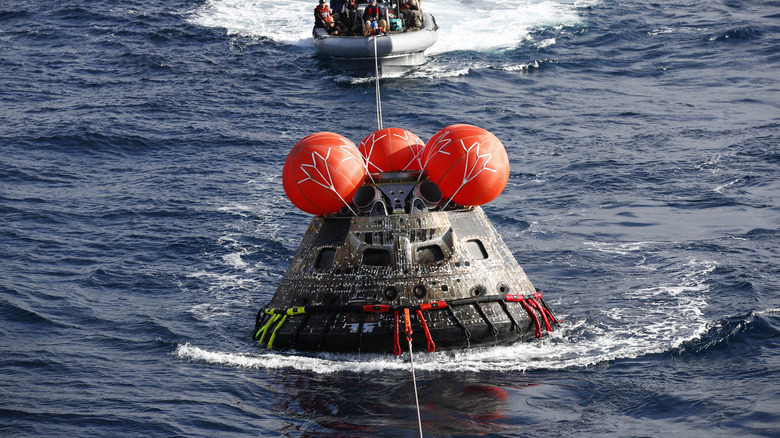
Watching a spacecraft launch into orbit is a breathtaking event that many science enthusiasts love. But watching these craft return to Earth for a landing is an important moment as well. When it comes to why many spacecraft typically land in water, the reason has to do with the water's ability to help absorb some of the massive collision forces that occur on impact.
But just because water provides an ideal landing surface doesn't mean splashdown happens on a soft cushion. A typical splashdown involves the spacecraft hitting the water at a speed of about 80 feet per second. This immense impact is no small event, which is why a return craft must be designed and constructed to handle the collision that awaits it. Additionally, the world's oceans provide a vast target for returning spacecraft to hit.
However, ocean landings have the potential to go wrong due to the weather, as windy conditions can cause the craft to move further away from its predetermined landing site. The same is true of the water itself, as rough currents can push a craft off course, forcing rescue teams to search for the returning crew. There's also the possibility that the craft can sink, which actually happened in 1961 when the Liberty Bell 7 took on water after a hatch problem, leading to NASA astronaut Gus Grissom's escape and eventual rescue.
How NASA recovers spacecraft after splashdown
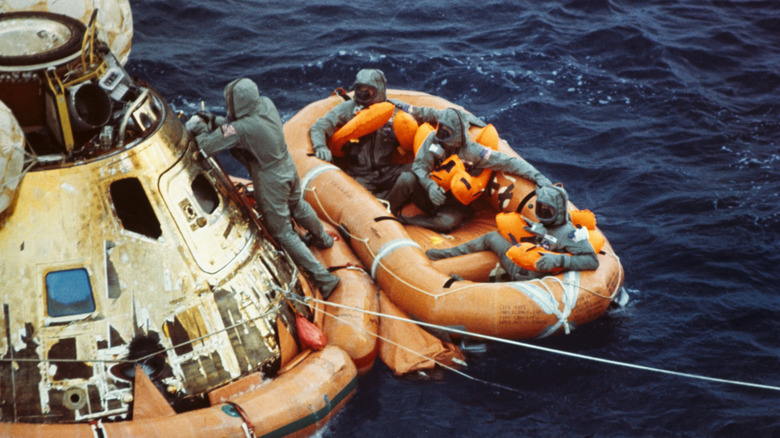
After a spacecraft splashes down in the ocean, the recovery process is handled by the U.S. Navy, as well as designated recovery teams. Those rescue forces undergo training for the event, which can be complicated, depending on conditions at the time. Helicopters can be used to bring the craft and its crew up out of the water if necessary, while modern devices like flotation collars give the craft a better chance of staying afloat.
One such splashdown occurred in April 2026, when the crew of the Artemis II returned to Earth in the Orion capsule. The four astronauts exited the Orion onto an inflatable raft, where military helicopters lifted them and transported them to a nearby naval vessel for medical evaluations. The Orion itself was also safely recovered, with Navy divers using a winch cable to guide the craft into a specially designed holding bay on the ship's deck. Once the Orion was ready, it would be transported back to the Kennedy Space Center.
In the years leading up to the Artemis II 2026 mission, NASA engineers conducted water-impact tests at Langley Research Center in Virginia. These tests examined the forces the Orion capsule and its crew would experience during a water landing. NASA compiled data from several capsule versions, along with information from the Artemis I mission, to refine its computer models before Artemis II. This work helped engineers to better understand what Orion would face during splashdown.