

Can You Charge Ryobi's USB Lithium Batteries With A Phone Charger?
We may receive a commission on purchases made from links.
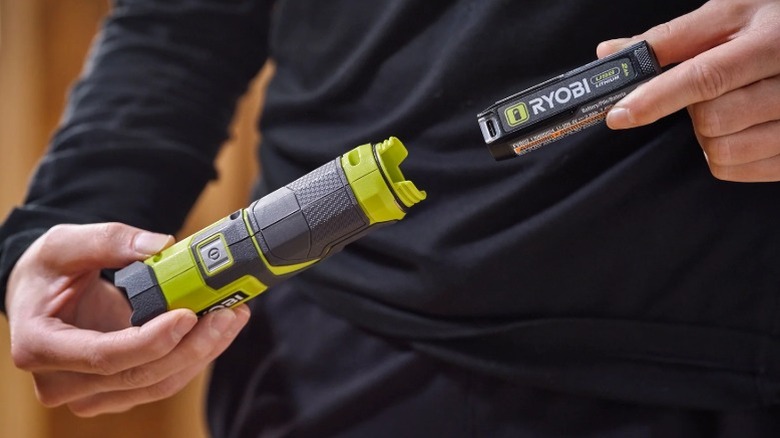
Ryobi's USB Lithium rechargeable batteries power dozens of useful USB Lithium tools and accessories and, unlike the brand's larger batteries, also sport USB-C ports. This lets you charge with a standard USB-C cable connected to a modern phone charger, so you don't need proprietary charging hardware. Ryobi's manuals don't specify a USB-C Power Delivery (PD) requirement or a minimum charger wattage, so any USB wall charger with the right cable should work, too. Just be sure it's a UL-listed power source, as Ryobi recommends.
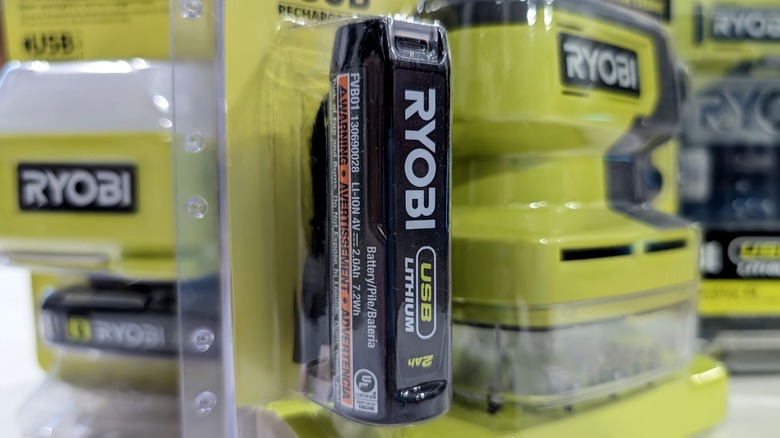
The battery comes in 2Ah and 3Ah capacities, with Ryobi claiming that the 3Ah USB Lithium battery offers 50% more runtime than the 2Ah version. Both versions come with a two-year limited manufacturer's warranty, which is a little less than what you'll find with other (bigger) Ryobi battery families.
Its USB-C charging is a nice feature for such a compact battery, giving you compatibility both with Ryobi's many USB Lithium tools and the cords you already have around the house. It also works the other way: Connecting a phone or other USB-rechargeable device via a USB-C cable will charge it using the USB Lithium battery.
Charging via USB-C versus using Ryobi's dedicated charger
While you can certainly use whatever USB-C cable and USB power supply you have lying around to charge your USB Lithium battery, there is a faster option: Ryobi's USB Lithium three-port charger. This charging hub can recharge up to three USB Lithium batteries at once, and it does so much faster than USB-C, with Ryobi claiming charging speeds that are up to 80% faster.
If you often use one or more of Ryobi's USB Lithium tools for projects or tasks around the house, it probably makes more sense to use the brand's dedicated charger. That's because it charges more batteries faster, letting you rotate between batteries without interrupting your project. Relying on one battery and one USB-C charging cable means much more downtime.
Charging multiple batteries at once also lets you keep multiple USB Lithium tools powered, too. That said, if you only use your USB Lithium products occasionally, a USB-C cable and charging brick should be fine.