

How Does A Liquid Nitrogen Freezer Work And What's It Good For?
Normally when you think of liquid nitrogen, you'd picture the stuff fancy cocktails come with, or perhaps spooky fog rolling off science fair demos. However, liquid nitrogen plays a crucial role in industrial settings, particularly inside freezers. For households, dry ice is way more useful.
The machine is specifically known as a liquid nitrogen freezer, and it comes in two main types. There are storage tanks designed to keep samples frozen for years, most frequently in lab settings that preserve vials. Then there are flash freezers designed to freeze food on factory lines as quickly as possible, typically within minutes. Both work very differently from regular home freezers since they cool by letting liquid nitrogen boil, which happens at roughly -321 degrees Fahrenheit. The rapid boiling simply pulls the heat away.
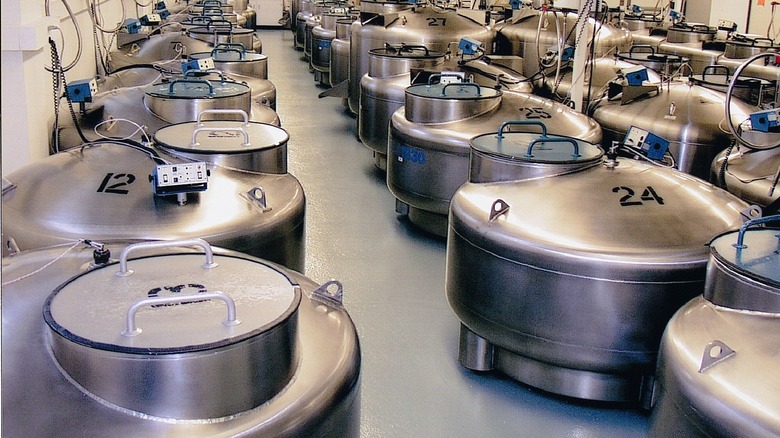
In storage tanks, that boiling happens in what are basically oversized thermoses, with a vacuum between two walls blocking outside heat. A steady supply of liquid nitrogen comes in via valves, and sensors keeps things topped up. The contents inside, typically vials, aren't directly immersed in the liquid, though, since they can burst. Instead, they sit in the frigid vapor above.
Meanwhile, flash freezers don't really have storage involved — they run food on a conveyor through an insulated tunnel. Overhead nozzles spray a fine nitrogen mist as that passes. Once frozen, the food is moved into ordinary compressor-cooled cold storage.
What liquid nitrogen freezers are actually good for
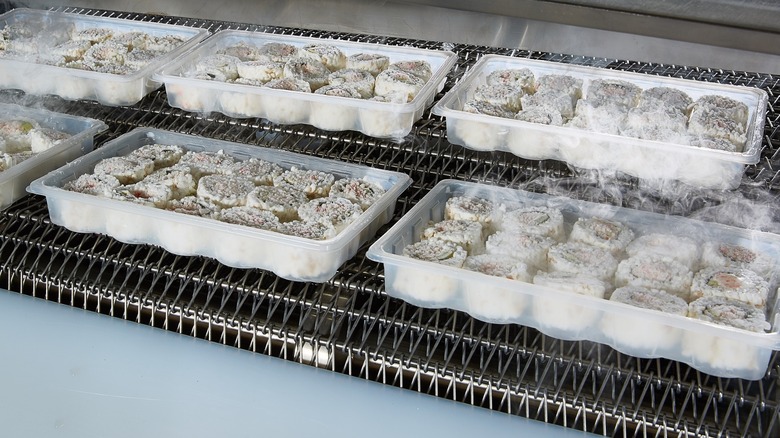
The reason liquid nitrogen isn't used for food storage is because it doesn't need it. Regular compressor refrigerators, available in various types, work just fine since food keeps just fine at around 0°F. However, flash freezing does come in handy for certain types of food because of how the ice forms on food. Freezing food gradually leads to the creation of big, jagged crystals that puncture cell walls. It's exactly why a strawberry from a home freezer often thaws into a mush. On the other hand, freezing quickly forms tiny crystals, which leave the texture mostly intact.
Intact texture also means that stuff like fruit tastes fresher. The smaller crystals simply lead to far less juice leaking out when food thaws. In one test, strawberries frozen slowly over 12 hours lost about 20% of their juice, while berries flash frozen with liquid nitrogen lost under 5%.
Using liquid nitrogen is a pretty expensive process, though, since that stuff simply boils away and cannot be reused. Freezing just one pound of fish burns through up to two pounds of nitrogen. That's why flash freezing is typically used for pricier food like seafood and berries.
Beyond food, storage tanks help preserve irreplaceable living samples. Biological activity basically grinds to a halt below roughly -206 degrees Fahrenheit, a temperature that liquid nitrogen helps maintain. An example is the San Diego Zoo's Frozen Zoo, a cell bank for wildlife conservation, which holds over 11,000 cell lines in liquid nitrogen.