

Free Legal Advice From ChatGPT Actually Helped A Man Win A Parking Ticket Dispute
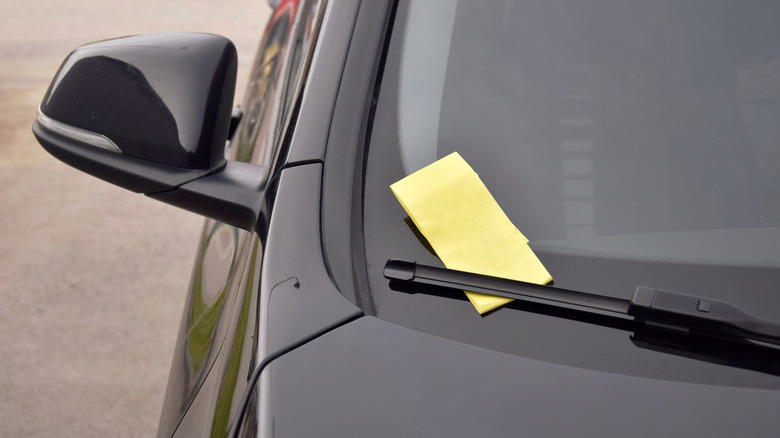
It's often said that legal paperwork is one of those things you should never use ChatGPT for since AI chatbots tend to hallucinate and can't be trusted. But that hasn't stopped people from doing so — and even getting good results out of it. More recently, one driver in England actually ended up winning a three-year fight over a parking charge. In this case, ChatGPT helped by drafting the letters.
Behind the feat is Rafal Goral, a 45-year-old refinery worker from Essex. It all started when he visited the Cornwall town of Newquay in August 2023, specifically a car park on Tower Road. He says that the pay machine over there had a long line and took only cash. Goral ended up paying through the RingGo parking app, which took time to download due to a weak signal.
Unfortunately for him, two weeks later, Smart Parking Limited, the private company running the car park, sent him a £100 (roughly $130) charge. The notice said that his payment came through 16 minutes after his car entered.
Goral then appealed, arguing that he'd have paid on time but the queue, the cash-only machine, and the app setup slowed things down. Despite that, he says he never heard back. Worse, the following January, a debt collector demanded £170.
Eventually, Goral decided to turn to ChatGPT. Whenever a letter or email arrived from Smart Parking or its debt collectors, he shared it with the chatbot and had it draft the replies. He even had it draft the defense he sent to court.
How it turned into a three-year fight
It was only on September 25, 2026, weeks before a scheduled court hearing, that he finally won the case. He learned that from an email that told him the case was over and he owed nothing. Given that the first charge came in in 2023, the case had dragged on for about three years. After that January letter, for four months, Goral actually spent the time trading letters with collectors before the case went quiet for roughly a year and a half. However, in November 2025, a second collection agency got in touch. This time, the warning came with a court date of October 2026, and by then, the amount had also risen to roughly £300.
Now Goral does say that at one point, Smart Parking actually offered to cut the charge to £60. That would have ended his troubles, but he refused, saying he saw the fight as a matter of principle. He also called the dispute "kind of a David and Goliath battle."
Goral isn't the only defendant to turn to ChatGPT. For instance, in 2025, a Lancashire chef named Loren Cole leaned on ChatGPT to fight a parking charge from the operator Parkingeye, which later dropped its case. There are numerous other cases like these. In fact, a September 2026 study from JUSTICE, a U.K. legal charity, found that about one in six people with a legal dispute in the past two years had used an AI chatbot for help.
A chatbot still cannot be a substitute for a lawyer

Now, while ChatGPT did write most of Goral's side of the dispute, it's unclear how much of that actually swayed Smart Parking into dropping the case. After all, the company hasn't said why it decided to do so. It also disputes Goral's account: A spokesperson told The Independent that the payment machines were working that day.
Also worth highlighting is that OpenAI doesn't pitch ChatGPT as a lawyer. Under its usage policies, nobody is supposed to use its services for personalized legal advice, or at least without a licensed lawyer being a part of the process. Of course, ChatGPT isn't outright banned from discussing legal problems, but that doesn't make its answers legal advice either.
Using AI chatbots can get you in trouble, too. Earlier in 2026, the Arizona Court of Appeals actually sanctioned a man who used generative AI to write his own appeal. The court found problems with six of the eight citations in his brief. Two of the cases he cited didn't even exist. The judges also pointed out that this case wasn't one of a kind. In their ruling, they cited a public database that has logged 1,751 instances of AI-invented content turning up in legal paperwork.
Ultimately, the errors caused by the AI cost the Arizona man his appeal. Things weren't that serious for Goral, though — he only risked a few hundred pounds if ChatGPT steered him wrong or hallucinated. Of course, a proper criminal case would carry a far bigger risk.