

What Does A White Navigation Light Mean In Boating?
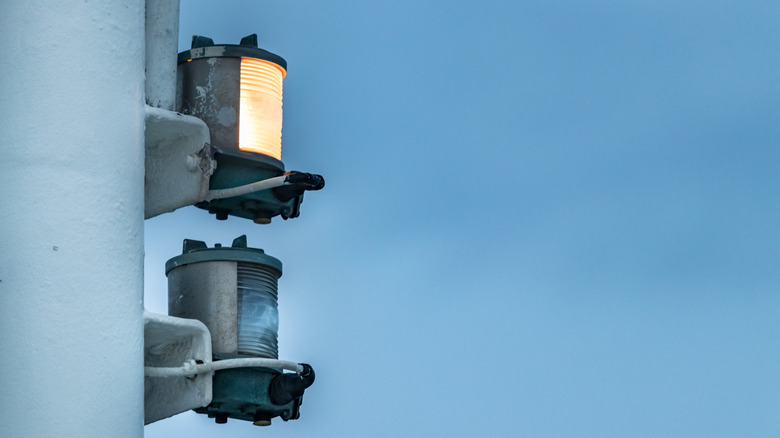
In boating, one has to be aware of the many rules and regulations. They apply when a boat is stationary, moving, overtaking, and even when it comes to fuel, such as the 1/3 rule in boating. On that note, different colors on a boat or buoys play a specific role. For instance, a yellow buoy and a red and white stripped buoy have different meanings. It's similar for boats, as various colors are used on flags or lights to inform others what you're doing or about to do.
With that in mind, a white navigation light is the one you'll likely spot on the water at night. However, what it means depends on where it's mounted and how it's displayed. There are different rules for different sized craft, and other light specifications, all laid out by the U.S. Coast Guard, but in simple terms, a white navigation light usually marks a boat or object and shows where it is and which way it's pointing.
For power-driven vessels, less than 12 meters (39.4 feet) in length, which includes motor boats and sailboats when a motor is in use, there are several lights needed, starting with the white navigation light. You can use an all-around (white) light, which, as the name implies, shines in all directions around the boat. This should be placed as close to the centerline as possible and shine in all directions.
On craft over 12 meters, but less than 20 meters (65.6 feet), you can use a light mounted on a masthead which shines in a 225-degree arc that is visible from the front and both sides. This is used in conjunction to a sternlight mounted on the boat's stern. It shines continuously across a 135-degree arc, covering the rear of the craft and 67.5 degrees to each side. These two lights make up a 360-degree circle. The main point is that your boat's white light needs to be visible from every direction for up to two nautical miles.
White lights work with green and red lights in boating
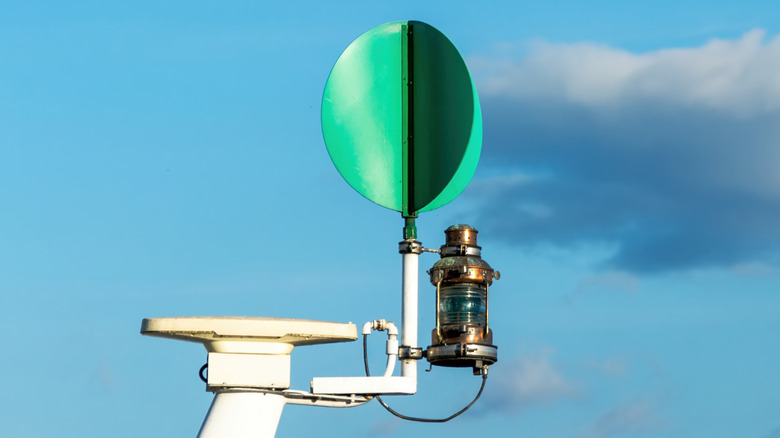
It's worth noting that the all-around white light is mostly used on smaller boats because, unlike sailboats, they don't have a long mast for the masthead light. However, white light isn't the only light used in boating for navigation purposes. Green and red lights are present as well and are often used in conjunction with the white navigation light.
More precisely, green and red lights are used as sidelights, meaning the red light is used to illuminate the port side, while the green light is used on the starboard side. Under the U.S. inland and international navigation rules, each light projects continuously across a 112.5-degree arc, from straight ahead to 22.5 degrees behind the beam on its own side. On boats shorter than 65.6 feet (20 meters), both sidelights can be combined into one lantern on the centerline, and on boats under 39.4 feet, that combined lantern needs to sit as close to the centerline as possible.
In addition to your white navigational light which announces your position, these red and green lights help others determine which way your boat is pointing. When visibility is difficult, it's important to know not only where other boats are, but also which way they're going.