

What's The Difference Between TCL QM7K And TCL QM8K Mini LED TVs?
We may receive a commission on purchases made from links.
Shopping for a TV can be confusing for many reasons, not least because TV manufacturers often give their models names that aren't very catchy. The value-oriented Chinese manufacturer TCL is no exception. Its current range features over a dozen different models, with each model name being a series of letters and numbers. Among them are the QM7K and QM8K, both of which were launched for the 2025 model year.
Although there is some overlap between the two models in terms of screen size, the prices of both are significantly different. For example, at the time of writing, a 75-inch QM7K carries a retail price of $1,999 according to TCL's website, while a 75-inch QM8K retails for $2,999. That's despite both models featuring the brand's QD-Mini LED technology, Bang & Olufsen audio, and bloom-reducing Halo Control System.
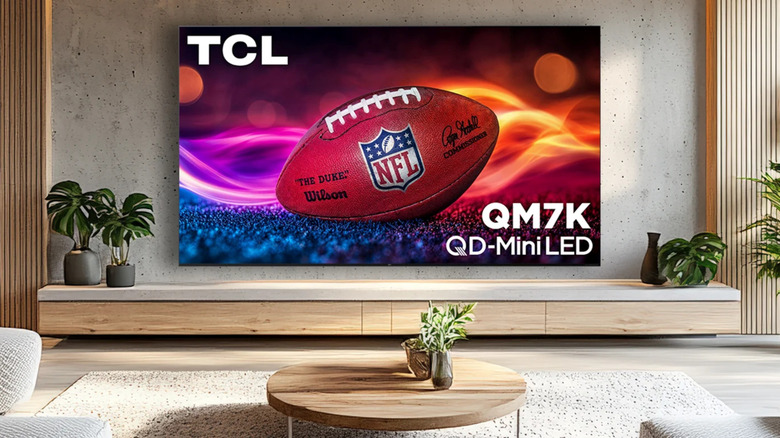
So what exactly justifies one model's $1,000 retail price hike over the other? To unpack the differences, let's start by taking a closer look at the TCL QM7K, which is the cheaper of the two. It's manufactured in a wide range of sizes, stretching from an entry-level 55-inch model to a range-topping 115-inch display. Rather than using OLED panels like some of its rivals, the QM7K uses QLED paired with Mini-LED technology to increase the vividness of colors while improving its ability to dim other areas of the screen.
The QM7K packs a lot for its price, but the QM8K packs even more
Gamers and sports fans should appreciate the QM7K's 144Hz native refresh rate, AMD FreeSync Premium Pro, and its support for Dolby Vision. Meanwhile, film fans benefit from Dolby Atmos and support for HDR 10+. The model uses Google TV OS and is compatible with both Chromecast and Apple AirPlay 2, and voice assistants from Amazon, Apple, and Google are also supported. There are four HDMI ports including one eARC port, two USB ports, and an Ethernet port. TCL ships each TV with a standard one year warranty.
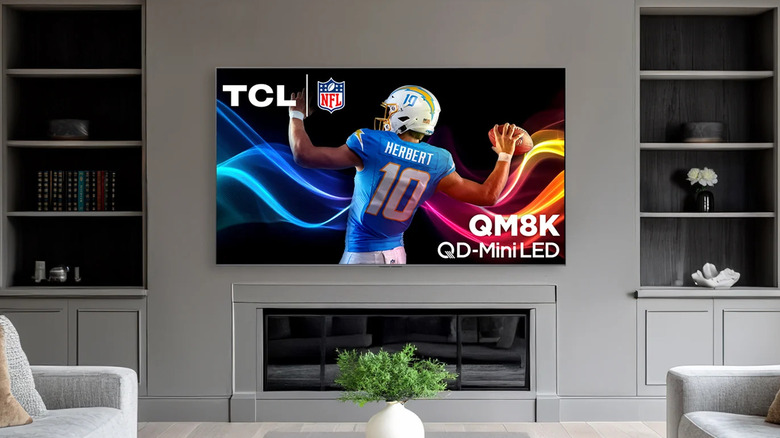
There's no doubt that the QM7K packs a lot of features for the money, but the TCL QM8K has an even longer list of built-ins. On top of everything previously mentioned for the QM7K, the QM8K also offers extras like an upgraded version of the Halo Control System. That system can produce even more precise dimming, which the company says can help improve the accuracy of both color and grayscale images, as well as reducing blooming to almost zero. In addition, the QM8K also supports ATSC 3.0, which you might know as NextGen TV. This technology allows for higher quality broadcasts, although it's currently only available in certain areas of the country.
Improved image quality is certainly nice to have, but the improvement that buyers are arguably most likely to notice when comparing the two models is that the QM8K is significantly brighter than its cheaper relative. According to TCL, the QM8K offers 5,000 nits of brightness, compared to the QM7K's 3,000 nits. For reference, both of these Mini LED displays are significantly brighter than the average OLED display, but the QM8K is especially bright.
Which model should you buy?
Unless support for NextGen TV is especially important to you or you're planning to place the TV in a space with very high levels of ambient light, the QM7K's lower retail price makes it look like the better option for most people. As a bonus, it's also available in a wider variety of sizes. However, things get a little more complicated when you start comparing the actual prices of older models, rather than their original retail prices.
As previously mentioned, both the QM7K and QM8K are 2025 models, and have since been superseded by the QM7L and QM8L, respectively. As a result, the remaining stock of both older models can potentially be found at a significant discount. At the time of writing, the QM8K is subject to some particularly large discounts, with a 98-inch QM8K TV available on Amazon for $2,999. That's a saving of $3,500 compared to its original launch MSRP.
The QM7K is also subject to frequent discounts, although they're not quite as drastic. We found a deal at Best Buy that brings the price of a 98-inch QM7K TV down to $2,499, which is a saving of $1,500 off the original launch MSRP. With that much smaller price difference between both models, the QM8K might be worth the upgrade. However, prices may have changed after publication and stock of both models remains limited, so be sure to check major retailers for the latest discounts before making a decision either way.