

What Is A Faraday Or Shake Flashlight & How Does It Work?
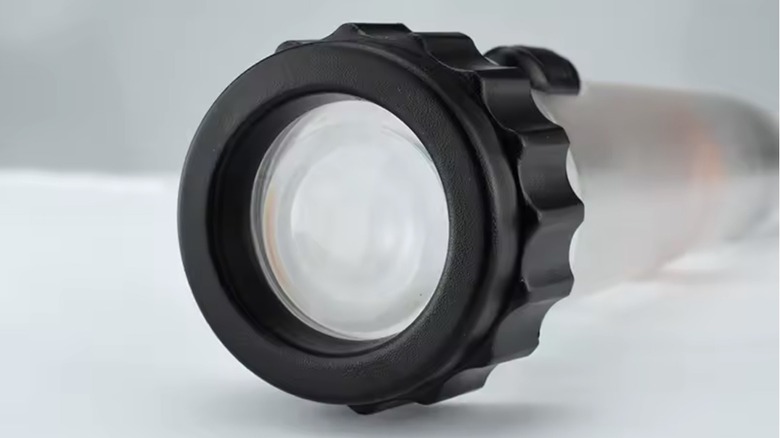
Flashlights are one of those tools that many people don't really think about until they find themselves trying to navigate some task in a dark or low-lit area. But when that time comes — be it in a basement work site, an emergency situation, or a power outage – a good flashlight can be a legitimate lifesaver.
A flashlight's brightness is important to make sure it is sufficient to light your space, of course. The device's power supply can be just as important because a flashlight with a dead battery is basically just a paper weight. If you want to take batteries out of your emergency kit equation, a Faraday Flashlight may be one of the better options you'll find on the consumer market, as the devices are designed to work without batteries. Interestingly enough, they are able to function without alkaline or lithium-ion power sources by utilizing scientific principles established by famed physicist Micheal Faraday all the way back in 1831.
Faraday's work ultimately laid out the fundamental laws for electromagnetic induction, which, as the name implies, is the process in which electricity is produced through magnets. It is that setup that allows a Faraday torch to produce light without the need of a dedicated battery. If you've ever found yourself in the dark holding a flashlight with a dead battery, you should know how handy a Faraday model could be.
How a Faraday Flashlight works
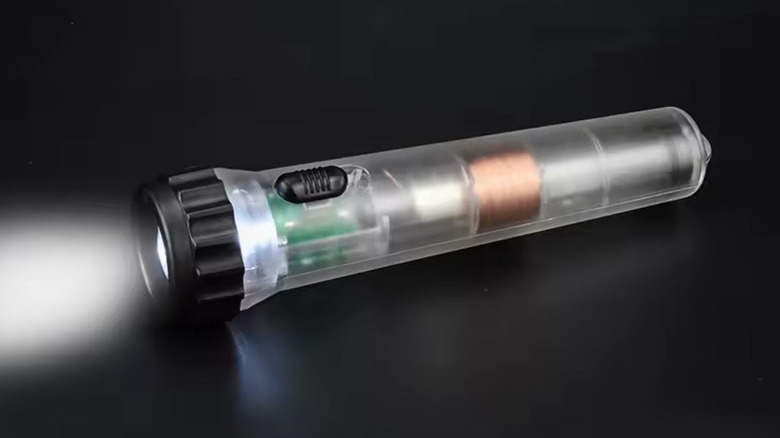
Before you get too excited about replacing your battery-powered flashlights with Faraday models, you should know that the battery-less setup does come with a catch: They are not designed to provide continuous illumination. In fact, they may only provide a few minutes of light at a time, with users needing to take an active part in generating the energy that powers a Faraday Flashlight.
To understand why, we'll need to address Faraday's electromagnetic induction principle. In essence, this process involves changing a magnetic field, which creates voltage within a circuit by moving either the circuit or the magnet. Thus, Faraday Flashlights feature a magnet, a small circuit board, and a coil of wire, along with an attached light that tends to be LED in nature these days. All of this is wrapped up in a slick transparent casing.
As for how the electrical current is created, like other non-battery powered flashlights, the user is required to take an active role in the process. You can do so by vigorously shaking the light itself in a horizontal motion, ensuring the magnet and circuit come into close and frequent contact within the tube. Fittingly, Faraday Flashlights are sometimes called "shake" lights. If you're curious how much light you can produce via a good shake, some users say that 30 seconds of shaking could produce about 5 minutes of illumination, though that may depend on the flashlights itself. Still, the extra work could be well worth it for folks who don't want to rely on battery power in an emergency.