

What Does A Yellow Navigation Light Mean In Boating?
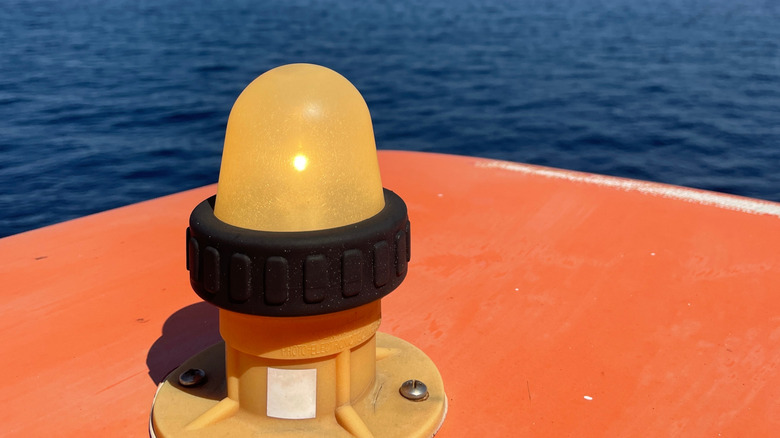
If it's your first time launching a boat, there's a lot you need to know, from how to operate the craft itself to the specific language used on the water to convey a huge variety of warnings and information. If you've seen a yellow navigation light, for example, you may assume it simply means "use caution" or slow down. The reality is that, under U.S. Navigation Rules, it may mean a number of things based on its flash pattern, location, and exact color.
Yellow lights primarily indicate towing operations. According to official definitions for navigation lights under U.S. Inland Navigation Rules, a towing light is a modified version of a standard sternlight. This means its centered on the back of a craft and is continuously visible through a 135-degree arc, extending 67.5 degrees to both sides of the rear of a vessel. The difference is that these lights on the back of a boat are typically white, while a towing light is yellow. Like the 100-foot rule, towing lights are meant to ensure that craft maintain a safe distance from one another while traversing busy waterways.
If a vessel is towing another one (or any other object) astern, regulations require that the towing vessel show a number of lights, including sidelights, a normal sternlight, and the yellow towing light vertically above the sternlight. It's also required to show two white masthead lights in a vertical line (or three if the length of the tow exceeds 200 meters).
Flashing yellow lights have other meanings
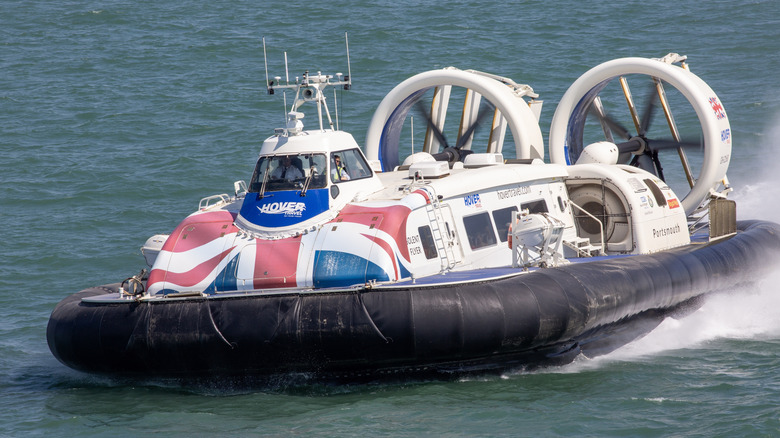
Like yellow buoys, yellow lights can have a number of different meanings, particularly when flashing. Some of them are incredibly specific; an all-around flashing light on an air-cushion vessel like a hovercraft indicates that it's currently in nondisplacement mode, meaning it's sitting up on the cushion and not submerged in the water.
There's also a specialized yellow signal described by the Inland Rules, called a "special flashing light." It flashes between 50 and 70 times every minute and has a visible arc between 180 to 225 degrees. It's also used in towing, but in this case it indicates the forward end of a vessel that's either being pushed ahead or towed alongside another, and generally only when the towed/pushed vessel exceeds 200 meters in length.
The idea is to distinguish multiple vessels from each other in a towing scenario, especially when visibility may be limited. For the same reason, a vessel being pushed ahead is also required to display sidelights in addition to the yellow special flashing light, to help avoid collisions and maintain safe distance between craft.