

Forget Turbocharged: This YouTuber's Harley Is Jet Powered
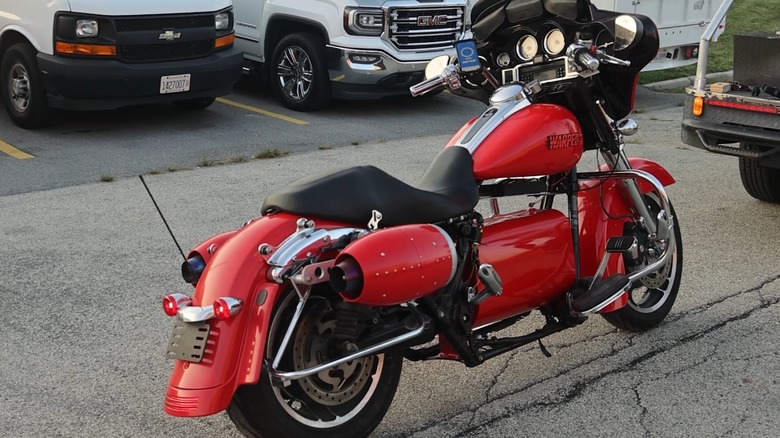
The Harley-Davidson Street Glide isn't a model that's short on power. In fact, the biggest Harley-Davidson stock engine you can get in 2026 can be found in the Street Glide Limited. But one of the fascinating aspects of custom culture is the willingness to experiment outside the lines of conventional design. In one such project, engineer and fabricator Matt Mikka of the YouTube channel Warped was tasked with converting a used Street Glide to run on two small jet engines.
The build was complex and required changes to several of the motorcycle's stock components. First, the engine and transmission were removed, as this custom bike would run purely from the twin turbines. But a mounting solution for the jet engines had to be developed, which would allow a safe and sturdy attachment to the bike. Mikka and his team had to design, waterjet-machine-cut, and weld pieces for a mounting system, installing the jets in place of the saddlebags.
These turbines burn up a lot of fuel because they're designed to intake such large amounts of air during operation. So, Mikka's team fabricated and fitted a second 11.3-gallon reserve tank (installed where the engine used to be) to supply extra diesel. In addition, Mikka removed the charging system and built his own battery using Tesla cells.
How it performed and rider reactions
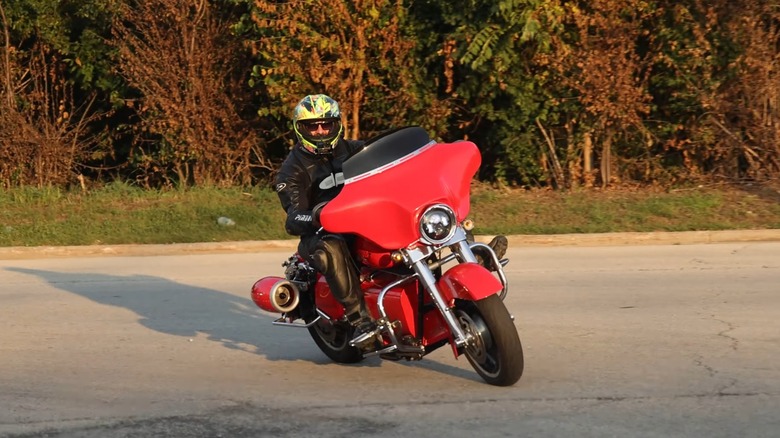
Jet engine output is measured differently than something like a vehicle engine. With the two small jet engines combined, they produced around 150 pounds of thrust. While that might not sound like much, it's important to consider that Mikka had removed both the engine and transmission, estimating the motorcycle was only around 350 pounds. In terms of the numbers, during testing, the jet-engine bike made 0-30 mph in 16.63 seconds and got up to nearly 45 mph. Later tests would push that figure to 60 mph, which isn't particularly impressive.
However, the client, Sean Kerr of the YouTube channel Bikes and Beads, claimed the ride was unlike any other motorcycle he'd ridden. For one thing, starting the bike requires a series of steps, similar to an aircraft, and if you follow them out of sequence, the system can short out. Then there is the sound of these twin-jet engines, which is blaringly loud. Kerr explained on a Bikes and Beards YouTube video, "After hearing this bike, this is not only the coolest thing I own, it's the loudest motorcycle I've ever heard in my entire life."
Beyond the sound, it lacked key characteristics of a typical Harley-Davidson ride. No vibration, no gears, just the jet's exhaust gas pushing the bike forward. It produced a strange feeling for both riders, even though acceleration rate and speed weren't high. In the end, the impressive feat is not in the form of performance figures, but in the fact that the project produced a working jet-propelled motorcycle.
The dangers of this twin-jet engine Harley-Davidson
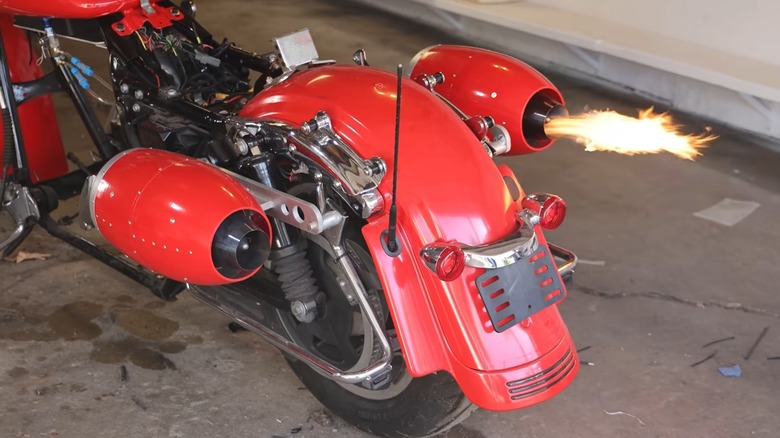
There are a few things that made this build particularly dangerous and required some extra measures to ensure safety. One piece Mikka had to fabricate was a containment shield around the turbines. One or both of these jet engines could explode if pushed too hard. The build had to protect the rider, given the close proximity to the jet engines.
Another potential issue was that when lowering the throttle, the engines could continue to run regardless of rider input. There is a similar phenomenon, called a runaway diesel engine, which can be stopped a few different ways, including an emergency shut-off valve. To prevent the jet bike from throttling on its own, Mikka installed a shut-off, which would quickly stop the fuel supply and put an end to a dangerous scenario.
It wasn't just the rider who was subject to the forces generated by these small jet engines, but also anyone directly behind the bike. These turbines literally shot flames on startup, so you can imagine the heat blasting behind the motorcycle as the throttle crept higher.