

Why Do Telescopes At Observatories Shoot Giant Lasers Into The Sky?
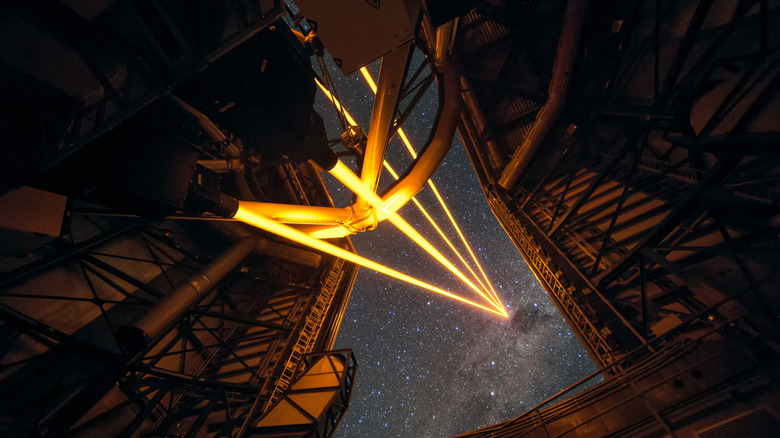
The whole point of telescopes is to collect light. And yet, on clear nights in places like Chile and Hawaii, where some of the world's biggest telescopes are installed to peek into space, they actually end up doing the opposite — when they fire orange laser beams into the sky. The thing is that our Earth has a pretty dense atmosphere that never sits still. It shifts around, and that keeps nudging incoming starlight off course. This nudging is exactly what causes it to twinkle. Twinkling is a pretty sight to the human eye, but for a telescope that collects light over a period of time to build an image, it turns these sharp points of light into a blur.
That's where a technique called adaptive optics comes in. Using it, telescopes are able to bend light at any given moment back to the way it was supposed to look if the air hadn't messed with it. Figuring that out involves tracking a bright reference star, known as a guide star. Specifically, how much air is warping that star's light is measured. A computer then reshapes a flexible mirror inside the telescope about 1,000 times per second to cancel out the warping.
It's a clever solution that comes with one big catch, unfortunately: it only works if the guide star sits right beside whatever the telescope is studying. Bright stars in the right spot are not easy to come by, though, so astronomers end up creating their own stars instead. They do it using lasers, typically orange. Each laser beam makes a small patch high up in the atmosphere glow just like a star. These 'stars' can be moved right beside the telescope's target.
How a laser turns into a star
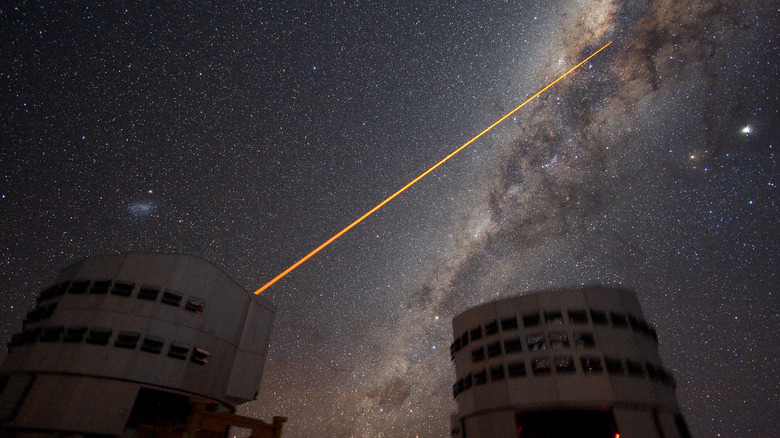
Specifically, the beams are aimed at a thin layer of sodium atoms – formed from meteors burning up in the atmosphere – that lie about 90 kilometers up from the surface. And since those atoms react to a single, very specific shade of orange-yellow light, the beams have to be tuned accordingly — leading to their orange color. Once the beam hits that layer, the atoms absorb it and glow in that same color. Some of that glow then travels back down to the telescope. To it, the glow looks like a faint star.
Hitting that layer reliably used to be pretty difficult. Older systems ran on toxic dyes that needed days of engineering work to stay stable. However, today's lasers stay locked in place all night, and all it takes is the press of a single button.
Even so, a single laser is affected by turbulence. Unlike light from distant galaxies, which crosses a much wider column of air, a laser star's light only comes down through a narrow cone, since it hovers just inside the atmosphere. That's why big observatories now fire several lasers at once. Multiple lasers create extra fake stars, covering multiple different spots around the target. Together, they show how the whole column of air is bending light. The readings are then gathered and stitched into a 3D turbulence map, just like a CT scan. In turn, the map tells the telescope's flexible mirror how to bend to capture light from the actual stars better.
Seven lasers, sharper pictures, and an off switch
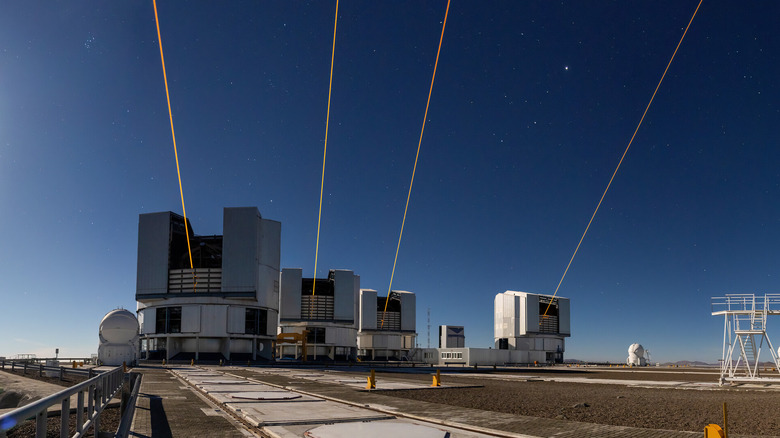
This clever little hack lets ground telescopes rival space telescopes. Many of the world's biggest telescopes use it, too. The European Southern Observatory uses it on its Very Large Telescope (VLT), a telescope composed of four big telescopes in Chile's Atacama Desert. While the VLT started off with a single laser back in 2006, the ESO upgraded it in 2016 by fitting one of the telescopes with four lasers. These lasers are extremely powerful, too – a full 4,000 times stronger than the legal limit on a consumer-oriented laser pointer.
By 2018, this setup let the VLT capture visible-light shots of Neptune sharper than the orbiting Hubble Space Telescope's. In other words, a telescope stuck within the confines of the atmosphere had outperformed one flying around in the perfect environment. Since then, the ESO has added lasers to the other three telescopes as well, taking the total laser count up to seven on the VLT. But it doesn't end there since ESO has an upcoming Extremely Large Telescope, an enormous new telescope built around the world's largest mirror. It's set to use lasers as well.
Now you might be wondering if such powerful lasers shot at the sky are a worry for aircraft passing overhead. Cheap laser pointers can already dazzle a pilot, so these might potentially be worse. However, the VLT makes use of a safety system that automatically switches the lasers off as soon as a plane nears the beam.